
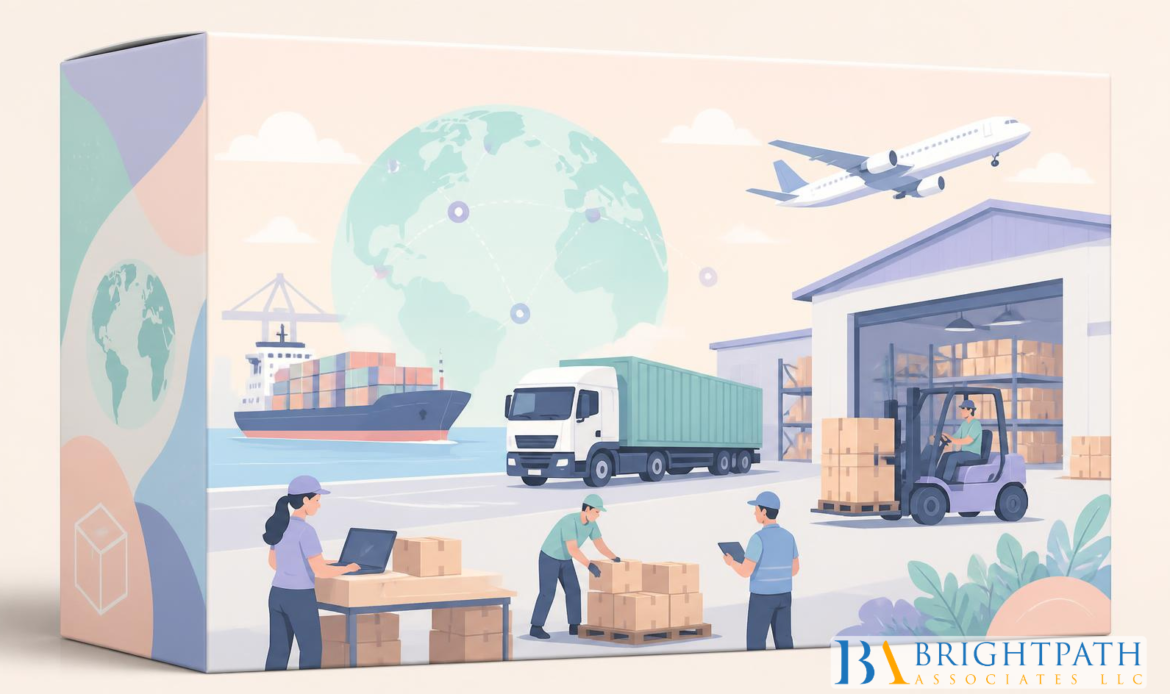
Introduction
Modern #LogisticsNetworks operate under constant pressure to move more freight, respond faster to changing customer expectations, and maintain competitive transportation costs. Demand can shift rapidly because of seasonal peaks, e-commerce promotions, supply chain disruptions, production changes, fuel volatility, or unexpected market conditions. For companies managing large freight volumes, the traditional approach of continuously adding trucks, warehouses, employees, and fixed infrastructure can quickly create excessive overhead.
Elastic logistics offers a different operating model. Instead of building permanent capacity for the highest possible demand, companies can create logistics networks that expand and contract according to actual requirements. The objective is not simply to reduce costs but to make transportation capacity more responsive, measurable, and commercially sustainable.
This approach is becoming increasingly relevant as the transportation industry evolves toward technology-enabled coordination, flexible carrier networks, and data-driven planning. Companies that understand how to combine external capacity, digital systems, strategic partnerships, and operational expertise can increase freight capability without allowing fixed costs to grow at the same pace.
Understanding the Elastic Logistics Model
Elastic logistics refers to the ability of a company to increase or decrease logistics capacity without making proportional investments in permanent infrastructure. Capacity can come from third-party carriers, flexible warehouse providers, freight marketplaces, technology platforms, temporary labor, regional transportation partners, and specialized logistics providers.
The concept is particularly valuable when freight volumes are unpredictable. A manufacturer may have relatively stable shipments throughout most of the year but experience significant demand during specific production cycles. An e-commerce company may experience enormous increases during promotional campaigns or holiday periods. Maintaining permanent assets for those temporary peaks creates idle capacity during slower periods.
An elastic model allows businesses to match transportation resources more closely with actual freight requirements. The result is a logistics structure that can support growth while limiting unnecessary capital expenditure and fixed operating expenses.
Traditional logistics expansion frequently depends on adding physical assets and personnel. More freight can mean additional vehicles, drivers, dispatchers, warehouses, supervisors, equipment, and administrative infrastructure. While these investments may support growth, they can also reduce financial flexibility.
The challenge becomes particularly visible when demand falls. Trucks still require maintenance, employees remain on payroll, facilities continue generating expenses, and technology systems require ongoing support. The company may have sufficient capacity but insufficient utilization.
This is where logistics consulting services can provide strategic value. Instead of simply recommending more resources, experienced consultants can examine freight flows, shipment patterns, transportation costs, carrier performance, service requirements, and network design. The objective is to identify which capabilities should remain internal and which can be accessed through flexible external networks.
Freight Brokerage Services as an Elastic Capacity Layer
#FreightBrokerageServices can play a central role in creating flexible transportation capacity. Freight brokers connect shippers with carriers that have available equipment and operational capacity. This allows companies to access additional transportation resources without purchasing or leasing an equivalent fleet.
For businesses experiencing temporary increases in freight volume, brokerage can provide an important buffer. Instead of maintaining enough vehicles to handle peak demand throughout the year, companies can use external carrier capacity when shipment volumes exceed their internal capabilities.
The value of this model depends heavily on carrier quality, pricing visibility, service reliability, and network coordination. A flexible capacity strategy must therefore consider more than simply finding an available truck. Carrier relationships, lane performance, compliance, transit times, and communication systems all influence the effectiveness of outsourced capacity.
Technology has become one of the most important enablers of elastic logistics. Modern delivery technology can connect shippers, carriers, warehouses, drivers, customers, and logistics managers through shared digital systems.
Transportation management platforms can provide greater visibility into shipment schedules, carrier capacity, freight costs, route performance, and delivery status. Real-time information makes it easier to identify capacity shortages before they become operational disruptions.
Technology can also improve the allocation of existing resources. When companies have better visibility into truck availability, shipment density, route efficiency, and delivery windows, they can increase asset utilization without necessarily adding physical capacity.
The objective is therefore not technology for its own sake. The real advantage comes from using digital infrastructure to make transportation decisions faster and more accurately.
Parcel Delivery and the Challenge of Variable Demand
The parcel delivery environment demonstrates why elasticity has become increasingly important. Consumers expect fast and reliable deliveries, while businesses must manage fluctuating order volumes across multiple regions.
E-commerce logistics has intensified this challenge because order volumes can change dramatically within short periods. A promotional campaign can create a sudden increase in shipments, while a change in consumer demand can reduce volumes almost as quickly.
Companies cannot always build permanent delivery infrastructure around these temporary peaks. Flexible carrier relationships, regional fulfillment partners, dynamic routing, and technology-enabled transportation management can provide additional capacity when required.
The modern parcel delivery model therefore increasingly depends on the ability to coordinate multiple transportation resources rather than relying exclusively on a single fleet or distribution structure.
Freight shipping involves more than moving goods from one location to another. Shipment size, origin, destination, timing, product characteristics, transportation mode, carrier availability, and customer requirements all influence the most efficient logistics strategy.
Shipping optimization allows organizations to examine these variables systematically. Instead of assigning every shipment through a fixed process, companies can evaluate transportation options according to cost, service level, capacity, and operational constraints.
Elastic logistics becomes significantly more powerful when combined with shipping optimization. External capacity can then be deployed strategically rather than reactively. A company can determine when additional carriers are required, which lanes should be outsourced, and where internal assets provide the strongest economic value.
Transportation Industry Trends Supporting Elastic Networks
Several #TransportationIndustry trends are reinforcing the shift toward flexible logistics. Digital freight platforms, automated dispatching, predictive analytics, connected vehicles, route optimization, and real-time shipment visibility are making transportation networks more responsive.
At the same time, shippers are becoming more comfortable with multi-carrier strategies. Instead of depending entirely on one transportation provider, companies can create diversified networks capable of responding to capacity shortages and changing market conditions.
Another important trend is the increasing integration between physical logistics operations and digital systems. Transportation decisions that were once based on manual communication can now be supported by continuously updated data.
These developments are creating a transportation environment in which network flexibility can become a strategic capability rather than simply a contingency measure.
The expansion of e-commerce logistics has fundamentally changed the relationship between inventory, transportation, and customer expectations. Businesses increasingly need to deliver smaller shipments more frequently while maintaining short delivery windows.
This creates a complex capacity problem. Demand is not always predictable by region, and delivery expectations can vary significantly between customers. A fixed logistics network may perform well under normal conditions but struggle during sudden demand spikes.
Elastic logistics provides an alternative by combining permanent infrastructure with flexible capacity. Internal distribution centers can provide stability while third-party carriers, temporary fulfillment resources, and technology platforms provide scalability.
For the e-commerce sector, this combination can be particularly important because customer expectations continue to influence logistics network design.
Building a Flexible Delivery Industry Strategy
The #DeliveryIndustry is moving toward greater integration between carriers, technology companies, logistics providers, and shippers. As this ecosystem develops, companies need to think of capacity as a network rather than a collection of owned assets.
A flexible strategy starts by understanding the company’s core logistics requirements. Certain routes, products, customers, or operational processes may justify dedicated infrastructure. Other areas may be better served through external partners.
The most effective model is often a hybrid structure in which the company maintains control over strategically important operations while using external resources for variability. This approach can provide stability without forcing the organization to carry the full cost of peak capacity throughout the year.
Elastic logistics does not eliminate risk. In fact, greater reliance on external partners introduces new considerations around service consistency, carrier reliability, data security, compliance, and operational visibility.
Companies must therefore establish clear performance expectations for transportation partners. Data should be used to monitor service levels, delivery accuracy, damage rates, transit performance, and cost trends.
A flexible network should also have contingency options. If one carrier becomes unavailable, the organization should have alternative capacity sources. This is particularly important for critical freight lanes and time-sensitive shipments.
The goal is to create flexibility without sacrificing control.
The Growing Importance of Delivery Sector Tech Talent
Technology alone cannot create an effective elastic logistics network. Skilled professionals are needed to interpret data, manage transportation systems, coordinate partners, improve workflows, and translate technology into operational results.
This has increased demand for delivery sector tech talent with a combination of logistics knowledge and digital expertise. Professionals who understand transportation operations, analytics, automation, software platforms, and network optimization can play an important role in building scalable logistics models.
Organizations increasingly need people who can bridge the gap between traditional transportation management and modern technology infrastructure. Recruiting these professionals requires an understanding of both the operational and technical sides of the delivery ecosystem.
As logistics networks become more technology-driven, leadership requirements are also changing. Executives responsible for transportation and supply chain operations must understand cost structures while also recognizing the strategic value of data, automation, digital platforms, and external capacity.
#ExecutiveSearchRecruitment can help organizations identify leaders with the cross-functional experience required for this environment. The most relevant candidates may come from transportation management, technology, supply chain strategy, operations, freight platforms, or related industrial sectors.
Leadership capability becomes particularly important when an organization is transitioning from an asset-heavy model toward a more flexible network. Such transformation requires coordination across finance, operations, technology, procurement, customer service, and commercial teams.
Creating Scale Without Creating Structural Complexity
The central principle of elastic logistics is simple: growth should not automatically require proportional growth in fixed infrastructure.
Companies can achieve this by combining internal capabilities with external transportation capacity, digital coordination, strategic carrier relationships, and continuous network optimization. The objective is to create a logistics system capable of responding to demand while maintaining financial discipline.
However, elasticity should not be confused with outsourcing everything. Companies still need strong internal control over strategy, performance measurement, customer requirements, data, and critical operational decisions.
The strongest networks are therefore neither completely asset-heavy nor completely asset-light. They are designed around a balance between control and flexibility.
Conclusion: Flexibility as a Competitive Logistics Capability
#ElasticLogistics represents a broader transformation in how companies think about freight capacity. Instead of treating transportation infrastructure as something that must constantly expand, organizations can design networks that adapt to changing requirements.
Freight brokerage services, delivery technology, shipping optimization, and advanced transportation management can provide the infrastructure needed to scale capacity without creating unnecessary overhead. Meanwhile, logistics consulting services can help organizations identify where flexibility creates value and where permanent investment remains strategically important.
As transportation industry trends continue to emphasize digital coordination and network flexibility, companies that build adaptable logistics structures can respond more effectively to demand fluctuations. The future of freight shipping will increasingly depend on intelligent capacity management rather than simply owning more assets.
For businesses operating across the delivery industry and e-commerce logistics, elasticity can become a practical mechanism for managing growth. Supported by the right technology, processes, partners, and delivery sector tech talent, flexible logistics networks can expand when demand requires them and contract when conditions change.
The real advantage is not simply lower overhead. It is the ability to scale transportation capability while preserving operational control, financial flexibility, and customer service. In an increasingly dynamic logistics environment, that adaptability can become one of the most important foundations for sustainable growth.
Find your next leadership role in Packaging and Freight Industry today!
Stay informed with the latest insights on Packaging and Freight Industry!