
Introduction
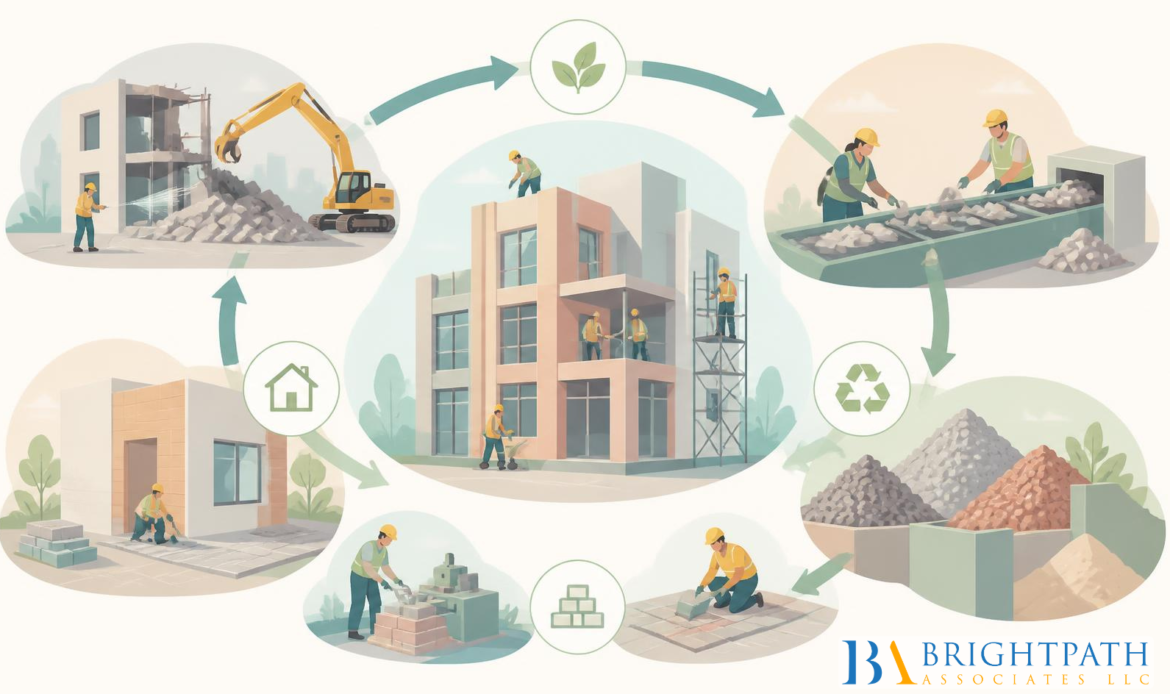
#ConstructionIndustry and demolition waste has traditionally been viewed as an unavoidable byproduct of building activity. For small and medium-sized businesses, however, this perception is rapidly changing. Materials removed from renovation projects, commercial demolitions, infrastructure upgrades, and residential redevelopment can represent a valuable secondary resource when they are properly identified, separated, processed, and redirected into productive markets. The circular economy provides a framework for transforming this waste from a disposal expense into a potential revenue stream.
For SMBs operating across construction, demolition, manufacturing, recycling, logistics, and building services, the opportunity is particularly significant. Rising material costs, tighter environmental expectations, changing Building regulations, and growing demand for Sustainable construction are encouraging businesses to rethink how resources move through the construction ecosystem. Instead of following a linear model of extraction, production, use, and disposal, companies can create systems in which materials remain useful for as long as possible.
The economic opportunity extends across Construction materials, Building supplies, Material recycling, and emerging Building technology. By combining operational discipline with strategic leadership, smaller businesses can develop practical circular-economy models without making the massive capital investments typically associated with large industrial sustainability programs.
Understanding the Value of Construction Demolition Waste
Construction demolition waste includes a broad range of materials, including concrete, lumber, metals, bricks, glass, insulation, fixtures, roofing materials, and reusable building components. The value of these materials varies significantly depending on quality, contamination, local demand, transportation costs, and processing requirements.
The first step for an SMB is therefore to stop viewing demolition waste as one homogeneous category. A damaged concrete slab, reusable timber beam, intact door, scrap metal component, and clean brick have very different economic values. Effective recovery begins with identifying these differences before materials reach a mixed waste stream.
This approach can fundamentally change Construction economics. Instead of paying contractors or disposal facilities to remove everything, businesses can recover valuable materials, reduce disposal expenses, and potentially sell recovered resources to other companies.
Traditional waste management focuses primarily on collection, transportation, and disposal. A circular model focuses on resource management. The objective is to determine how each material can remain economically useful for another application.
For SMBs, this shift requires changes in project planning. Demolition teams can conduct pre-demolition assessments to determine which components have resale, reuse, or recycling potential. Contractors can coordinate with recyclers before work begins. Warehouses can establish dedicated storage areas for recovered materials. Procurement teams can also consider secondary materials when purchasing Building supplies.
This creates a more integrated system in which waste reduction becomes part of the commercial strategy rather than simply an environmental obligation.
Recovering Value from Concrete and Masonry
Concrete represents one of the most significant material streams generated during demolition. Although demolished concrete is often treated as low-value waste, crushing and processing can transform it into recycled aggregate for suitable construction applications.
Advances in #Concreteproduction and processing equipment have made material recovery increasingly practical for businesses operating at sufficient scale. Recycled concrete aggregate can potentially support road bases, foundations, landscaping applications, and other projects where specifications permit its use.
The economics depend heavily on transportation and processing costs. A local recycling operation may therefore have an advantage because it can serve nearby demolition contractors and construction projects. By reducing the distance materials travel, businesses can improve the commercial feasibility of recovered aggregate while reducing transportation-related environmental impacts.
The Lumber industry provides another important example of circular value creation. Demolition sites frequently contain timber that can be reused, refurbished, remanufactured, or processed into other wood products.
Not every piece of recovered lumber will be suitable for direct reuse. Nails, paint, moisture damage, structural deterioration, and contamination can affect quality. Nevertheless, carefully sorted timber can have substantially greater value than mixed construction waste.
SMBs can create specialized recovery processes that identify high-quality wood before demolition. Salvaged beams, flooring, doors, structural timber, and architectural wood can potentially enter secondary markets rather than being discarded. Lower-grade wood can move into other processing streams where appropriate.
This creates a hierarchy of value in which direct reuse generally receives priority before recycling or disposal.
Building Technology Enables Better Material Recovery
Building technology is increasingly helping companies understand what materials exist within structures before demolition begins. Digital building records, project documentation, material databases, scanning technologies, and Building Information Modeling can improve visibility into existing assets.
For smaller contractors, adopting advanced technology does not necessarily mean implementing an expensive enterprise-wide system. Even basic digital inventories can improve material tracking. Photographs, measurements, material classifications, and condition assessments can be recorded before dismantling begins.
Over time, this information can help businesses develop more accurate estimates of recovery value. Instead of entering a demolition project without knowing what will be recovered, companies can begin treating buildings as inventories of potentially valuable materials.
Material recycling becomes commercially attractive when businesses understand both the input and output sides of the market. Simply collecting waste is not enough. An SMB must know who will purchase recovered materials, what specifications those buyers require, and what processing costs will be involved.
A successful recycling model therefore starts with demand. Contractors, landscaping companies, manufacturers, building-material suppliers, salvage businesses, and infrastructure companies can become potential customers depending on the material stream.
Once demand is understood, businesses can design collection and processing operations around commercially valuable materials. This market-driven approach reduces the risk of accumulating large quantities of recovered material without reliable buyers.
Creating New Markets for Recovered Building Supplies
Recovered materials can also enter markets outside traditional recycling channels. Architectural salvage is one example. Doors, windows, fixtures, bricks, timber, lighting components, and other elements may have resale value when they retain functional or aesthetic qualities.
SMBs can develop specialized resale operations around these materials. A recovered door may have considerably greater value as a reusable product than as a source of scrap material. Similarly, reclaimed timber can appeal to architects, designers, homeowners, and specialty contractors seeking distinctive materials.
#DigitalMarketplaces and online catalogs can further expand the customer base for recovered Building supplies. Businesses can photograph products, document dimensions and condition, and make inventory available to customers beyond their immediate geographic area.
Circular construction businesses must operate within applicable Building regulations and technical standards. Recovered materials cannot automatically be substituted for newly manufactured products simply because they are available.
Structural materials may require inspection, testing, certification, or documentation. Certain materials may contain hazardous substances and therefore require specialized handling. Businesses must understand local requirements concerning demolition, transportation, processing, reuse, and disposal.
Regulatory knowledge can become a competitive advantage. Companies that consistently document material quality and maintain reliable processes can build greater confidence among contractors and commercial customers.
The Economics of Local Circular Construction
Transportation is one of the most important variables in the economics of construction waste recovery. A material with substantial theoretical value may become commercially unattractive if it must be transported long distances for processing or resale.
This creates an opportunity for regional SMBs. Local demolition contractors can partner with nearby recyclers, salvage businesses, manufacturers, and construction companies. Materials can circulate within a regional economy rather than leaving the area as waste.
Such localized systems can strengthen Construction economics by reducing disposal fees, transportation requirements, and dependence on newly extracted materials. They can also create new commercial relationships among businesses that previously operated independently.
Sustainable construction is increasingly becoming a business consideration rather than simply a corporate responsibility initiative. Developers, property owners, contractors, and investors are paying greater attention to resource efficiency, waste reduction, and environmental performance.
For SMBs, demonstrating measurable material recovery can strengthen their market position. A demolition contractor capable of recovering substantial quantities of reusable materials may differentiate itself from competitors that rely entirely on conventional disposal.
Sustainability can also support customer relationships. Businesses that provide transparent information about recovered materials, diversion rates, and reuse strategies can demonstrate value beyond basic project execution.
Workforce Development and Construction Jobs
The circular economy also changes the nature of #ConstructionJobs. Traditional demolition work focuses heavily on speed and removal. Circular demolition requires additional capabilities, including material identification, careful dismantling, sorting, quality assessment, inventory management, logistics, and resale coordination.
This creates opportunities for workers to develop specialized skills. Instead of treating demolition solely as physical removal, companies can train employees to become material recovery specialists.
For SMBs, workforce development can become an important part of long-term competitiveness. Employees who understand materials, equipment, safety, technology, and market requirements can help businesses recover greater value from each project.
Automation can further improve circular construction operations. Sorting systems, material-handling equipment, digital inventory platforms, and data analytics can help businesses process larger volumes with greater consistency.
However, technology should solve a defined operational problem rather than become an expensive objective by itself. An SMB might begin with digital material tracking before investing in sophisticated automated sorting equipment.
Data can also help companies identify which demolition projects generate the greatest recovery value. Over time, historical project information can improve estimating, purchasing, staffing, logistics, and customer pricing.
Leadership and Executive Search Recruitment
The transition toward circular construction requires leadership capable of connecting environmental objectives with commercial performance. Companies need executives and managers who understand operations, procurement, technology, sustainability, regulatory requirements, and market development.
This is where #ExecutiveSearchRecruitment can become strategically important. As circular-economy business models expand, organizations may require leaders with experience across construction, recycling, manufacturing, supply-chain management, sustainability, and technology.
The most effective leaders will not treat circularity as a separate sustainability program. Instead, they will integrate resource recovery into the company’s operating model, customer strategy, financial planning, and growth objectives.
For SMBs, the best approach is often to start small and develop capabilities incrementally. A company might initially focus on one material stream, such as concrete, timber, brick, or reusable fixtures. Once collection, processing, storage, and sales processes become reliable, the business can expand into additional categories.
Partnerships can accelerate this development. A demolition company does not necessarily need to own every recycling asset. It can collaborate with specialized processors, salvage businesses, transportation companies, and manufacturers.
This ecosystem approach allows smaller companies to participate in circular markets without carrying the entire infrastructure investment themselves.
Conclusion
Construction demolition waste represents more than an environmental challenge. For SMBs, it can become an underdeveloped commercial resource. Concrete, timber, metals, fixtures, bricks, and other recovered materials can support new revenue opportunities when businesses create disciplined systems for identification, separation, processing, reuse, and resale.
The combination of Building technology, Material recycling, evolving Building regulations, and changing customer expectations is making circular construction increasingly practical. Companies that understand the economics of recovered materials can reduce disposal costs while developing new markets and strengthening their competitive position.
Ultimately, the circular economy creates an opportunity to redefine how the construction sector views materials. What once represented waste can become inventory, feedstock, resale products, or valuable inputs for future projects. For forward-looking SMBs, monetizing demolition materials is not simply about being more sustainable. It is about building a more resilient, resource-efficient, and commercially intelligent construction business.
Find your next leadership role in Building Material Industry today!
Stay informed with the latest insights on Building Material Industry!