
Introduction
For decades, maintenance in #PlasticManufacturing was largely reactive. Equipment was operated until something failed, production stopped, and maintenance teams were called in to identify and repair the problem. This traditional “fix-on-failure” model appeared practical because it avoided unnecessary maintenance and allowed machinery to operate continuously until a fault occurred. However, as manufacturing systems have become more complex and interconnected, the cost of unexpected downtime has increased dramatically.
Modern production environments depend on highly automated machinery, advanced control systems, interconnected equipment, and sophisticated production processes. A failure in one machine can create a chain reaction that affects an entire production line. Lost production, damaged materials, emergency repairs, overtime, delayed deliveries, and dissatisfied customers can quickly turn a relatively small equipment problem into a significant financial loss.
Predictive maintenance is changing this equation. Instead of waiting for equipment to fail, manufacturers are using data, sensors, analytics, and intelligent monitoring technologies to identify early warning signs and address potential problems before they become production failures. For the plastics sector in particular, this shift is becoming increasingly important as manufacturers pursue greater efficiency, reliability, and competitiveness.
Why Predictive Maintenance Matters in the Plastics Industry
The plastics industry operates a wide range of complex equipment, including injection molding machines, extrusion systems, blow molding equipment, compressors, cooling systems, material handling equipment, and automated packaging lines. These machines often operate for extended periods under demanding conditions.
A failure in a critical component can interrupt production and affect multiple downstream processes. For example, an unexpected failure in an injection molding machine may stop an entire production cell, leaving operators, robots, material handling systems, and quality inspection equipment idle.
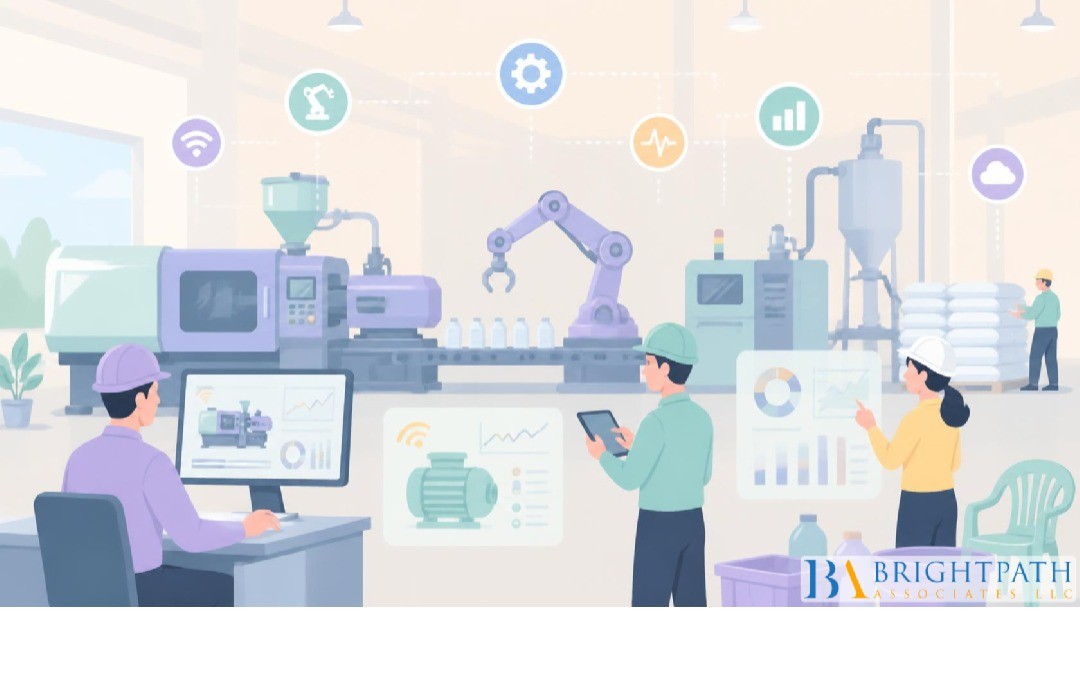
Predictive maintenance provides manufacturers with a way to monitor equipment health continuously. Temperature, vibration, pressure, energy consumption, motor performance, lubrication conditions, and other operational variables can be analyzed to identify abnormal patterns.
This approach supports the broader objectives of Plastics industry risk management. Instead of treating equipment failure as an unavoidable operational event, manufacturers can identify potential risks earlier and develop maintenance strategies around actual equipment conditions.
Preventive maintenance represented an important improvement over reactive maintenance. Under a preventive model, equipment is serviced according to a predetermined schedule. Bearings might be replaced after a certain number of operating hours, machines might be inspected every few months, and lubrication activities might occur at fixed intervals.
Although preventive maintenance reduces some risks, it can also result in unnecessary maintenance. Components may be replaced while they still have considerable useful life, while unexpected failures can still occur between scheduled inspections.
Predictive maintenance takes a different approach. It uses actual equipment data to determine when intervention may be necessary.
This creates a more dynamic maintenance model. Rather than asking when a machine is scheduled for maintenance, plant managers can ask whether the machine is showing measurable signs of degradation. This distinction can improve maintenance efficiency while reducing unnecessary downtime.
The Role of Plastics Manufacturing Technology Investment
Implementing predictive maintenance requires investment in sensors, industrial connectivity, analytics platforms, #AutomationInfrastructure, and employee capabilities. For manufacturers, this means predictive maintenance must be considered as part of a broader Plastics manufacturing technology investment strategy.
The objective should not simply be to purchase monitoring technology. Manufacturers need to understand which machines are most critical, which failure modes create the greatest financial impact, and which data points can provide meaningful early warnings.
A high-value production asset may justify sophisticated monitoring because its failure could stop an entire facility. Less critical equipment may require a simpler maintenance approach.
This prioritization allows companies to build predictive maintenance programs gradually while demonstrating measurable returns on investment.
Predictive maintenance depends on reliable operational data. Sensors installed on machinery can continuously capture information about equipment performance. Advanced systems can then compare current conditions with historical patterns and expected operating ranges.
The real value emerges when organizations can identify relationships between equipment behavior and actual failures. Over time, maintenance teams can develop more accurate models of how machines deteriorate.
For plastics manufacturers, this may involve monitoring motor temperatures, hydraulic pressure, screw performance, cycle times, vibration levels, energy consumption, or other process indicators. When these variables begin to deviate from normal patterns, maintenance teams can investigate before a major failure occurs.
The result is a transition from assumptions to evidence-based maintenance decisions.
Predictive Maintenance and Supply Chain Resilience
Equipment reliability is closely connected to supply chain performance. A machine breakdown can delay production, which can then affect customer deliveries, inventory levels, transportation schedules, and supplier commitments.
This makes predictive maintenance relevant to Plastics industry supply chain management. A reliable production environment provides manufacturers with greater confidence when planning capacity and delivery schedules.
Predictive maintenance can also improve spare-parts planning. If analytics indicate that a particular component is approaching the end of its useful life, procurement teams can order replacement parts before the failure occurs. This reduces the risk of emergency purchasing and extended downtime caused by unavailable components.
The maintenance function therefore becomes increasingly connected to procurement, inventory management, production planning, and customer service.
In competitive markets, manufacturers often focus on product pricing, quality, capacity, and innovation. Equipment reliability can be overlooked because it is primarily viewed as an internal operational concern.
However, reliable production can become a significant competitive advantage. A manufacturer capable of maintaining consistent output and meeting delivery commitments may be better positioned to win and retain customers.
This is particularly relevant when conducting Plastics industry competitive analysis. Organizations should consider not only the technologies their competitors use but also their ability to maintain operational continuity.
A highly automated facility with poor maintenance practices may be less competitive than a slightly less sophisticated facility that consistently achieves high equipment availability.
Predictive Maintenance and Plastics Market Expansion Strategies
#MarketExpansion requires production capacity that can scale reliably. When manufacturers enter new geographic markets or add new product categories, unexpected equipment failures can limit their ability to meet growing demand.
Predictive maintenance can support Plastics market expansion strategies by helping organizations improve asset utilization and production reliability before increasing capacity.
A company planning to expand production can use equipment health data to determine whether its existing assets can support higher utilization. If certain machines already show signs of deterioration, maintenance or replacement can be addressed before additional demand places further pressure on the production system.
This creates a stronger foundation for expansion because growth is supported by operational readiness rather than simply additional equipment purchases.
Predictive maintenance is not an isolated technology. It exists within a broader Plastics industry innovation ecosystem involving equipment manufacturers, automation providers, software developers, data specialists, engineering organizations, and maintenance professionals.
Collaboration among these stakeholders can accelerate innovation. Machine manufacturers can provide detailed information about equipment behavior, while technology providers can develop monitoring and analytics solutions capable of interpreting that information.
Manufacturers can also collaborate with universities, research organizations, and technology companies to develop new approaches to equipment monitoring and failure prediction.
This ecosystem approach is important because predictive maintenance technology continues to evolve. Artificial intelligence, machine learning, digital twins, edge computing, and advanced industrial connectivity are creating new possibilities for understanding equipment health.
Strategic Partnerships and Technology Adoption
Developing predictive maintenance capabilities internally can be challenging, particularly for manufacturers that lack specialized data or automation expertise. Plastics industry strategic partnerships can help organizations access capabilities that would otherwise require significant internal investment.
Equipment suppliers may provide monitoring platforms as part of service agreements. Automation specialists can integrate sensors and industrial systems. Analytics providers can develop predictive models. Maintenance organizations can help interpret equipment behavior and establish intervention procedures.
The most effective partnerships are built around shared performance objectives rather than simply technology procurement. The goal should be measurable improvements in equipment availability, maintenance efficiency, production continuity, and total operating cost.
Technology can identify a potential problem, but skilled professionals must determine what action should be taken. Predictive maintenance therefore increases the importance of technical knowledge rather than eliminating the need for maintenance professionals.
Engineers and technicians must understand machinery, production processes, data interpretation, and failure mechanisms. Organizations may also need managers capable of connecting maintenance strategies with broader business objectives.
This is contributing to demand for specialized talent and making Plastics industry recruiters increasingly important to organizations undergoing technological transformation. Companies need professionals who can bridge traditional mechanical and electrical expertise with modern digital capabilities.
Leadership is equally important. Executives must understand how maintenance investments affect production capacity, operational risk, and long-term competitiveness.
Executive Leadership for Zero-Downtime Operations
Moving toward zero-downtime operations requires more than installing predictive monitoring systems. It requires a culture that treats reliability as a strategic business objective.
Senior leaders must establish clear priorities around asset performance, technology adoption, workforce development, and operational resilience. This is where #ExecutiveSearchRecruitment can support organizations seeking experienced executives who understand manufacturing transformation.
Plastics industry global leadership increasingly requires executives who can manage technological change across complex manufacturing networks. Leaders must evaluate economic conditions, competitive pressures, technology investments, supply chain vulnerabilities, and workforce requirements simultaneously.
The strongest leadership teams recognize that predictive maintenance is not simply a maintenance department initiative. It is part of a broader operational strategy designed to improve competitiveness and resilience.
Changing Plastics economic trends are placing additional pressure on manufacturers to control operating costs. Energy prices, labor expenses, raw material costs, transportation challenges, and fluctuating demand can all affect profitability.
In this environment, unexpected downtime becomes even more expensive. Manufacturers need to maximize the value generated by existing assets while controlling maintenance and production costs.
Predictive maintenance can contribute to this objective by reducing emergency repairs, improving asset utilization, extending equipment life, and enabling better production planning.
The financial case becomes particularly compelling when manufacturers measure downtime not only through repair costs but also through lost production, missed delivery opportunities, labor inefficiencies, and customer impact.
Predictive maintenance represents an important step toward smarter industrial operations, but it may not be the final stage. As artificial intelligence and industrial analytics become more sophisticated, maintenance systems can move from predicting failures to recommending specific actions.
This progression could eventually create maintenance environments where systems automatically identify developing problems, estimate remaining useful life, recommend replacement windows, optimize spare-parts inventory, and coordinate maintenance activities with production schedules.
For the plastics industry, this evolution could transform maintenance from a reactive cost center into a strategic source of operational intelligence.
Conclusion: Reliability as a Competitive Strategy
The transition from fix-on-failure maintenance to predictive maintenance reflects a broader transformation in manufacturing. The objective is no longer simply to repair equipment quickly after something goes wrong. It is to understand equipment behavior early enough to prevent disruption.
For plastics manufacturers, predictive maintenance can strengthen Plastics industry risk management, improve supply chain reliability, support technology investment decisions, and enhance competitive performance. It can also create new opportunities for innovation, partnerships, and workforce development.
As manufacturing becomes increasingly connected and automated, zero-downtime operations will remain an ambitious goal rather than an absolute guarantee. Yet organizations that combine intelligent monitoring, skilled people, strong leadership, and disciplined maintenance strategies will be better positioned to approach that goal.
The future of industrial maintenance is therefore not defined by how quickly a company can fix a broken machine. It is defined by how effectively it can recognize that failure is coming—and act before production ever stops.
Find your next leadership role in Plastics Industry today!
Stay informed with the latest insights on Plastics Industry!