
Introduction
For decades, manufacturers built their sourcing strategies around globalization. Components, raw materials, #ElectronicSystems, machinery, and specialized technologies could be sourced from suppliers located anywhere in the world. Global supply chains offered manufacturers access to competitive pricing, specialized expertise, and large production ecosystems. However, recent disruptions have demonstrated that efficiency alone is no longer enough to create a resilient manufacturing operation.
Geopolitical tensions, transportation disruptions, labor shortages, trade restrictions, natural disasters, and unpredictable demand have exposed vulnerabilities in highly centralized sourcing models. A disruption affecting one country or supplier can quickly influence production schedules across multiple regions. As a result, manufacturers are increasingly reconsidering how they source critical materials, technologies, and industrial services.
The shift toward regional sourcing networks is emerging as an important strategy for building greater resilience. Rather than completely abandoning global suppliers, manufacturers are creating diversified networks that combine international expertise with regional production, suppliers, service providers, and technology partners. This transition is also changing how organizations approach Industrial automation, workforce planning, technology investment, and executive leadership.
Globalization is not inherently problematic. In fact, international sourcing remains essential for many manufacturing sectors. The challenge occurs when an organization becomes excessively dependent on a small number of suppliers, countries, transportation routes, or manufacturing hubs.
A single-source strategy can create significant operational exposure. If a supplier experiences production delays, the manufacturer may not have an alternative source capable of meeting the same technical specifications. Similarly, a disruption at a major shipping port can affect production schedules thousands of miles away.
Modern factories are also becoming increasingly interconnected. Manufacturing automation depends on programmable controllers, sensors, robotics, industrial networks, software platforms, and specialized components. A shortage of even one critical component can affect an entire production line.
This makes supply chain resilience more than a procurement issue. It has become an operational, technological, and leadership challenge. Manufacturers must understand not only where their components come from but also how quickly they can identify alternatives, qualify new suppliers, modify production processes, and maintain operational continuity.
From Global Supply Chains to Regional Networks
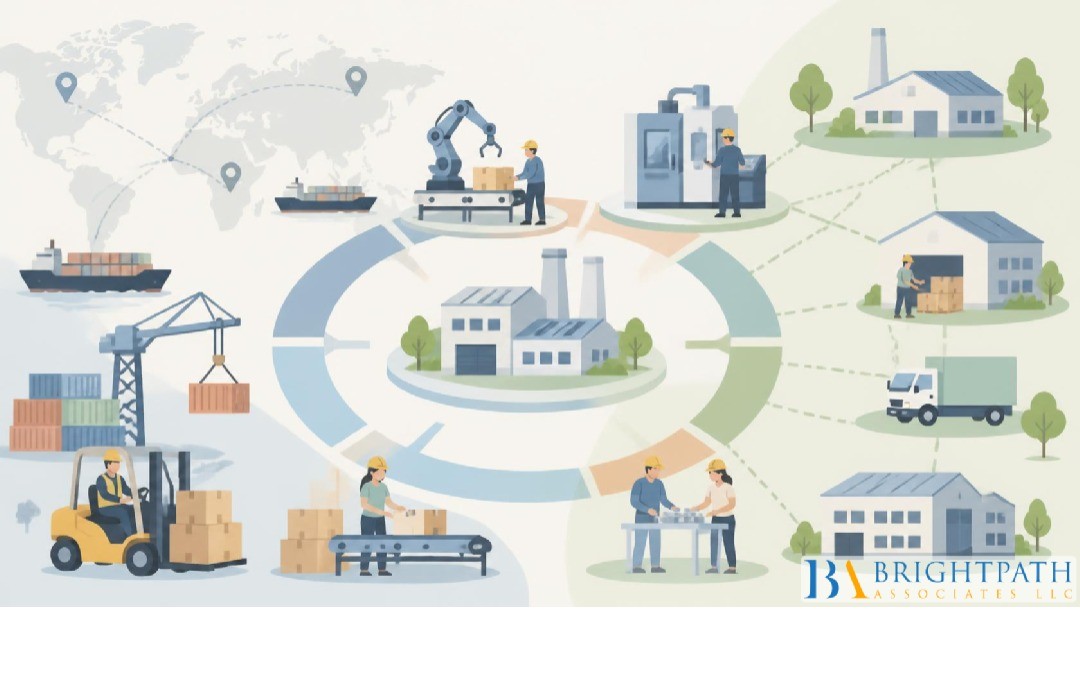
Regional sourcing does not mean replacing every international supplier with a local company. Instead, it involves creating multiple supply options across strategically important geographic areas.
A regional network may include local component manufacturers, technology providers, engineering firms, maintenance specialists, logistics companies, and automation partners. These organizations can work alongside established global suppliers to create a more flexible sourcing ecosystem.
The advantage is responsiveness. Regional suppliers can often reduce transportation distances, shorten lead times, and provide faster technical support. When combined with global suppliers, they create a diversified model that balances cost, innovation, and resilience.
For manufacturers, this approach can be particularly valuable in sectors where production downtime is extremely expensive. Automotive, electronics, food processing, pharmaceuticals, machinery, and industrial equipment manufacturers increasingly need supply networks capable of responding quickly to unexpected disruptions.
One of the biggest challenges associated with regional manufacturing is maintaining cost competitiveness. Higher labor costs or smaller production volumes can make localized production more expensive than offshore alternatives. This is where Industrial automation becomes strategically important.
Automation technologies allow manufacturers to improve productivity while reducing dependence on repetitive manual processes. Advanced Automation solutions manufacturing strategies can integrate robotics, sensors, programmable controllers, data platforms, and intelligent inspection technologies into production environments.
A regional facility equipped with advanced automation may achieve productivity levels that were previously associated with much larger offshore operations. Automation can also improve consistency, quality, workplace safety, and production visibility.
PLC programming service providers play an important role in this transition. Programmable Logic Controllers are central to many industrial production systems, controlling machinery, material handling, safety processes, and production sequences. As manufacturers establish or modernize regional facilities, flexible PLC programming can help them adapt equipment to changing production requirements.
Robotics Integration and Flexible Production
#RegionalManufacturingNetworks also require greater flexibility. Traditional production systems designed for high-volume, standardized manufacturing can struggle when companies need to produce smaller batches or respond quickly to changing customer requirements.
Robotics integration offers an opportunity to address this challenge. Modern robotic systems can perform assembly, material handling, welding, packaging, palletizing, inspection, and other repetitive processes. When properly integrated with manufacturing equipment and production software, robots can enable facilities to switch between products more efficiently.
The objective is not simply to add robots to a factory. Effective robotics integration requires careful planning around production workflows, machine communication, safety systems, maintenance, and workforce capabilities. Manufacturers must create automation architectures that can evolve as demand and sourcing requirements change.
This flexibility is becoming increasingly important as companies build regional manufacturing capacity. Instead of designing factories exclusively around one product or process, organizations can develop adaptable systems capable of supporting multiple production scenarios.
Resilient sourcing also depends on visibility. Manufacturers cannot effectively manage regional networks if they lack accurate information about production performance, equipment health, inventory, and supplier-related risks.
SCADA systems provide an important layer of operational visibility by allowing manufacturers to monitor industrial processes and equipment in real time. When integrated with modern manufacturing environments, SCADA platforms can provide valuable information about production conditions, machine performance, alarms, energy consumption, and operational trends.
This data can help manufacturers identify potential disruptions before they become major problems. For example, unusual equipment behavior may indicate an impending failure, while production data may reveal inefficiencies caused by a newly introduced component.
Connected control systems further strengthen this visibility. By integrating machines, sensors, controllers, and software platforms, manufacturers can create a more transparent production environment. This enables faster decision-making and supports a more proactive approach to operational risk.
Industrial Machine Vision and Quality Resilience
Quality assurance is another critical consideration when regionalizing manufacturing. A new supplier or production facility must be capable of maintaining consistent product quality. Technology can help reduce the risks associated with changing production environments.
Industrial machine vision systems are increasingly being used for automated inspection, dimensional verification, defect detection, assembly validation, and product identification. These systems can analyze products at production speed while providing consistent inspection standards.
For manufacturers developing regional supply networks, Industrial machine vision can support quality control across multiple facilities. Standardized inspection technologies can help organizations maintain consistent quality requirements even when production is distributed across different locations.
This is particularly important for industries where product failures can result in substantial financial, regulatory, or reputational consequences.
Technology alone cannot create a resilient manufacturing network. Skilled people remain essential for designing, operating, maintaining, and improving advanced production systems.
The expansion of regional manufacturing is increasing demand for engineers, automation specialists, controls professionals, robotics experts, maintenance technicians, and plant leaders. As a result, Automation jobs are becoming increasingly connected to broader manufacturing transformation.
Companies may find that their biggest limitation is not access to machinery but access to people capable of implementing and managing that machinery. A factory can purchase sophisticated equipment, but without qualified professionals, the technology may not deliver its expected value.
This creates a strong connection between supply chain strategy and talent strategy. Organizations need to identify which capabilities must exist internally and which can be provided through external partners.
Executive Leadership and the New Sourcing Strategy
The move toward regional sourcing requires leadership capable of balancing operational efficiency with long-term resilience. Executives must understand manufacturing technology, supply chain risk, financial implications, workforce requirements, and changing customer expectations.
This is where Executive search industrial automation becomes increasingly relevant. Companies undergoing automation-led transformation often require leaders who understand both industrial operations and emerging technologies.
Traditional leadership models may not be sufficient when manufacturing organizations are simultaneously managing automation investments, regional expansion, supplier diversification, and digital transformation. Leaders must be comfortable making decisions across multiple disciplines.
#ExecutiveSearchRecruitment can therefore play an important role in identifying executives who can guide organizations through complex industrial transformation. The right leadership can help connect procurement strategies with production technology, talent development, operational performance, and long-term business objectives.
The strongest sourcing strategies are unlikely to be purely local or purely global. Instead, manufacturers are moving toward balanced networks that combine different geographic and technological capabilities.
Critical components may be dual-sourced across multiple regions. Strategic suppliers may be supported through long-term partnerships. Regional facilities may provide faster response capabilities, while global facilities continue to deliver economies of scale.
Digital technologies can further strengthen these networks by improving communication between suppliers, plants, logistics providers, and corporate teams. Advanced analytics can help organizations identify patterns and potential disruptions, while automation can improve the ability of regional facilities to compete on productivity.
The result is a sourcing model designed not simply for the lowest possible cost but for the best combination of cost, speed, flexibility, quality, and resilience.
Manufacturing Automation and the Future of Resilient Production
The future of resilient manufacturing will depend heavily on Manufacturing automation. As companies diversify their sourcing networks, automated production technologies will help regional facilities achieve greater productivity and consistency.
However, resilience should not be viewed as a one-time transformation. Supplier networks, technologies, markets, and workforce requirements will continue to change. Manufacturers must therefore develop systems that can adapt.
Flexible control systems, scalable robotics, advanced inspection, connected production platforms, and intelligent data systems can provide the technological foundation for this adaptability. At the same time, organizations need leadership teams capable of continuously evaluating risk and making strategic adjustments.
Conclusion
The movement from global dependencies toward regional networks represents a fundamental change in how manufacturers think about supply chains. The objective is not to eliminate globalization but to reduce vulnerability to concentrated dependencies.
Regional networks can provide manufacturers with greater flexibility, faster response times, improved supplier diversification, and stronger operational continuity. When supported by Industrial automation, Robotics integration, SCADA systems, Industrial machine vision, and advanced Control systems, regional facilities can become highly productive components of a broader manufacturing ecosystem.
Ultimately, resilient sourcing is about creating options. Manufacturers that have multiple qualified suppliers, flexible production capabilities, strong technology infrastructure, and capable leadership are better positioned to respond when disruptions occur.
As supply chains continue to evolve, the companies that succeed will be those that treat resilience as a strategic capability rather than simply a contingency plan. The combination of diversified sourcing, Automation solutions manufacturing, #SkilledTalent, and forward-looking Executive Search Recruitment strategies can help manufacturers build supply networks prepared not only for today’s disruptions but also for tomorrow’s uncertainty.
Find your next leadership role in Industrial Automation Industry today!
Stay informed with the latest insights on Industrial Automation Industry!