
Introduction
#InventoryManagement in the forest products sector has become increasingly complex as manufacturers, distributors, retailers, and end customers demand greater transparency about where materials originate and how they move through the supply chain. From timber harvesting and transportation to processing, warehousing, and final distribution, every stage can introduce uncertainty, delays, documentation gaps, or compliance risks. Blockchain-verified chain of custody offers a potential solution by creating a more transparent and tamper-resistant record of material movement.
For companies operating across the lumber industry, paper manufacturing, wood product manufacturing, and related sectors, the technology can strengthen inventory accuracy while supporting sustainability and regulatory requirements. Instead of relying exclusively on disconnected spreadsheets, paper documents, and centralized databases, organizations can use blockchain to create a shared digital record of transactions and material transfers.
The result is not simply better inventory tracking. A blockchain-enabled supply chain can support forest product innovation, improve operational accountability, strengthen customer confidence, and provide management teams with better information for strategic decision-making.
Understanding Blockchain-Verified Chain of Custody
A chain of custody establishes how forest-based materials move from their original source through processing and distribution. Traditionally, companies have depended on certificates, invoices, shipping documents, inventory records, and supplier declarations to establish material provenance. While these systems can work, they often depend heavily on manual data entry and communication between organizations.
Blockchain introduces another layer of verification. Each significant transaction or movement of material can be recorded digitally and linked to previous records. Because blockchain records are designed to be difficult to alter retrospectively without detection, participants can develop a more reliable history of the material.
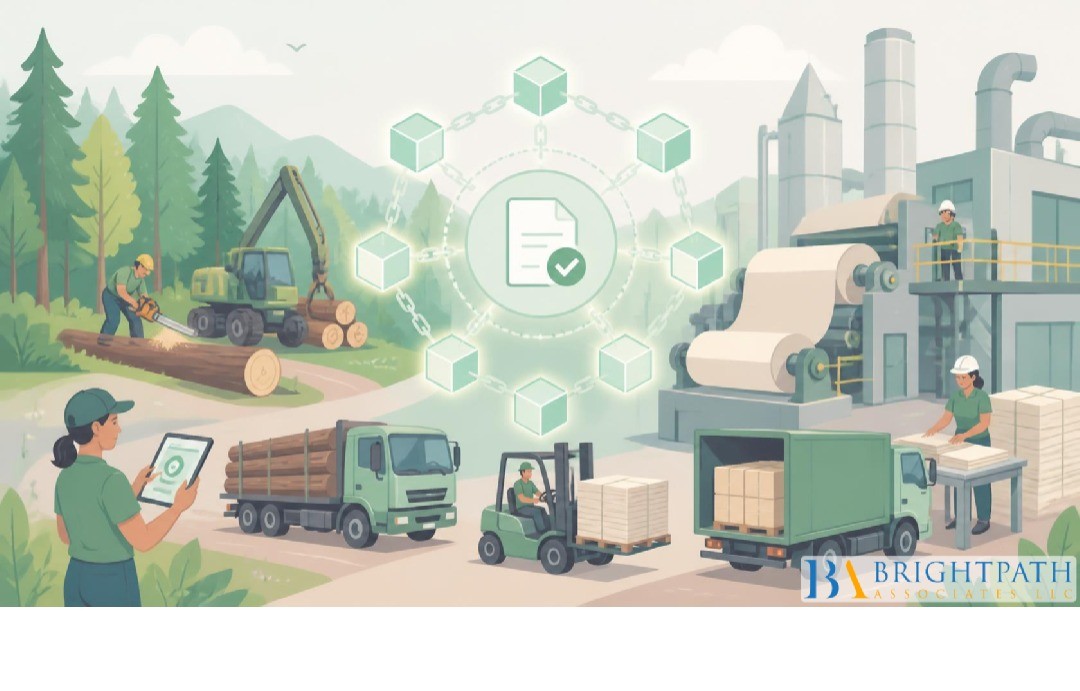
For example, timber harvested from an approved source can receive a digital record when it enters the supply chain. When the material reaches a sawmill, processing information can be added. Further records can document movement to a manufacturer, warehouse, distributor, or customer. This creates a connected history that can help companies verify where inventory originated and how it was transformed.
This approach is particularly relevant as businesses seek greater transparency around sustainable materials and responsible sourcing.
Inventory inaccuracies can create significant operational problems for forest product businesses. Excess stock ties up working capital, while insufficient inventory can interrupt production and create delivery delays. When material records are fragmented across different systems, determining the precise quantity, location, and status of inventory can become difficult.
Blockchain-verified records can help organizations establish a consistent digital history for inventory movements. Each transaction can provide information about the material entering or leaving a facility, helping supply chain managers reconcile physical inventory with recorded inventory.
For the lumber industry, this could involve tracking timber from harvesting through sawmill processing and distribution. In the paper sector, the same principle could be applied to wood fiber, pulp, recycled materials, and finished paper products.
Improved visibility can also help managers identify discrepancies earlier. Instead of discovering inventory inconsistencies during an annual audit or physical stock count, organizations can potentially identify unusual transactions or missing records closer to the point where they occur.
Blockchain and Timber Harvesting Transparency
#TimberHarvesting represents one of the most important points in the forest products supply chain because it establishes the origin of raw materials. Concerns about illegal logging, unauthorized harvesting, land-use changes, and inconsistent documentation have increased pressure on companies to demonstrate responsible sourcing.
A blockchain-supported chain of custody can provide a structured digital record beginning at the source. Information relating to harvesting authorization, supplier identity, geographic origin, volume, transportation, and receiving facilities can potentially become part of the digital chain.
This does not mean blockchain independently proves that information is accurate. The technology cannot guarantee that incorrect information was not entered at the beginning of the process. However, once verified information enters the system, blockchain can help preserve its transaction history and make unauthorized changes more difficult.
This distinction is important. Effective blockchain implementation requires strong data governance, supplier verification, auditing, and operational controls alongside the technology itself.
Supporting Forestry Regulations and Compliance Requirements
Forestry regulations are becoming increasingly important for companies operating internationally and across complex sourcing networks. Governments, customers, certification organizations, and investors increasingly expect companies to demonstrate responsible sourcing and compliance.
Blockchain can support these requirements by creating accessible records of material movements and associated documentation. Instead of searching through disconnected records to demonstrate provenance, companies could use a unified digital history to trace specific material batches through multiple stages of the supply chain.
For compliance teams, this can reduce the administrative burden associated with verification. For executives, it can improve visibility into supply chain risks and make it easier to identify suppliers or processes requiring additional attention.
The value becomes particularly significant when organizations operate across multiple jurisdictions, where documentation requirements and forestry regulations can differ.
Blockchain-verified chain of custody also has significant potential for recycled materials. Paper recycling solutions depend on accurate information about the collection, processing, sorting, and transformation of recovered paper.
The recycled fiber supply chain can involve numerous participants, making it difficult to maintain consistent visibility from collection through final manufacturing. Blockchain can help establish a digital record of material transactions, creating greater transparency about how recycled material enters and moves through production systems.
For paper manufacturers, this can strengthen sustainability reporting while helping distinguish recycled inputs from other raw materials. It can also support more reliable documentation when customers request information about the environmental characteristics of finished products.
As demand for circular production models increases, reliable traceability will become an increasingly important component of paper recycling solutions.
The Role of Paper and Pulp Technology
The paper and pulp sector is undergoing significant #TechnologicalTransformation. Advanced production equipment, automation, data analytics, artificial intelligence, and connected manufacturing systems are changing how mills monitor production and manage resources.
Blockchain can complement these technologies by providing a trusted transaction layer between organizations. While manufacturing execution systems and enterprise resource planning platforms can manage production and inventory internally, blockchain can provide a shared record across organizational boundaries.
This creates opportunities for stronger integration between suppliers, pulp mills, paper manufacturers, logistics providers, distributors, and customers. As paper and pulp technology becomes increasingly connected, organizations will need reliable mechanisms for exchanging data without creating additional administrative complexity.
The integration of blockchain with existing digital systems can therefore become an important part of broader digital transformation strategies.
Connecting Blockchain with Wood Product Manufacturing
Wood product manufacturing involves multiple transformations between raw timber and finished products. Logs can become lumber, panels, engineered wood, furniture components, construction materials, or other finished products. Each transformation creates additional inventory records and opportunities for traceability gaps.
A blockchain-enabled system can associate batches of incoming material with subsequent production activities. When properly designed, the digital record can show how source material was transformed and distributed.
This can be particularly valuable for manufacturers selling products where customers increasingly want evidence of responsible sourcing. Construction companies, retailers, architects, and consumers may demand more information about the origin and sustainability of wood products.
For manufacturers, stronger traceability can therefore become more than a compliance function. It can become a commercial differentiator.
Automation in Paper industry operations is already transforming production environments through robotics, sensors, automated material handling, machine monitoring, and advanced process control. Blockchain can extend this transformation beyond the factory floor.
Automated systems can generate data about material movements, production quantities, shipments, and inventory changes. Blockchain infrastructure can potentially record selected transactions, reducing reliance on manual documentation.
The combination can create a more connected supply chain in which physical movements and digital records remain closely synchronized. Such integration may reduce administrative workloads while improving the speed at which managers receive operational information.
However, companies should avoid treating blockchain as a replacement for every existing system. Its strongest role is often as a complementary technology that connects organizations and strengthens the integrity of shared records.
Understanding the Economics Behind Traceability
The economics of implementing blockchain must be evaluated carefully. #TechnologyInvestments require spending on software, integration, cybersecurity, employee training, supplier onboarding, data governance, and ongoing system management.
For smaller organizations, the business case may initially appear challenging. However, the potential benefits extend beyond inventory accuracy. Reduced reconciliation work, faster audits, improved compliance, fewer disputes, better supplier visibility, and stronger customer trust can contribute to long-term value.
The economics become particularly compelling when organizations manage complex supply chains with many participants. The greater the number of handoffs, the greater the potential value of having a consistent record of transactions.
For executives evaluating blockchain investments, the key question should therefore not simply be whether blockchain is technically possible. The more important question is whether verified traceability addresses a meaningful operational or commercial problem.
Blockchain as a Driver of Forest Product Innovation
Forest product innovation increasingly involves more than developing new materials and manufacturing techniques. It also includes finding smarter ways to manage the information surrounding those products.
Blockchain can contribute to this innovation by connecting physical materials with digital identities. This could enable businesses to develop more sophisticated approaches to sourcing, inventory management, sustainability reporting, and customer engagement.
As sustainable materials become increasingly important to markets, the ability to prove sourcing claims may become as valuable as the claims themselves. Companies that invest in reliable traceability systems can position themselves for a business environment where transparency becomes a competitive requirement.
Technology alone cannot transform supply chain performance. Organizations need employees who understand both industrial operations and emerging digital systems. Supply chain managers, procurement professionals, compliance specialists, data analysts, IT teams, and manufacturing leaders must collaborate to make blockchain implementations successful.
This creates new workforce requirements across the lumber, paper, pulp, forestry, and wood manufacturing sectors. Companies increasingly need professionals who can connect operational knowledge with digital transformation capabilities.
This is where #ExecutiveSearchRecruitment can play an important role. Organizations implementing blockchain and advanced supply chain technologies may require senior leaders capable of managing technology adoption while maintaining operational efficiency. Recruiting executives with experience in supply chain transformation, manufacturing technology, sustainability, data governance, and industrial operations can help companies turn technology investments into measurable business outcomes.
The Strategic Future of Blockchain-Verified Inventory
Blockchain-verified chain of custody is unlikely to eliminate every supply chain challenge. Instead, its greatest value lies in creating a more trusted information environment across complex networks.
As lumber industry trends continue to evolve toward greater sustainability, digitization, automation, and transparency, companies will need stronger systems for managing both physical products and the information associated with them. Blockchain can provide one component of that infrastructure.
The technology can support timber harvesting transparency, strengthen forestry regulations compliance, improve paper recycling solutions, enhance paper and pulp technology ecosystems, and provide greater visibility across wood product manufacturing.
At the same time, its success will depend on implementation discipline. Companies must establish clear data standards, verify information at its source, integrate blockchain with existing enterprise systems, and ensure that supply chain partners participate effectively.
Conclusion
Inventory management in forest-based industries is becoming increasingly interconnected with sustainability, compliance, technology, and customer expectations. Blockchain-verified chain of custody provides organizations with an opportunity to bring these priorities together through a more transparent and resilient information framework.
For businesses across forestry, pulp and paper, lumber, recycling, and #WoodManufacturing, better traceability can reduce uncertainty while creating new opportunities for operational improvement. Combined with automation, advanced analytics, and modern supply chain systems, blockchain can help organizations move toward a more connected industrial ecosystem.
The companies most likely to benefit will be those that view traceability not simply as an administrative requirement but as a strategic capability. By investing in digital infrastructure, skilled leadership, and sustainable materials management, forest product businesses can strengthen their supply chains while preparing for the next generation of industrial transformation.
Find your next leadership role in Paper & Forest Industry today!
Stay informed with the latest insights on Paper & Forest Industry!