
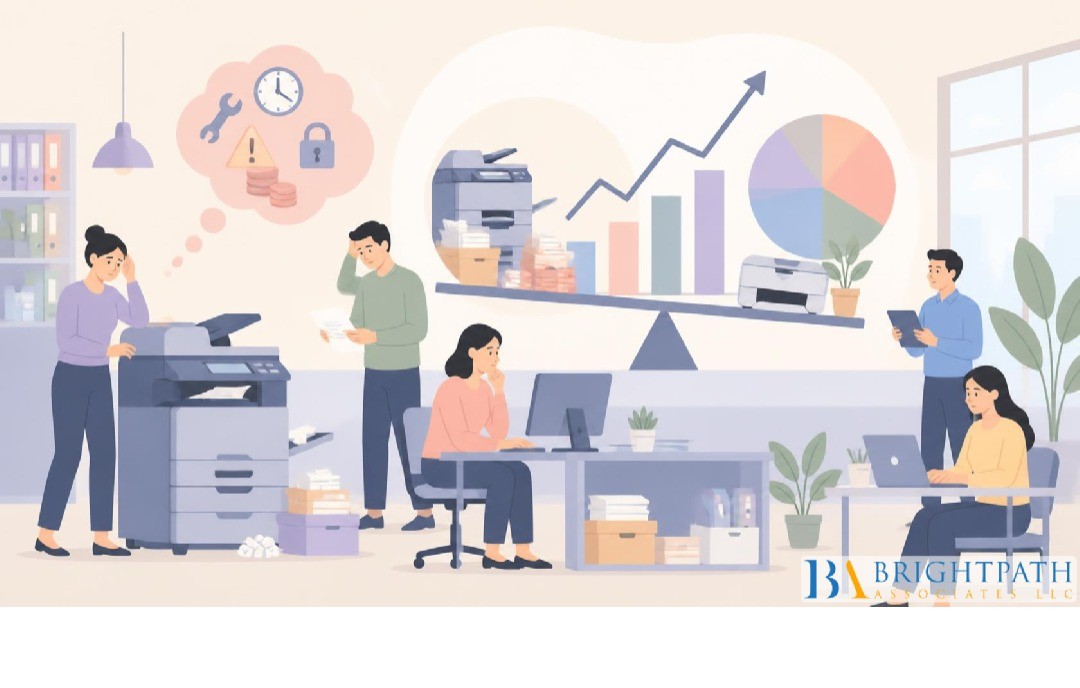
In many organizations, the office environment is treated as a relatively stable part of the business. Desks, printers, scanners, copiers, filing systems, telephones, and other forms of #BusinessEquipment may remain in service for years because they continue to perform their basic functions. From the surface, keeping older equipment can appear to be a financially responsible decision. If a machine still works, why replace it?
The problem is that functionality does not necessarily equal efficiency.
Legacy office equipment can create hidden costs through maintenance, energy consumption, employee downtime, security vulnerabilities, inefficient workflows, and compatibility problems. These costs are rarely visible on a conventional balance sheet because they are distributed across different departments and operational activities. As a result, businesses may underestimate the true cost of maintaining outdated equipment.
For organizations operating in a competitive Office supplies industry environment, understanding these hidden expenses can help executives make better procurement and modernization decisions. The question should not simply be whether legacy equipment still works. It should be whether the equipment continues to generate sufficient business value relative to the total cost of ownership.
The True Cost of Keeping Old Equipment
The purchase price of office equipment is only one component of its overall cost. Once equipment enters an organization, expenses can accumulate through repairs, replacement parts, consumables, electricity, software compatibility, employee time, and administrative support.
Older equipment can also become increasingly difficult to service. Manufacturers may discontinue replacement parts, technicians may become less familiar with outdated models, and organizations may need to maintain larger inventories of spare components.
These costs can remain hidden because they are often categorized as routine operational expenses rather than being associated with the original equipment purchase.
An ROI analysis should therefore consider the complete lifecycle of Business equipment rather than focusing exclusively on acquisition cost.
Office equipment maintenance is one of the most obvious hidden expenses associated with aging assets. A printer that frequently jams, a copier requiring repeated service calls, or an outdated scanner producing inconsistent results can consume significant resources.
The direct maintenance bill is only part of the problem.
Employees may lose time waiting for repairs, searching for alternative equipment, or manually completing tasks that could otherwise be automated. IT teams may also spend valuable hours troubleshooting compatibility and connectivity problems.
When these indirect costs are calculated, the economics of keeping legacy equipment can change dramatically.
Employee Productivity Is an Important ROI Factor
Productivity losses are often overlooked when organizations evaluate equipment replacement.
Consider an employee who spends several minutes every day dealing with slow printing, repeated paper jams, manual data entry, or unreliable scanning. Individually, the lost time may appear insignificant. Across dozens or hundreds of employees and an entire year, however, those minutes can become a substantial operational expense.
This is particularly relevant as #OfficeTechnology trends continue to emphasize automation, cloud connectivity, digital workflows, and intelligent document management.
Modern equipment can reduce repetitive administrative tasks and allow employees to spend more time on higher-value activities.
The ROI of new equipment should therefore include the value of recovered employee time.
Legacy Equipment and Energy Consumption
Older office equipment may also consume more energy than newer models. Printers, copiers, monitors, lighting systems, and other devices can contribute to ongoing electricity costs.
While the energy consumption of an individual device may appear small, organizations with large equipment fleets can accumulate meaningful expenses.
Energy efficiency has also become increasingly relevant to corporate sustainability strategies. Companies are under growing pressure to manage operating costs while reducing environmental impact.
Replacing outdated equipment may therefore provide both financial and sustainability benefits, particularly when energy-intensive devices are involved.
Modern offices are highly connected environments. Printers, scanners, multifunction devices, conference systems, and other equipment can connect to corporate networks and cloud platforms.
This creates a cybersecurity consideration.
Legacy devices may not support modern security standards, encryption capabilities, authentication methods, or firmware updates. A device that appears harmless from an operational perspective may nevertheless create a vulnerability within the organization’s digital infrastructure.
The Digital transformation in office environments has increased the importance of treating office equipment as part of the organization’s technology ecosystem.
Businesses should consider whether older equipment can be securely integrated into modern networks. If it cannot, replacement may become a risk-management decision rather than simply a productivity investment.
Compatibility Problems Create Hidden Expenses
Technology changes rapidly. Software applications, operating systems, cloud platforms, and communication systems evolve continuously.
Legacy office equipment may not always integrate effectively with newer systems.
Employees may need workarounds, specialized drivers, manual processes, or additional software to keep older devices operational. IT departments may be required to maintain older systems alongside newer infrastructure.
These compatibility costs can become particularly significant during broader technology upgrades.
A company may discover that replacing one outdated device is not enough because several #InterconnectedSystems depend on the older technology.
Office Supply Management and Equipment Strategy
Office supply management has traditionally focused on items such as paper, toner, stationery, and consumables. However, modern organizations increasingly need to consider the relationship between consumables, equipment, digital workflows, and procurement.
For example, an outdated printer may consume more toner and paper because of inefficient operation. A modern multifunction device might reduce consumption while offering scanning, digital storage, and automated workflow capabilities.
This means equipment decisions can influence broader Office supply management strategies.
Organizations should examine total usage patterns rather than evaluating equipment and supplies separately.
Procurement teams can play a major role in identifying the hidden costs of legacy equipment. Traditional purchasing decisions often emphasize initial price, but a more sophisticated approach evaluates total cost of ownership.
This includes acquisition, installation, maintenance, energy consumption, consumables, software, security, employee productivity, replacement parts, and eventual disposal.
Office supply vendors can also become strategic partners by helping businesses assess equipment utilization and lifecycle costs.
Instead of asking only which machine has the lowest purchase price, procurement leaders can ask which solution provides the strongest long-term value.
This approach can lead to more informed purchasing decisions.
The Role of Office Supply Vendors
#OfficeSupplyVendors increasingly offer more than basic products. Many can provide managed print services, equipment leasing, maintenance programs, technology integration, and usage analytics.
These services can help organizations understand how their equipment is actually being used.
For example, usage data may reveal that certain devices are underutilized while others experience excessive demand. Businesses can use this information to consolidate equipment, improve placement, or replace inefficient assets.
The relationship between organizations and Office supply vendors can therefore evolve from transactional purchasing toward strategic collaboration.
Commercial Office Furniture and Workplace Modernization
Equipment modernization should not be considered independently from the physical workplace. Commercial office furniture, workspace layouts, meeting areas, technology stations, and collaboration spaces increasingly need to support hybrid work and digitally enabled operations.
An organization may invest in modern office equipment while retaining a workplace designed around outdated working practices.
A broader modernization strategy can evaluate how furniture, equipment, technology, and employee workflows interact.
For example, collaborative workspaces may require modern conferencing equipment, flexible power access, integrated displays, and wireless connectivity. Traditional office layouts may not support these requirements efficiently.
Workplace modernization should therefore consider the entire employee experience.
Digital transformation in office environments is changing the purpose of physical equipment. Documents that once required printing may now be stored and shared electronically. Digital signatures can reduce paper usage. Cloud platforms can eliminate some physical filing requirements.
However, this does not mean that physical office equipment has become irrelevant.
Instead, the role of equipment is changing.
Modern multifunction devices can act as bridges between physical and digital workflows by scanning documents, applying security controls, connecting with cloud platforms, and automating document processes.
The strategic goal should therefore be to integrate physical equipment into a broader digital workflow rather than simply replacing old machines with newer versions of the same technology.
Office Technology Trends and the Modern Workplace
#OfficeTechnologyTrends increasingly focus on intelligent automation, cloud connectivity, cybersecurity, sustainability, remote collaboration, and data-driven decision-making.
Artificial intelligence and workflow automation are also beginning to influence administrative processes.
Organizations that continue relying heavily on outdated equipment may struggle to take advantage of these developments.
Modernization does not require replacing every device simultaneously. Businesses can prioritize equipment based on business impact, security risk, utilization, and lifecycle status.
A phased modernization strategy can make investment more manageable while still delivering measurable improvements.
Calculating the ROI of Equipment Replacement
A meaningful ROI analysis should compare the annual cost of keeping legacy equipment with the expected cost and benefits of replacement.
The analysis should consider maintenance expenses, consumable costs, energy consumption, downtime, employee productivity, security risks, software compatibility, and potential automation benefits.
For example, if an older device requires frequent repairs and causes employee downtime, the organization should estimate the annual value of those lost hours. If a newer system reduces those interruptions, the productivity improvement becomes part of the investment return.
Businesses should also consider the expected useful life of the replacement equipment and any financing or leasing arrangements.
The strongest business case combines direct financial savings with operational improvements.
Equipment replacement should not be driven solely by age. Some older devices may continue to provide excellent value, while newer equipment can become obsolete quickly if it does not integrate with business systems.
Procurement teams should therefore evaluate equipment based on performance, security, compatibility, utilization, maintenance requirements, and strategic relevance.
Organizations can establish lifecycle reviews that identify assets approaching the point where maintenance costs or operational risks exceed their value.
This creates a more predictable modernization process and reduces the likelihood of emergency replacements.
Talent and Technology Must Evolve Together
Modern office environments require employees who can work effectively with digital tools, automated workflows, cloud applications, and connected systems.
This creates an important connection between technology investment and talent management.
Organizations may need professionals who can manage digital transformation, procurement analytics, technology implementation, workplace operations, and cybersecurity.
#TalentAcquisitionStrategies should therefore align with technology modernization.
Hiring employees who understand emerging technologies can help organizations extract greater value from new investments. At the executive level, leaders must be capable of connecting operational modernization with financial and strategic objectives.
This is where #ExecutiveSearchRecruitment can help organizations identify experienced leaders who can guide technology transformation while maintaining focus on productivity, cost management, and organizational performance.
The hidden costs of legacy office equipment demonstrate why modernization should be viewed as a strategic business decision rather than a simple replacement exercise.
Old equipment can create expenses through maintenance, downtime, energy consumption, security vulnerabilities, compatibility problems, and inefficient workflows. These costs may remain invisible when organizations focus only on purchase prices.
A modern office strategy considers equipment as part of a connected ecosystem involving technology, employees, procurement, facilities, and business processes.
Organizations can begin by understanding what equipment they own, how frequently it is used, how much it costs to maintain, and what risks it creates. From there, executives can prioritize investments according to business impact.
Conclusion: Looking Beyond the Purchase Price
Legacy office equipment can appear inexpensive because its original purchase cost has already been paid. But the absence of a new purchase does not mean the equipment is free.
Every repair, service interruption, consumable expense, compatibility issue, security vulnerability, and lost employee hour represents a potential cost.
As the Office supplies industry continues to evolve, businesses need to move beyond traditional purchasing models and evaluate the total economic value of their equipment.
Modern Business equipment should support productivity, security, sustainability, and digital workflows. Procurement should focus on total cost of ownership. Office supply vendors should be evaluated based on their ability to provide long-term value. And leadership teams should connect technology decisions with broader talent and operational strategies.
The most important question is not, “Can our old equipment still work?”
It is, “Is keeping it still the smartest business decision?”
For organizations willing to examine the hidden costs carefully, the answer can reveal opportunities to improve productivity, reduce operational waste, strengthen security, and create a more future-ready workplace.
Find your next leadership role in Business Supplies & Equipment Industry today!
Stay informed with the latest insights on Business Supplies & Equipment Industry!