
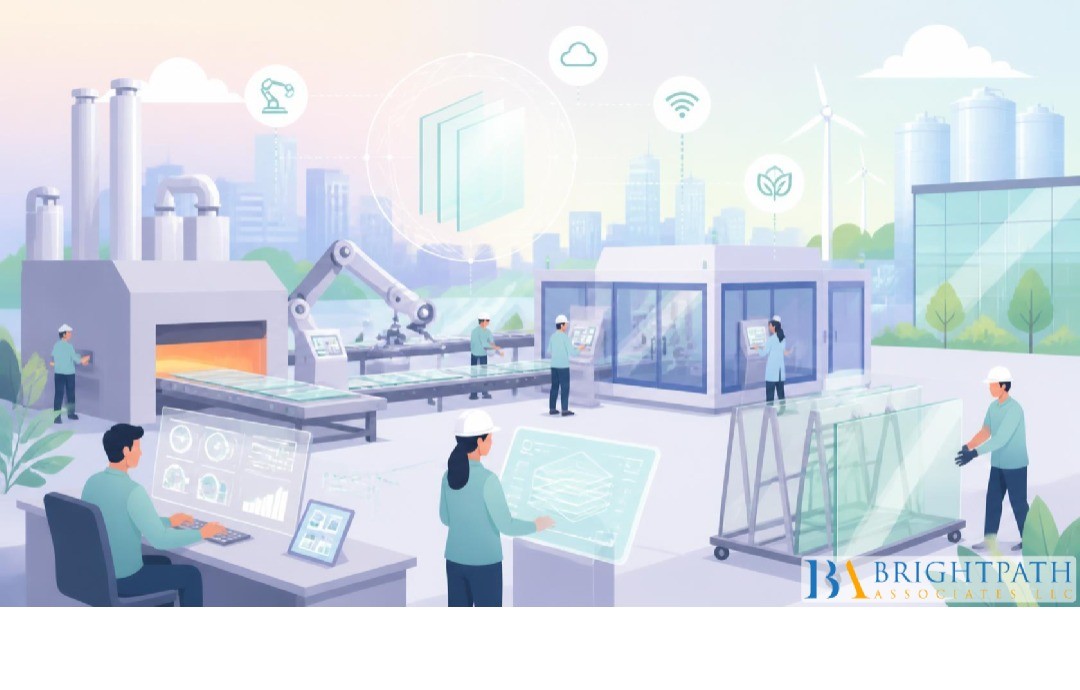
Introduction: The Glass Industry Enters a Digital Era
The glass industry has always been closely associated with precision, engineering, heat management, and highly controlled manufacturing processes. Today, however, digital technology is changing how glass manufacturers design products, manage production, monitor equipment, optimize energy consumption, and respond to customers.
The transformation is being driven by several factors at once. Rising energy costs, sustainability expectations, labor challenges, increasingly customized products, and pressure for greater manufacturing efficiency are encouraging glass companies to rethink traditional operating models.
Digital transformation is not simply about installing new software or replacing manual processes with automated equipment. It involves connecting production systems, collecting meaningful data, applying analytics, and using technology to make faster and more accurate decisions.
Although the discussion is centered on glass, the transformation is part of a broader evolution across construction and industrial materials. Glass industry innovation increasingly intersects with developments in Concrete industry trends, Ceramic manufacturing technology, and Advanced concrete technology as manufacturers across the building-materials ecosystem pursue greater efficiency and sustainability.
For glass businesses, the central opportunity is to use digital capabilities to create a more intelligent, flexible, and resilient manufacturing operation.
Digital Transformation and the Modern Glass Manufacturing Model
Traditional glass manufacturing depends heavily on tightly controlled production parameters. Temperature, raw-material composition, furnace conditions, forming processes, cooling rates, surface quality, and finishing operations all influence the final product.
Historically, many decisions depended on operator experience and periodic inspections.
Digital systems can now provide continuous information about these processes.
Connected sensors can monitor equipment conditions and production parameters. Manufacturing execution systems can connect production activities with planning and quality processes. Analytics platforms can identify patterns that may not be immediately visible to operators.
This creates a shift from reactive management toward predictive management.
Instead of discovering a problem after defective glass has been produced, manufacturers can increasingly identify process deviations earlier.
The result can be lower waste, more consistent quality, improved equipment utilization, and stronger production planning.
The Role of Glass Industry Innovation
Glass industry innovation is increasingly being influenced by digital technologies.
Manufacturers are exploring automated inspection, artificial intelligence, machine vision, predictive maintenance, digital production planning, robotics, and advanced process analytics.
Machine vision is particularly valuable because glass products require extremely high levels of visual and dimensional quality.
Automated inspection systems can examine surfaces and identify defects more consistently than manual inspection alone.
Digital systems can also connect quality data with specific production conditions.
If a recurring defect appears, manufacturers can investigate whether it is associated with temperature fluctuations, raw-material characteristics, machine settings, or another process variable.
This creates a feedback loop between production and quality management.
Artificial Intelligence and Predictive Manufacturing
Artificial intelligence can become particularly valuable when large volumes of manufacturing data are available.
Glass plants generate information from furnaces, forming equipment, sensors, quality-control systems, energy meters, and production scheduling platforms.
Individually, these data points may have limited value.
When analyzed together, they can reveal relationships between operating conditions and production outcomes.
Predictive models can potentially identify conditions associated with equipment failure or product defects.
This supports predictive maintenance and proactive production management.
The objective is not to remove human expertise.
Instead, digital tools can provide operators and managers with better information for making decisions.
Experienced professionals remain essential for interpreting unusual situations and determining how changes should be implemented safely.
Energy Efficiency and Sustainable Glass Production
Energy consumption is a major consideration in glass manufacturing because melting processes require substantial heat.
Digital transformation can help manufacturers understand where energy is being consumed and where efficiency improvements may be possible.
Connected energy-monitoring systems can provide information across different stages of production.
Manufacturers can compare energy consumption with production volumes, product types, operating conditions, and equipment performance.
This makes it easier to identify inefficient processes.
Digital optimization can also contribute to broader sustainability objectives.
Although the glass sector has its own specific challenges, its transformation reflects the wider movement toward Sustainable building materials.
Customers and construction companies increasingly want materials that support environmental objectives without compromising performance.
Digital manufacturing can help companies pursue these objectives while maintaining production quality.
Connecting Glass With Broader Construction Materials Markets
Glass does not operate independently from the wider construction-materials ecosystem.
Architectural glass is closely connected with concrete, ceramics, metals, insulation, coatings, and other building products.
Understanding Concrete industry trends can therefore provide valuable market context for glass manufacturers.
For example, changes in construction activity, building design, energy-efficiency requirements, and infrastructure investment can influence demand for architectural glass.
Similarly, innovation in concrete and ceramics can affect building design and material selection.
Companies that monitor these connected markets can make better decisions regarding capacity, product development, and investment.
This is where digital market intelligence becomes increasingly important.
Glass Market Analysis in a Data-Driven Environment
Glass market analysis is becoming more sophisticated as companies gain access to larger volumes of market and operational data.
Manufacturers can evaluate customer demand, product performance, regional construction activity, pricing trends, energy costs, and competitive movements.
Digital tools can make these analyses faster.
Rather than relying exclusively on historical sales reports, executives can combine internal information with broader market indicators.
This can support more informed decisions about capacity expansion and product development.
For example, if demand for specialized architectural glass is increasing in a particular market, manufacturers can evaluate whether existing production capabilities can meet that demand or whether investment in new equipment is justified.
Data-driven market analysis can therefore connect commercial strategy with manufacturing planning.
Digital Technology and Ceramic Manufacturing Technology
The relationship between glass and ceramics is also becoming increasingly relevant.
Ceramic manufacturing technology is adopting many of the same digital capabilities, including automation, process monitoring, machine vision, robotics, and predictive analytics.
Both industries depend on precise thermal processes and careful material control.
Lessons from one sector can therefore influence the other.
Manufacturers across both markets are seeking ways to reduce defects, improve energy efficiency, increase throughput, and optimize raw-material utilization.
This convergence creates opportunities for technology providers and engineering professionals who understand multiple materials-processing environments.
Automation and Smart Production
Automation is becoming a core component of digital transformation.
Robotic handling systems can reduce manual movement of heavy or fragile glass products.
Automated packaging and palletizing can improve consistency and reduce workplace risks.
Automated production scheduling can coordinate manufacturing requirements with customer orders and available capacity.
However, automation should be introduced strategically.
A company does not become digitally mature simply because it installs more robots.
The technology must address a genuine operational need.
Manufacturers should evaluate whether automation improves productivity, quality, safety, flexibility, or cost performance.
The strongest digital transformation programs connect automation investments with measurable business outcomes.
Digital Transformation and Advanced Concrete Technology
The wider building-materials sector is also experiencing significant technological development.
Advanced concrete technology, for example, is changing how construction materials are designed, produced, monitored, and optimized.
These developments are relevant to glass manufacturers because construction customers increasingly evaluate complete building systems rather than individual materials.
Buildings are becoming more integrated.
Energy performance, durability, aesthetics, structural efficiency, and environmental impact increasingly influence material selection.
Glass manufacturers that understand these broader requirements can develop products that align more closely with modern construction needs.
Digital transformation therefore extends beyond the factory floor.
It also influences product development and customer engagement.
Sustainability Across the Building Materials Ecosystem
Sustainability is becoming a strategic priority throughout the building-materials sector.
Cement industry sustainability, Sustainable building materials, energy-efficient glass, recyclable materials, and resource-efficient ceramic products are all part of a broader movement toward lower-impact construction.
Digital technology can support this transition by making environmental performance more measurable.
Manufacturers can track energy consumption, production waste, material utilization, and other indicators.
This data can help executives establish improvement targets and evaluate progress.
For companies serving construction markets, stronger sustainability data can also support customer communication and commercial positioning.
The ability to demonstrate measurable improvements may become increasingly important as buyers evaluate suppliers.
Ceramic Industry Growth and Competitive Technology
Ceramic industry growth is also creating demand for more sophisticated manufacturing capabilities.
Like glass producers, ceramic manufacturers are dealing with pressure to improve quality, manage energy costs, respond to customization, and reduce waste.
Digital technologies can help both industries address these challenges.
This creates a broader industrial lesson: manufacturing competitiveness increasingly depends on the ability to combine physical production capabilities with digital intelligence.
Companies that continue relying entirely on manual monitoring may struggle to achieve the same levels of visibility and responsiveness as digitally enabled competitors.
Concrete Production Efficiency and Lessons for Glass
Concrete production efficiency demonstrates another important principle: data becomes valuable when it supports operational decisions.
Concrete producers can monitor material inputs, mixing conditions, production volumes, equipment performance, and quality indicators.
Glass manufacturers can apply a similar philosophy to their own processes.
The specific variables differ, but the management principle remains the same.
Collect information from critical processes, identify meaningful relationships, and use those insights to improve operations.
This approach prevents digital transformation from becoming a technology project without measurable business value.
The Workforce Behind Digital Transformation
Technology cannot transform a glass company without capable people.
As factories become more connected, manufacturers need professionals who understand manufacturing processes as well as digital technologies.
Engineers may need experience with automation, analytics, sensors, control systems, and production software.
Operations leaders need to understand how technology affects productivity and workforce organization.
Managers also need to communicate effectively with employees who may be concerned about changing responsibilities.
Digital transformation should therefore include workforce development.
Employees need training to understand new systems and use them effectively.
The objective should be to augment human expertise rather than simply replace it.
Construction Materials Recruitment and Emerging Talent Needs
The changing technological environment is creating new talent requirements across the materials sector.
Construction materials recruitment increasingly involves identifying professionals with multidisciplinary expertise.
Companies may need leaders who understand manufacturing, engineering, sustainability, digital systems, supply chains, and commercial strategy.
This is particularly important for organizations implementing major transformation initiatives.
A technology investment can fail to produce expected results if the organization lacks leaders capable of integrating the technology into daily operations.
Recruitment strategies therefore need to consider future capabilities rather than focusing exclusively on traditional industry experience.
Executive Search Recruitment for Digital Leadership
Executive Search Recruitment can play an important role as glass and building-materials companies modernize their operations.
Digital transformation often requires leadership changes at the executive, operations, engineering, technology, and manufacturing levels.
Companies may need executives capable of connecting technology investment with profitability, sustainability, production efficiency, and customer expectations.
The strongest candidates may come from different but related industrial sectors.
Experience in ceramics, advanced manufacturing, automation, construction materials, or other process industries can sometimes provide valuable perspectives for glass manufacturers.
The important consideration is whether a leader can successfully translate technology into operational and commercial results.
Conclusion: Digital Transformation as the Next Competitive Frontier
Digital transformation is reshaping the glass industry from production to market strategy.
Connected equipment, artificial intelligence, machine vision, predictive maintenance, automation, analytics, and digital planning systems are giving manufacturers new ways to improve quality, reduce waste, manage energy consumption, and respond to customers.
At the same time, the transformation is occurring within a larger building-materials ecosystem influenced by Concrete industry trends, Ceramic manufacturing technology, Sustainable building materials, Advanced concrete technology, and Cement industry sustainability.
This broader perspective matters because customers increasingly evaluate materials based on performance, sustainability, efficiency, and integration into modern construction systems.
For glass manufacturers, digital transformation should therefore be treated as a strategic business initiative rather than simply an IT upgrade.
The companies that gain the greatest advantage will be those that connect technology investments with clearly defined operational goals. They will use data to understand production, automation to improve consistency, analytics to anticipate problems, and leadership to ensure that technology becomes embedded into the organization.
The future of Glass industry innovation will ultimately depend on more than sophisticated equipment. It will depend on the ability to combine digital intelligence, manufacturing expertise, sustainability, market awareness, and strong leadership.
For companies prepared to make that transition, digital transformation can become a powerful foundation for higher efficiency, stronger competitiveness, and long-term growth in an increasingly technology-driven industrial economy.
Find your next leadership role in Glass, Ceramic, Concrete Industry today!
Stay informed with the latest insights on Glass, Ceramic, Concrete Industry!