
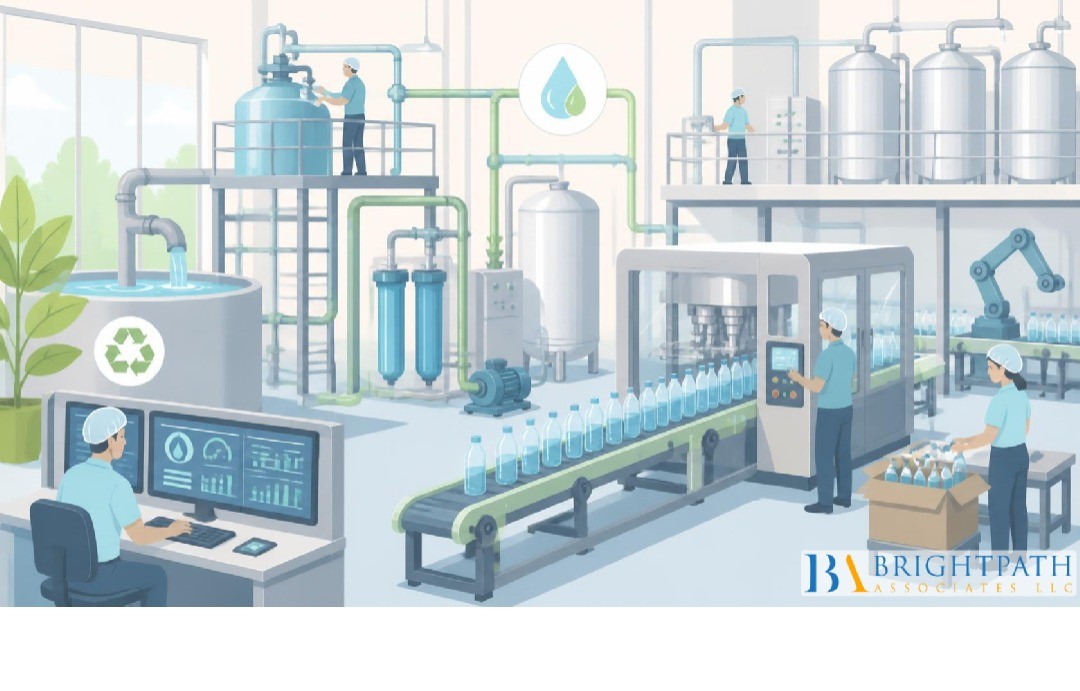
Introduction
Water is one of the most important resources in beverage manufacturing. It is required not only as an ingredient in many products but also for cleaning, sanitation, cooling, processing, utilities, equipment operation, and facility maintenance. As production volumes increase and water availability becomes a greater #OperationalConcern, beverage manufacturers are looking for ways to reduce non-potable water consumption without compromising product quality, hygiene, or production efficiency.
For manufacturers, water reduction is no longer simply an environmental initiative. It can become a measurable operational strategy. Lower water consumption can reduce treatment costs, wastewater volumes, energy requirements, and pressure on production infrastructure.
The opportunity becomes particularly significant when water-intensive processes are connected to digital monitoring and automation. Modern Industrial automation can help manufacturers measure water consumption, identify abnormal usage, control equipment more precisely, and establish repeatable operating procedures.
The challenge is to determine where non-potable water is being consumed, which processes genuinely require it, and where technology can enable safe reuse or reduction. By combining process engineering, Automation solutions manufacturing, intelligent monitoring, and workforce expertise, beverage producers can create a more efficient approach to industrial water management.
Understanding Non-Potable Water Consumption in Beverage Facilities
Not every water application inside a beverage facility requires potable-quality water. Potable water is essential when water directly becomes part of a beverage or comes into contact with product under conditions where safety requires it. However, many supporting operations may have different quality requirements.
Cooling systems, certain utility processes, equipment cleaning stages, landscaping, toilet flushing, and other non-product applications may potentially use appropriately treated non-potable water, depending on local regulations, facility design, and risk controls.
The first step is therefore understanding the facility’s complete water flow.
Manufacturers need visibility into how much water enters the facility, where it is used, where it becomes wastewater, and which streams may be suitable for treatment and reuse.
Without reliable measurement, water reduction initiatives often depend on estimates.
Digital measurement changes this equation.
Modern Industrial automation provides beverage manufacturers with the ability to monitor water-intensive processes continuously.
Sensors can measure flow, pressure, temperature, tank levels, and other operating parameters. Automated systems can then use this information to regulate water consumption according to actual process requirements.
Instead of allowing equipment to operate with fixed water settings, manufacturers can establish dynamic control strategies.
For example, cleaning processes can be programmed to use different water volumes according to equipment size, cleaning stage, or production requirements.
Automation can also identify unusual consumption patterns.
A sudden increase in flow may indicate a leak, faulty valve, incorrect operating settings, or equipment malfunction.
Early detection can prevent significant water losses.
Automation Solutions Manufacturing and Process Optimization
Automation solutions manufacturing can support water efficiency by integrating individual processes into a coordinated operating environment.
Water systems are often connected to production equipment, cleaning systems, pumps, valves, tanks, cooling systems, and wastewater infrastructure.
When these systems operate independently, water consumption can become difficult to optimize.
Integrated automation allows manufacturers to coordinate equipment operation.
Water can be supplied when required and reduced or stopped when a process reaches its defined operating condition.
This reduces unnecessary consumption while maintaining production requirements.
For beverage manufacturers, the value comes from precision. Small reductions in water use across thousands of production cycles can create substantial annual savings.
PLC Programming Service and Precise Water Control
A #PLCProgrammingService can play an important role in developing automated water-management systems.
Programmable logic controllers can control pumps, valves, sensors, cleaning sequences, and other components based on predefined operating conditions.
Instead of relying entirely on manual intervention, PLC-based systems can establish repeatable water-use parameters.
A cleaning sequence, for example, can be programmed to operate according to defined time, flow, temperature, and pressure requirements.
This improves consistency while reducing the possibility of excessive water use caused by human error.
PLC systems can also communicate with broader control platforms, allowing water consumption data to be incorporated into production monitoring.
SCADA systems provide another important layer of visibility.
Supervisory control and data acquisition platforms can collect information from multiple areas of a beverage facility and present it to operators through centralized interfaces.
Water-flow information can be monitored alongside production data, equipment status, alarms, and process conditions.
This creates a clearer picture of how water consumption changes throughout the production cycle.
Operators can identify high-consumption processes and investigate deviations.
Management can also use historical data to compare facilities, production lines, shifts, or operating periods.
The result is a shift from generalized water-saving targets toward data-driven water management.
Identifying Water Loss Through Control Systems
Effective Control systems can help manufacturers identify where water is being lost.
Water waste may come from leaks, excessive cleaning cycles, equipment inefficiencies, uncontrolled flow, faulty valves, or processes that continue operating after production has stopped.
Automated controls can help prevent these situations.
For example, valves can automatically close when equipment is not operating. Pumps can adjust their operation according to demand. Alerts can notify operators when consumption exceeds established thresholds.
These capabilities are especially useful in large facilities where manual monitoring of every water-consuming process is impractical.
Cleaning and sanitation are among the most water-intensive activities in many beverage manufacturing environments.
Hygiene requirements cannot be compromised, but cleaning processes can often be optimized through better monitoring and control.
Manufacturing automation can create standardized cleaning sequences that deliver consistent results.
Instead of relying on extended cleaning times simply as a safety margin, manufacturers can establish process parameters based on validated cleaning requirements.
Flow sensors, conductivity measurements, temperature monitoring, and other process indicators can provide information about cleaning progress.
This can potentially reduce unnecessary rinsing and improve water efficiency while maintaining required sanitation standards.
Any changes to cleaning procedures must, of course, be validated against applicable food-safety and quality requirements.
Robotics Integration and Water Efficiency
Robotics integration is becoming increasingly relevant to beverage manufacturing.
Robotic systems can support packaging, palletizing, material handling, inspection, and other repetitive processes.
Although robots do not directly reduce water use in every application, they can contribute to overall process consistency.
Automated handling can reduce product damage and improve production precision. In turn, fewer production errors may reduce cleaning requirements associated with spills, rejected products, or process interruptions.
Robotics can also operate within tightly controlled production cycles, allowing facilities to coordinate equipment operation more effectively.
When integrated with broader automation platforms, robotic systems can become part of a connected manufacturing environment.
#IndustrialMachineVision can indirectly contribute to water conservation by identifying production problems earlier.
Vision systems can inspect containers, labels, seals, packaging, fill levels, and product characteristics.
Early identification of defects can prevent larger production problems.
If a packaging or filling issue creates repeated product spills, for example, the resulting cleanup may consume additional water.
Machine vision can help detect abnormalities quickly, allowing operators to address problems before they escalate.
This demonstrates an important principle of industrial water efficiency: reducing waste is not always about controlling water directly. Improving overall production quality can reduce secondary water consumption.
Designing Water Reuse Systems
One of the most significant opportunities for reducing non-potable water demand is reuse.
Water from certain processes may potentially be collected, treated, and reused for suitable applications.
The feasibility depends on water quality, contamination risk, treatment requirements, local regulations, and facility design.
Automation can help manage these systems by monitoring tank levels, water quality indicators, flow rates, and treatment processes.
A connected system can ensure that reused water is directed only toward approved applications.
This provides an additional layer of process control.
Water reuse should never be implemented simply because a particular water stream appears clean. Appropriate technical assessment and regulatory compliance are essential.
Water reuse requires reliable quality monitoring.
Sensors and automated systems can monitor relevant parameters and trigger alarms when conditions move outside predefined limits.
This can help operators determine whether a water stream is suitable for its intended application.
Automated monitoring also creates records that can support operational review and compliance requirements.
For beverage manufacturers, this traceability is particularly valuable because water management must coexist with strict quality expectations.
Technology therefore becomes a tool for managing both efficiency and control.
Building a Business Case for Water Reduction
Water reduction initiatives should be evaluated financially as well as environmentally.
Manufacturers should consider the cost of incoming water, treatment, pumping, heating, cooling, wastewater processing, chemicals, energy, maintenance, and infrastructure.
Reducing water consumption can therefore create savings across several cost categories.
The investment required for sensors, automation, control systems, treatment infrastructure, and software should be compared with expected long-term savings.
A phased approach can help.
Manufacturers can begin with high-consumption processes, measure results, and then expand successful initiatives to other production areas.
This creates a stronger business case for additional investment.
Technology implementation requires appropriate leadership and technical expertise.
Executive search #IndustrialAutomation can help manufacturers identify leaders capable of connecting automation strategy with operational objectives.
The right leader must understand production systems, engineering requirements, cybersecurity, maintenance, workforce development, and financial performance.
Water optimization is rarely the responsibility of one department.
Operations, engineering, quality, maintenance, sustainability, IT, and finance may all influence the outcome.
Strong leadership is necessary to coordinate these functions.
Automation Jobs and the Changing Manufacturing Workforce
The adoption of automation is changing the skills required within beverage manufacturing.
Automation jobs increasingly involve PLC programming, robotics, controls engineering, data analysis, system integration, instrumentation, and industrial cybersecurity.
Employees responsible for water-intensive processes may also need to understand digital monitoring and automated control.
Rather than eliminating the need for people, automation changes the nature of their work.
Operators can move away from repetitive manual monitoring toward exception management, process optimization, and system oversight.
Manufacturers therefore need to invest in training alongside technology.
#ExecutiveSearchRecruitment can support organizations seeking specialized leadership for increasingly automated manufacturing environments.
As beverage production becomes more connected, executives need to understand how technology affects productivity, sustainability, quality, and cost.
Leaders who can combine industrial engineering knowledge with digital transformation expertise can help organizations identify practical opportunities for efficiency.
The ability to translate technology into measurable business value is becoming increasingly important.
A successful transformation requires more than installing equipment. It requires leadership capable of creating a culture of continuous improvement.
Conclusion
Reducing non-potable water usage in beverage production is becoming an increasingly important component of efficient manufacturing.
The strongest opportunities often emerge when manufacturers combine process optimization with digital monitoring and automation.
Industrial automation can provide the control necessary to manage water precisely. Automation solutions manufacturing can connect production systems, while PLC programming service capabilities can create repeatable operating sequences. SCADA systems can provide real-time visibility, and Control systems can identify abnormal consumption.
Manufacturing automation can also optimize cleaning processes, while Robotics integration and Industrial machine vision can improve overall production consistency and reduce indirect sources of water waste.
The objective should not simply be to consume less water. It should be to use the right amount of water, for the right process, at the right time, with measurable control over the outcome.
For beverage manufacturers, this approach can support lower operating costs, stronger resource efficiency, improved process visibility, and greater resilience.
However, technology alone will not deliver these results. Organizations need engineers, operators, managers, and executives who understand both the technical and commercial dimensions of transformation.
With targeted investment, reliable data, appropriate automation, and effective Executive Search Recruitment, beverage manufacturers can turn water management from a largely reactive utility function into a strategic component of modern manufacturing efficiency.
Find your next leadership role in Industrial Automation Industry today!
Stay informed with the latest insights on Industrial Automation Industry!