
Introduction
The #DairyIndustry is entering a period in which technology is changing how producers understand animal health, productivity, and operational performance. For decades, farmers and dairy managers have relied on visual observation, experience, scheduled examinations, and conventional production records to identify health problems. These methods remain valuable, but they can miss subtle changes that occur before visible symptoms appear.
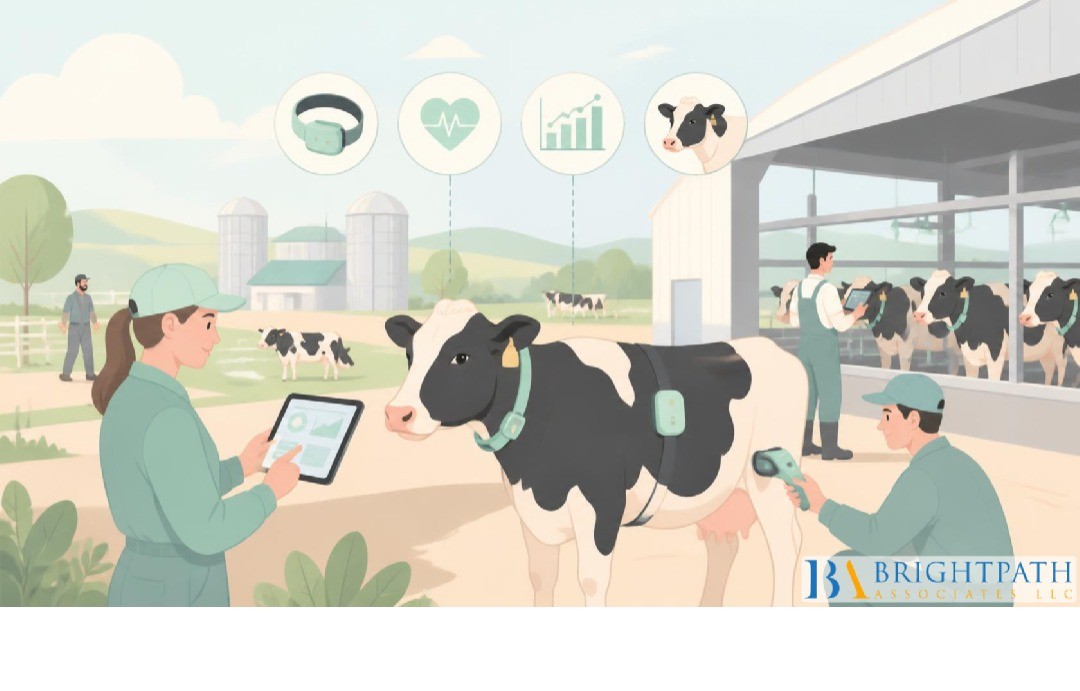
Wearable technology is creating a new opportunity. Sensors attached to dairy animals can continuously collect information about movement, activity, rumination, body temperature, feeding behavior, and other indicators. Although heat detection has been one of the most widely discussed applications, the broader opportunity is much larger.
Wearables can help dairy businesses move toward proactive herd health management by identifying behavioral changes before they become serious health events. This can potentially improve animal welfare, reduce treatment costs, support milk production, and strengthen overall farm economics.
The development of these systems is part of a wider transformation involving Milk production technologies, Dairy automation technologies, Food technology, data analytics, and Dairy industry digital transformation. For modern dairy executives, the question is increasingly not whether technology can collect information, but how effectively that information can be converted into better operational decisions.
Why Early Health Detection Matters
A dairy animal may begin experiencing a health problem before obvious physical symptoms become visible. Changes in eating behavior, movement, rumination, resting patterns, or activity can occur before producers recognize that something is wrong.
By the time a condition becomes clearly visible, treatment may be more complicated and expensive. Milk production can also decline, reproductive performance may be affected, and recovery may take longer.
Wearable sensors can provide another layer of observation.
Instead of relying solely on periodic human inspections, producers can receive continuous behavioral information. When an animal’s activity suddenly deviates from its normal pattern, the system can generate an alert for further investigation.
The technology does not diagnose every disease automatically. Its value is in helping producers identify animals that deserve attention earlier.
This shift from reaction to prevention could become one of the most important applications of precision dairy management.
Heat detection has been an important use case for animal wearables because changes in activity can indicate reproductive readiness. However, focusing exclusively on reproduction underestimates the broader capabilities of modern sensors.
The same wearable that detects unusual activity may also contribute to health monitoring.
Changes in rumination can potentially indicate digestive problems. Reduced movement may suggest lameness or illness. Changes in feeding behavior can provide another warning signal. Alterations in resting patterns may indicate discomfort or environmental stress.
The value comes from combining multiple signals rather than depending on a single measurement.
Over time, individual animals can develop behavioral baselines. The system can then identify deviations from normal patterns specific to that animal.
This personalized approach can be more informative than applying one generalized threshold across an entire herd.
Milk Production Technologies and Connected Herd Management
#MilkProductionTechnologies are increasingly moving toward integrated systems in which animal information is connected with production data.
Wearable sensors can complement milking systems, feeding systems, environmental monitoring, and farm management platforms.
When these systems communicate with each other, producers can develop a more comprehensive understanding of herd performance.
For example, a reduction in milk output may become more meaningful when combined with changes in rumination and activity. Rather than viewing the production decline in isolation, management can investigate whether an emerging health issue may be contributing to the change.
This creates a stronger decision-making environment.
The goal is not simply to collect more data. It is to connect the right data so that producers can make better decisions faster.
Dairy automation technologies are changing many aspects of farm operations, from milking and feeding to cleaning and environmental monitoring.
Wearables add another dimension by providing information directly from the animal.
As farms become larger and labor availability becomes more challenging, automated monitoring can help employees prioritize their attention.
Instead of manually observing every animal with equal frequency, staff can use technology to identify animals that require closer inspection.
This can improve labor efficiency without eliminating the importance of human expertise.
The best systems will likely combine automation with experienced farm personnel. Technology identifies patterns, while trained professionals interpret the context and determine the appropriate response.
Turning Sensor Data Into Actionable Health Insights
The greatest challenge associated with wearable technology is not collecting information. It is interpreting that information correctly.
A dairy operation can generate enormous volumes of sensor data. If employees receive too many alerts, they may begin ignoring them. If the system generates alerts that are not meaningful, confidence in the technology can decline.
Successful implementation therefore requires intelligent alert management.
Systems should distinguish between normal variation and meaningful changes. They should prioritize alerts according to potential severity and provide enough context for employees to investigate.
This is where data analytics and machine learning can become increasingly important.
Instead of simply stating that an animal’s activity has changed, future systems may be able to identify combinations of behavioral indicators associated with specific health risks.
Animal health is closely connected to sustainability.
Healthy animals generally support more efficient dairy operations. When health problems are identified early, producers may reduce treatment requirements, production losses, and unnecessary resource consumption.
Sustainable dairy farming practices therefore extend beyond environmental measures such as water conservation and energy efficiency. Animal welfare, herd longevity, feed efficiency, and responsible resource use are also important components.
Wearables can support this broader sustainability model by helping producers manage animals more proactively.
Improved health management may contribute to longer productive lifespans and more efficient use of feed and other resources.
Technology should not replace good animal husbandry. Instead, it can provide producers with additional information to strengthen it.
The Economic Case for Proactive Herd Management
The business case for wearables depends on whether the technology produces measurable operational benefits.
#DairyProducers must consider equipment costs, software subscriptions, connectivity, maintenance, employee training, and integration with existing systems.
These costs need to be compared with potential benefits.
Earlier detection of illness can potentially reduce production losses. Better reproductive management can improve herd productivity. More targeted labor allocation can reduce operational inefficiencies. Better data can also improve herd-level decision-making.
The return on investment will vary by farm size, technology platform, animal population, management practices, and local economics.
For this reason, dairy executives should evaluate wearable technology as an operational investment rather than simply a technology purchase.
Wearables are part of a much broader Dairy industry digital transformation.
Modern dairy operations are increasingly integrating sensors, automated milking systems, farm management software, cloud platforms, artificial intelligence, predictive analytics, and connected equipment.
This creates opportunities for farms to move from fragmented records toward integrated digital operations.
A manager could potentially view herd health, milk production, feed consumption, reproductive performance, equipment status, and environmental conditions through a connected platform.
Such visibility can change how decisions are made.
Instead of responding primarily to problems after they occur, management can identify emerging trends and intervene earlier.
Connecting Herd Health With Dairy Supply Chain Management
Herd health can also influence the broader supply chain.
Unexpected health problems can reduce milk availability, change production forecasts, and create downstream planning challenges.
Dairy supply chain management depends on reasonably predictable raw-material availability. If production fluctuates unexpectedly, processors and distributors may need to adjust procurement, production scheduling, inventory, and transportation.
Better herd monitoring can potentially improve forecasting by providing earlier insight into production changes.
This does not eliminate supply-chain uncertainty, but it can improve visibility.
For larger dairy organizations, connecting farm-level data with processing and distribution systems could eventually create more responsive supply networks.
Dairy e-commerce is also evolving as consumers become more interested in product origin, quality, sustainability, and transparency.
While consumers may never interact directly with herd-management technology, digital monitoring can contribute to the systems that support product quality and traceability.
Dairy businesses may increasingly use technology to demonstrate responsible production practices and provide greater transparency across their value chains.
For premium Dairy products, this can become particularly relevant.
Consumers purchasing specialized products may place greater importance on sourcing, animal welfare, sustainability, and production standards.
Technology can help companies document and communicate these practices more effectively.
Challenges of Wearable Adoption
Despite the potential, wearable technology is not without challenges.
Sensors must be durable enough to operate in demanding farm environments. Battery life, connectivity, data accuracy, device maintenance, and animal comfort all matter.
There is also the challenge of integrating wearable systems with existing farm-management platforms.
Producers should avoid creating isolated technology systems that require employees to constantly switch between platforms.
#DataPrivacy and ownership can also become important as farms generate increasing volumes of operational information.
Before investing, dairy businesses should evaluate technology reliability, vendor support, interoperability, scalability, and total cost of ownership.
Technology adoption requires capable leadership.
Dairy organizations need executives who understand both traditional agricultural operations and emerging digital technologies.
This is creating new requirements for Dairy industry executive search.
Leaders must be able to evaluate technology investments, understand production economics, manage change, develop employees, and connect farm-level innovation with broader business strategy.
The most effective leaders will not necessarily be technology specialists. They will be professionals capable of translating technology into operational value.
They must understand when automation makes sense, how data should be used, and how employees can work effectively alongside digital systems.
Executive Search Recruitment and the Future Dairy Workforce
#ExecutiveSearchRecruitment can play an increasingly important role as dairy companies build leadership teams for digital transformation.
The future dairy executive may need knowledge spanning animal production, manufacturing, supply chains, Food technology, sustainability, data, automation, and commercial strategy.
Organizations that adopt advanced technology without developing the necessary leadership capabilities may struggle to realize its full potential.
Leadership must create the organizational environment in which employees trust technology, understand its purpose, and use its information effectively.
Training is equally important. Farm workers and managers need practical knowledge of how alerts are generated, how data should be interpreted, and when human investigation is necessary.
Building Dairy Industry Growth Strategies Around Intelligence
Dairy industry growth strategies are increasingly moving toward productivity, differentiation, sustainability, and data-driven management.
Wearables can contribute to all four areas.
Better herd health can support productivity. Data-enabled management can improve efficiency. Improved animal monitoring can support sustainability goals. Connected information can strengthen operational decision-making.
However, technology should be integrated into a broader strategy.
A dairy business should first identify the problems it wants to solve and then determine whether wearable technology provides a meaningful solution.
This prevents technology adoption from becoming an exercise in collecting data without measurable business outcomes.
Conclusion
#WearableTechnology represents a significant evolution in dairy management because its value extends far beyond heat detection.
By continuously monitoring activity, rumination, movement, and other behavioral indicators, wearable systems can help producers identify potential health concerns earlier and prioritize attention more effectively.
Combined with Milk production technologies and Dairy automation technologies, these systems can contribute to a more connected and proactive dairy operation.
They can also support Sustainable dairy farming practices by improving animal health, resource efficiency, and operational decision-making.
The broader opportunity lies in Dairy industry digital transformation. As farms connect animal data with production systems, supply chains, and management platforms, the dairy business can move toward a more intelligent operating model.
Find your next leadership role in Dairy industry today!