
Introduction
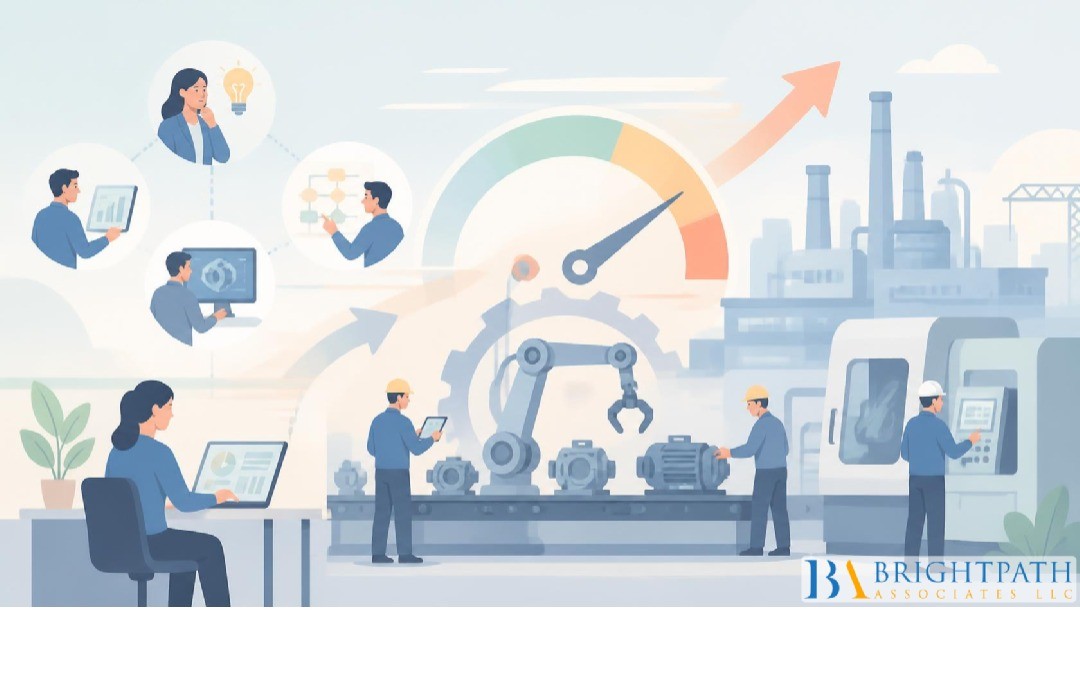
For manufacturers, speed has traditionally been associated with production capacity, delivery times, and #CustomerService. Today, another form of speed is becoming equally important: decision-making velocity. Companies that can identify changes, evaluate options, make informed decisions, and execute those decisions quickly are increasingly better positioned to compete in uncertain markets.
The importance of faster decision-making is particularly visible across the machinery sector. Industrial machinery businesses operate in environments shaped by fluctuating demand, supply-chain disruptions, technology changes, labor shortages, equipment costs, and evolving customer expectations. A delay in approving a capital investment, responding to a supplier problem, hiring a critical engineer, or adjusting production capacity can create consequences that extend throughout the organization.
For US Machinery manufacturers, decision-making velocity does not mean making rushed choices. It means developing the systems, information, processes, and leadership capabilities necessary to make high-quality decisions without unnecessary delays.
The companies gaining an advantage are increasingly those that can turn information into action faster than competitors while maintaining appropriate levels of analysis and risk control.
Why Speed Matters More in Modern Manufacturing
Manufacturing environments have become significantly more interconnected. A decision about equipment can influence production capacity, maintenance costs, workforce requirements, energy consumption, and customer delivery schedules.
A machinery manufacturer may need to decide whether to repair an existing machine, purchase Used machinery, invest in new equipment, or redesign a production process. Waiting too long can increase downtime or cause the organization to miss an opportunity.
Similarly, manufacturers considering Industrial automation solutions must evaluate technology, return on investment, workforce implications, integration requirements, and future scalability.
The challenge is that information is often distributed across multiple departments. Engineering may have one perspective, operations another, finance another, and sales another. If decision-making requires excessive coordination before action can occur, valuable time can be lost.
Decision-making velocity addresses this organizational friction.
Fast decisions are only valuable when they are based on reliable information. Manufacturing leaders therefore need access to accurate and timely operational data.
Production data can reveal equipment utilization, downtime, defect rates, throughput, energy consumption, and capacity constraints. Financial data can show capital availability, operating costs, and return expectations. Market information can provide insight into demand, pricing, and customer requirements.
Industrial automation can strengthen this information environment by generating real-time data from production equipment.
When systems are connected effectively, executives do not need to rely exclusively on delayed reports. They can see how operations are performing and respond more quickly.
However, more data does not automatically produce faster decisions. Companies need systems that present relevant information clearly and help decision-makers focus on the variables that actually influence outcomes.
Industrial Automation and Faster Operational Decisions
#IndustrialAutomationSolutions can improve decision-making velocity by connecting machines, production systems, and operational information.
Automated equipment can provide real-time information about production conditions and machine performance. Supervisory systems can help managers monitor operations across facilities. Digital dashboards can provide visibility into production performance.
This can shorten the time between identifying a problem and responding to it.
For example, if a production line begins operating below its normal performance level, automated monitoring may identify the deviation immediately. Maintenance teams can investigate before the issue develops into a major breakdown.
The result is not simply better automation. It is faster organizational response.
Machinery maintenance provides one of the clearest examples of decision-making velocity.
When a critical machine begins showing signs of failure, management may need to determine whether to continue operating, reduce production, perform immediate maintenance, or shut the equipment down.
Delaying the decision can turn a manageable maintenance issue into a major production interruption.
Modern Machinery maintenance programs increasingly use condition monitoring and operational data to support these choices.
The objective is to provide maintenance teams with enough information to prioritize interventions before equipment failure becomes unavoidable.
Faster maintenance decisions can reduce downtime, improve asset utilization, and support Manufacturing efficiency.
Precision Machining Requires Rapid Feedback
Precision machining operations depend on tight tolerances, consistent processes, and reliable equipment. Small deviations can result in material waste, rework, or rejected components.
Decision-making velocity becomes particularly important when quality problems emerge.
If production data, inspection results, and machine conditions are available quickly, engineers can identify potential causes and adjust processes sooner.
Precision machining businesses can therefore benefit from integrating production information with quality-control systems.
The faster an organization can move from identifying a deviation to implementing a corrective action, the smaller the potential impact on production.
Capital equipment decisions can often move slowly because they involve significant financial commitments.
Manufacturers may spend months evaluating whether to purchase new Industrial machinery, upgrade an existing production line, acquire Used machinery, or outsource certain operations.
Careful analysis is essential, but excessive delays can create opportunity costs.
Machinery financing can provide additional flexibility by allowing manufacturers to acquire equipment without making the entire investment upfront.
Executives should evaluate financing options alongside production requirements, expected utilization, maintenance costs, technology life cycles, and expected returns.
The objective is to create a capital decision process that is rigorous but not unnecessarily slow.
Used Machinery and Faster Capacity Expansion
Used machinery can sometimes provide manufacturers with a faster route to additional capacity. When demand increases unexpectedly, waiting for new equipment to be manufactured and delivered may not be practical.
A carefully evaluated used machine can provide additional production capability more quickly.
However, speed should not eliminate due diligence.
Companies need to consider machine condition, compatibility, maintenance history, replacement-part availability, technology integration, and expected remaining life.
The competitive advantage comes from making these assessments efficiently.
A company with a standardized equipment-evaluation process may be able to make acquisition decisions significantly faster than a competitor starting from scratch each time.
Manufacturing efficiency is usually discussed in terms of equipment utilization, labor productivity, material consumption, and production throughput.
Yet organizational decision speed can have a significant influence on all of these factors.
A highly efficient production line can still underperform if management takes too long to address recurring bottlenecks.
Likewise, a manufacturer may have excess capacity because leadership has delayed decisions about equipment upgrades, workforce expansion, or production scheduling.
#OperationalEfficiency therefore requires both technical optimization and organizational responsiveness.
The Changing Role of Manufacturing Jobs
Faster decision-making is also influencing Manufacturing jobs. As automation and digital systems become more common, employees increasingly need to interpret information and make decisions rather than simply perform repetitive tasks.
Operators may monitor automated production systems and respond to exceptions. Maintenance technicians may use equipment data to prioritize repairs. Engineers may analyze production information to optimize processes.
This does not eliminate the importance of practical manufacturing knowledge. Instead, it combines traditional expertise with digital capabilities.
Organizations that invest in employee training can create teams capable of responding more quickly to operational changes.
One of the biggest barriers to decision-making velocity is unclear authority.
If employees do not know who has the authority to approve purchases, change production schedules, modify processes, or authorize maintenance, decisions can become unnecessarily slow.
Manufacturing leaders should establish clear decision rights.
Not every decision needs executive approval. Routine operational decisions can often be delegated to managers or technical specialists within defined boundaries.
This allows senior executives to focus on decisions that have greater strategic consequences.
The goal is not centralized control. It is appropriate control at the appropriate level.
Creating a Culture That Supports Faster Decisions
Technology alone cannot create decision-making velocity. #OrganizationalCulture matters just as much.
Employees need to feel comfortable raising problems early. If workers believe that reporting problems will lead to criticism, issues may remain hidden until they become more expensive to solve.
A strong decision-making culture encourages transparency, evidence-based discussion, and rapid corrective action.
Leaders should also distinguish between intelligent risk-taking and careless decision-making.
A fast decision that is based on clear evidence and reasonable assumptions can be more valuable than a theoretically perfect decision made after an opportunity has disappeared.
The Machinery industry is experiencing rapid technological change. Customers increasingly expect manufacturers to deliver more efficient, connected, flexible, and intelligent equipment.
Companies must therefore make decisions about technology investments, product development, service models, talent, and partnerships faster than they may have in the past.
Competitors that respond more quickly to changing customer requirements can gain market share before slower organizations have completed their internal evaluations.
This does not mean abandoning strategic planning. It means creating shorter feedback loops between market information and executive action.
Strategic planning should establish not only what decisions need to be made but also how quickly they need to be made.
For example, a manufacturer may establish defined review cycles for capital investment, technology adoption, supplier risk, workforce planning, and production capacity.
This creates predictable processes while preventing decisions from remaining indefinitely in discussion.
Companies can also use scenario planning to prepare for likely situations.
If demand rises sharply, leadership should already understand how it will evaluate additional machinery, labor, financing, and production capacity.
Preparation increases decision speed when conditions change.
Leadership as the Foundation of Decision Velocity
The quality of leadership has a direct impact on organizational responsiveness.
Executives who encourage accountability, communicate clearly, and establish decision rights can help organizations move faster.
Conversely, leadership teams that require excessive approvals or avoid difficult decisions can create bottlenecks throughout the company.
This makes executive capability increasingly important across the manufacturing sector.
Leaders must be able to interpret data, understand technology, evaluate risk, communicate decisions, and align multiple departments around execution.
#ExecutiveSearchRecruitment can support manufacturers seeking leaders capable of operating in increasingly complex and fast-moving environments.
Organizations may require executives with experience in industrial technology, manufacturing operations, engineering, finance, supply chain management, digital transformation, and workforce development.
The right executive does more than manage existing operations. Strong leaders can establish decision frameworks that improve organizational responsiveness.
They can also build teams capable of making informed decisions without unnecessary escalation.
For growing machinery businesses, leadership quality can therefore become a significant component of competitive advantage.
Conclusion: Speed Is Becoming a Strategic Asset
Decision-making velocity is emerging as a competitive advantage because modern manufacturing environments reward organizations that can respond quickly without sacrificing judgment.
For US Machinery manufacturers, this means developing systems that connect operational data with executive action. Industrial automation solutions can improve visibility, Machinery maintenance can become more proactive, and Precision machining operations can respond faster to quality deviations.
Used machinery and Machinery financing can support faster capacity decisions when evaluated through disciplined processes. Manufacturing jobs are also evolving as employees increasingly combine technical expertise with digital decision-making skills.
The Machinery industry will continue to face changing customer expectations, technological disruption, labor challenges, and economic uncertainty. In this environment, organizations that wait too long to act may lose opportunities even when they possess excellent products and equipment.
The answer is not simply to make decisions faster. It is to create an organization capable of making the right decisions at the right speed.
Ultimately, the manufacturers that thrive in the coming years may not be those with the largest factories or the most sophisticated machines. They may be the companies that can see change earlier, decide with confidence, and turn decisions into action faster than their competitors.
Find your next leadership role in Machinery Industry today!
Stay informed with the latest insights on Machinery Industry!