
Introduction
#RetailSupplyChains are becoming more complex as consumers, retailers, investors, and regulators demand greater transparency about how products are produced, transported, processed, and delivered. For businesses operating across the agricultural and food sectors, sustainability is no longer limited to what happens on the farm. It extends across sourcing, processing, packaging, logistics, inventory management, and retail distribution.
This growing expectation is making supply chain visibility a strategic priority. Retail partners increasingly need reliable information about environmental performance, resource consumption, production practices, and supplier compliance. Without accurate data, sustainability claims can become difficult to verify, while organizations may struggle to identify inefficiencies or environmental risks.
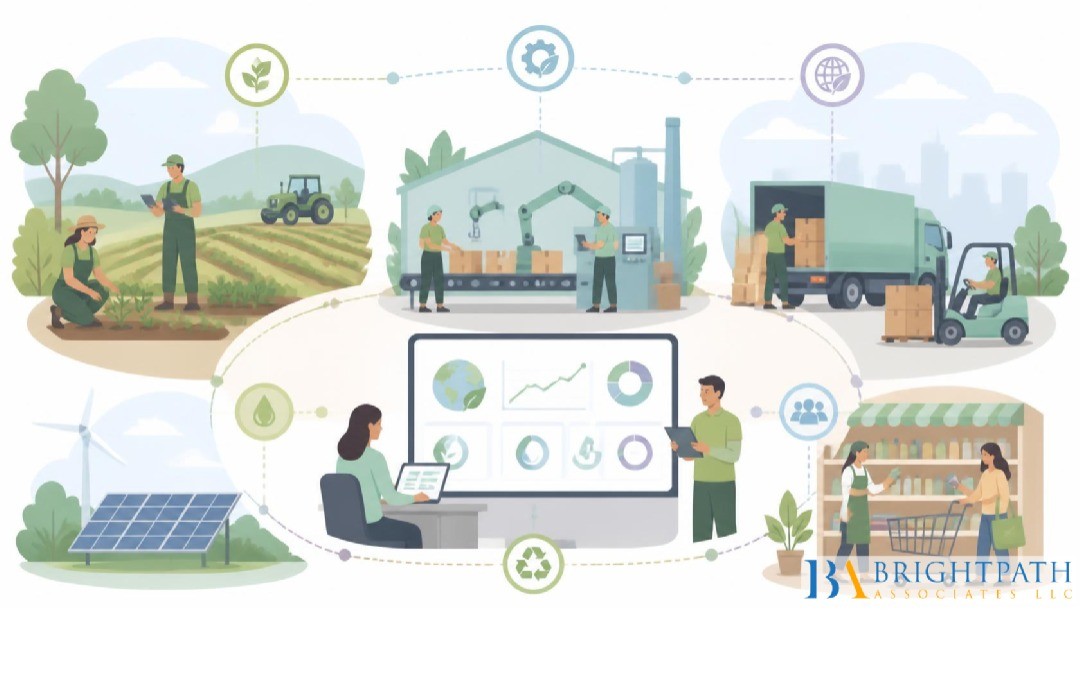
Agricultural technology is helping address this challenge by connecting farms, suppliers, processors, distributors, and retailers through digital systems. Sensors, satellite monitoring, analytics platforms, automated records, and Farm management software can provide greater insight into how agricultural products move through the supply chain.
For executives, the objective is not simply to collect more data. The goal is to establish meaningful sustainability metrics that can be consistently measured, verified, shared, and converted into better business decisions.
Building Visibility From Farm to Retail Shelf
The foundation of sustainable supply chain management begins with understanding where products originate and how they move through the system. Agricultural businesses often work with multiple farms, suppliers, processors, logistics providers, and distribution centers. Each participant may use different systems for recording production and sustainability information.
This fragmentation can make it difficult for retail partners to obtain a consistent picture of environmental performance.
Digital Farming technologies can help create a more connected information environment. Data relating to crop production, water consumption, fertilizer application, soil conditions, energy use, and harvesting can be captured closer to the source and transferred into broader supply chain systems.
The objective is to create a continuous flow of information rather than relying entirely on periodic reports.
When retail partners have better visibility, they can make more informed sourcing decisions and identify areas where suppliers may need additional support.
Sustainability Metrics That Matter to Retail Partners
Effective sustainability measurement requires organizations to focus on metrics that are relevant to both #EnvironmentalPerformance and commercial outcomes. Agricultural businesses may track water consumption, soil health, energy use, fertilizer application, pesticide use, waste generation, crop yields, and emissions.
The importance of each metric varies depending on the crop, geography, production method, and customer requirements.
For example, water efficiency may be particularly important in regions facing water scarcity, while soil health may be a central concern for businesses focused on long-term agricultural productivity.
Retail partners increasingly need information that can be compared across suppliers. Standardized measurement practices therefore become essential.
Reliable metrics can also help suppliers demonstrate improvements over time rather than simply making broad sustainability claims.
Modern Agricultural technology provides tools for capturing and analyzing sustainability information at a level that was previously difficult to achieve.
Connected sensors can monitor soil moisture, weather conditions, irrigation, and environmental factors. Satellite and remote-sensing technologies can provide information about crop conditions across large areas. Automated equipment can record field activities and input applications.
When these technologies are integrated, businesses can create a more complete picture of production.
However, technology adoption should be driven by clear objectives. Collecting large quantities of data without determining how it will be used can create unnecessary complexity.
Executives should identify which sustainability questions retail partners need answered and then build data systems around those requirements.
Precision Agriculture and Resource Efficiency
Precision agriculture can play an important role in improving sustainability metrics. Instead of applying water, fertilizers, and crop-protection products uniformly across entire fields, farmers can use data to identify differences in crop and soil conditions.
This allows inputs to be applied more selectively.
For retail partners, the benefit is not simply improved farm efficiency. Precision agriculture can generate measurable information about resource utilization.
A retailer sourcing agricultural products may be able to understand whether suppliers are reducing water consumption, improving fertilizer efficiency, or maintaining productivity while using fewer inputs.
This creates a stronger connection between farm-level innovation and retail-level sustainability objectives.
Sustainable #FarmingPractices need to be measurable if they are going to support supply chain transparency. Suppliers may implement crop rotation, soil conservation, water-efficient irrigation, integrated pest management, renewable energy systems, or other environmental practices.
Retail partners need reliable mechanisms to determine whether these practices are being implemented consistently.
Digital records can support this process by documenting farm activities and production conditions. When information is standardized, retailers can compare supplier performance more effectively.
This does not mean every supplier should be forced into exactly the same production model. Agricultural conditions vary significantly. Instead, retailers should establish clear sustainability outcomes while allowing suppliers flexibility in how they achieve them.
Organic Farming and Digital Traceability
Organic farming provides an important example of how production practices and supply chain transparency intersect. Organic products require specific production standards and documentation, making traceability particularly valuable.
Digital systems can help maintain records of inputs, field activities, harvest information, supplier details, and product movement.
For retail partners, stronger digital traceability can simplify supplier verification and reduce uncertainty around product claims.
Technology can also support Organic farming without changing its fundamental principles. Data systems can document traditional practices while providing more efficient ways to manage records and demonstrate compliance.
Agricultural innovation is increasingly shaped by the expectations of downstream customers. Retailers want suppliers that can provide reliable products while demonstrating progress on sustainability.
This is encouraging agricultural businesses to invest in technologies that improve both productivity and transparency.
Innovative solutions may include automated irrigation, sensor networks, crop monitoring, digital records, predictive analytics, robotics, and advanced Farm management software.
The strongest innovations are those that create value at multiple stages of the supply chain. A system that improves farm efficiency while also generating reliable sustainability data may provide greater value than a technology that solves only one operational problem.
Farm Management Software and Data Integration
#FarmManagement software can become an important link between farm operations and retail supply chain systems. It can centralize information about crops, inputs, field activities, inventory, labor, equipment, and production schedules.
When properly integrated, the software can provide retailers and supply chain partners with more consistent information.
The challenge is interoperability. Different farms and suppliers may use different software platforms, data formats, and reporting methods.
Executives should therefore prioritize systems that can integrate with existing technologies rather than creating additional isolated data environments.
Data quality is equally important. Inaccurate or incomplete information can undermine even the most sophisticated digital platform.
Digital Farming is moving agriculture toward more connected operational models. Instead of sustainability information being collected only at the end of a production cycle, digital systems can provide continuous information.
This can help identify emerging problems earlier.
For example, unusual weather conditions, irrigation failures, equipment problems, or changes in crop health can affect production and sustainability performance. Early visibility gives managers an opportunity to respond before these issues create larger consequences.
For retail partners, real-time or near-real-time visibility can also improve planning. Better information about crop conditions and expected production can support inventory planning and reduce supply uncertainty.
Sustainable Agriculture Investment and Business Value
Sustainable agriculture investment is increasingly being evaluated through both environmental and financial outcomes. Retailers and agricultural businesses need to understand whether sustainability initiatives create measurable long-term value.
Investment in precision irrigation, renewable energy, soil monitoring, digital platforms, or efficient machinery may require significant upfront capital.
The business case becomes stronger when these investments reduce resource consumption, improve yields, reduce waste, strengthen supplier relationships, or create access to sustainability-focused markets.
Executives should therefore avoid treating sustainability investment as an isolated expense. It should be evaluated as part of long-term supply chain resilience and commercial strategy.
Supply chain visibility can strengthen relationships when it is built around collaboration rather than surveillance.
Suppliers may resist data-sharing initiatives if they believe information will be used primarily to penalize them. Retail partners should therefore communicate clearly about how data will be used and how suppliers can benefit.
Shared sustainability goals can create stronger relationships. Retailers can provide technical support, training, #InvestmentAssistance, or longer-term purchasing commitments to suppliers that are improving their environmental performance.
This approach can transform sustainability from a compliance requirement into a strategic partnership.
Agricultural Sustainability and Risk Management
Agricultural sustainability is closely connected to supply chain risk. Environmental challenges such as water scarcity, soil degradation, extreme weather, and changing growing conditions can affect both production and retail availability.
Visibility allows businesses to identify potential vulnerabilities earlier.
If data indicates that a supplier region is experiencing declining water availability, for example, retailers can evaluate alternative sourcing options or support adaptation measures.
This creates a more proactive approach to supply chain management.
Sustainability metrics can therefore function as early-warning indicators rather than simply reporting tools.
#DigitalSustainabilitySystems require people who understand agriculture, technology, supply chains, data, and environmental management.
Agricultural organizations increasingly need employees who can interpret data and translate it into practical operational decisions. Retail organizations similarly require sustainability and supply chain professionals who understand how farm-level information affects procurement and commercial strategy.
Leadership becomes particularly important as these responsibilities increasingly overlap.
Executives must determine which technologies to adopt, how sustainability performance should be measured, how suppliers should be evaluated, and how information should be incorporated into strategic planning.
Executive Search Recruitment for Sustainable Supply Chains
#ExecutiveSearchRecruitment can help organizations identify leaders capable of managing the intersection of agriculture, technology, sustainability, and supply chain operations.
The ideal leadership profile is increasingly multidisciplinary. Senior executives may need experience in agricultural operations, digital transformation, procurement, sustainability strategy, data analytics, and retail partnerships.
Strong leaders can help organizations avoid fragmented sustainability programs by connecting farm-level initiatives with broader commercial objectives.
They can also create organizational structures that encourage collaboration between farmers, technology teams, procurement professionals, retailers, and sustainability specialists.
Conclusion: Turning Visibility Into a Competitive Advantage
Supply chain visibility is becoming an essential capability for agricultural businesses and their retail partners. Sustainability performance can no longer remain hidden within individual farms or supplier organizations. Retailers increasingly need reliable information that demonstrates how products are produced and how environmental performance is improving.
Agricultural technology, Precision agriculture, Digital Farming, and Farm management software are creating new opportunities to capture and connect this information. These technologies can improve visibility into resource use, production practices, supplier performance, and environmental outcomes.
Sustainable farming and Organic farming can benefit from digital traceability by making established practices easier to document and communicate. Agricultural innovation can also create greater value when technology simultaneously improves productivity and generates meaningful sustainability data.
For retail partners, this visibility can strengthen supplier relationships, improve sourcing decisions, reduce risk, and support more credible sustainability strategies. For agricultural producers, it can create opportunities to demonstrate performance and differentiate themselves in competitive markets.
Sustainable agriculture investment should therefore be viewed not only as an environmental responsibility but also as a long-term business strategy. Organizations that invest in measurable resource efficiency, reliable data systems, and resilient supply networks can strengthen both sustainability and commercial performance.
Ultimately, the future of agricultural supply chains will depend on the ability to connect information across the entire journey from farm to consumer. With effective Agricultural technology, disciplined sustainability metrics, collaborative supplier relationships, and capable leadership supported by Executive Search Recruitment, businesses can transform supply chain visibility from a reporting requirement into a strategic advantage.
Find your next leadership role in Farming Industry today!