
Introduction
Small and mid-sized businesses are under increasing pressure to improve productivity, control operating costs, support hybrid work, and provide employees with better #DigitalTools. At the same time, rapid advances in artificial intelligence, automation, cloud platforms, connected devices, and workplace technology are creating an expanding range of investment opportunities. For SMB leaders, the challenge is no longer whether technology should be adopted. The more important question is where technology investment will create the greatest long-term value.
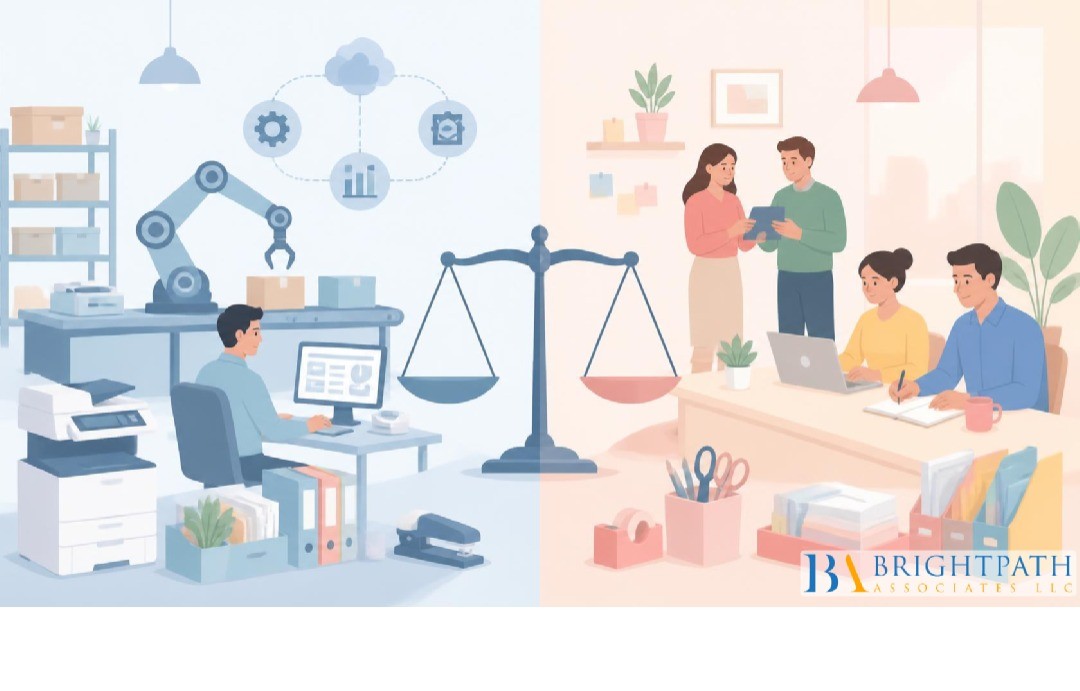
The distinction between automation and augmentation provides a useful framework for making these decisions. Automation focuses on allowing technology to perform tasks with minimal human intervention, while augmentation uses technology to help employees perform their existing responsibilities more effectively. Both approaches can generate significant benefits, but they have different implications for workforce strategy, procurement, operating costs, and organizational culture.
For companies operating within the Office supplies industry, this distinction is particularly relevant. Businesses are managing everything from traditional Business equipment and Commercial office furniture to sophisticated collaboration platforms, smart devices, cloud systems, and digitally connected workplaces. Successful technology investment requires a balance between efficiency and human capability.
Understanding Automation and Augmentation
Automation involves technology taking over repetitive, predictable, or rules-based activities. In an office environment, this can include automated invoice processing, inventory updates, scheduling, document routing, data entry, customer notifications, and procurement workflows.
Augmentation takes a different approach. Instead of removing employees from a process, technology improves their ability to complete the process. An employee might use artificial intelligence to analyze information, software to identify purchasing patterns, or collaboration technology to make decisions more quickly.
The distinction matters because not every repetitive activity should necessarily be automated. Some tasks may be relatively simple but still require judgment, communication, creativity, or relationship management. SMBs should therefore evaluate technology according to the value it creates rather than adopting automation simply because it is available.
Large corporations often have dedicated #TechnologyTeams, transformation offices, and significant budgets for experimentation. SMBs typically operate with tighter financial constraints and fewer specialized resources. A technology investment that fails to deliver measurable value can therefore have a greater impact on a smaller company’s finances.
SMBs should begin by identifying business problems rather than starting with specific technologies. If employees spend excessive time processing purchase orders, automation may be appropriate. If employees need better information to make purchasing decisions, augmentation may deliver greater value.
This approach also improves Office supply management. Technology should help organizations understand what they buy, why they buy it, how frequently products are consumed, and where unnecessary spending occurs.
Automation Opportunities in Office Supply Management
Office supply management is an area where automation can provide immediate operational benefits. Many organizations still rely on manual processes for ordering supplies, tracking inventory, approving purchases, and reconciling invoices.
Automated systems can monitor inventory levels and trigger replenishment when products reach predetermined thresholds. Purchase requests can be routed automatically to appropriate managers, while digital records can reduce the amount of manual administrative work required.
For SMBs, the value comes from reducing friction rather than eliminating employees. Employees who previously spent hours managing routine purchasing activities can redirect their time toward vendor relationships, cost analysis, budgeting, and strategic procurement.
Automation can also reduce the risk of stockouts and excessive inventory. When purchasing decisions are based on reliable consumption data, businesses can maintain better control over working capital.
Office supply vendors are also adapting to changing customer expectations. Traditional supplier relationships increasingly include digital ordering platforms, inventory visibility, subscription-based replenishment, integrated procurement systems, and data-driven purchasing recommendations.
SMBs should evaluate vendors based on their ability to support modern procurement processes rather than simply comparing product prices.
A supplier that offers reliable data integration, consistent fulfillment, transparent pricing, and useful reporting may create more value than a vendor offering slightly lower unit prices but requiring significant manual administration.
Technology can also make supplier performance easier to evaluate. Businesses can compare delivery times, product availability, order accuracy, pricing changes, and purchasing trends across vendors.
Commercial Office Furniture and the Connected Workplace
#CommercialOfficeFurniture is increasingly influenced by workplace technology. Hybrid work, flexible seating, collaborative environments, ergonomic requirements, and connected workplace systems are changing how organizations think about office design.
Technology investment should therefore be considered alongside physical workplace investment. Smart meeting rooms, occupancy sensors, connected desks, digital room-booking systems, and collaborative displays can influence how employees use physical spaces.
However, SMBs should avoid investing in technology simply because it appears sophisticated. The right solution depends on workforce size, office usage, employee needs, and long-term workplace strategy.
A smaller company may benefit more from flexible furniture and reliable collaboration tools than from an expensive smart-office infrastructure.
Current Office technology trends demonstrate that workplace technology is moving toward greater integration. Artificial intelligence, cloud computing, collaboration platforms, cybersecurity tools, workflow automation, and connected devices are increasingly becoming part of everyday office operations.
SMBs should distinguish between technologies that solve genuine business problems and those that create unnecessary complexity.
Artificial intelligence can support research, writing, data analysis, customer service, scheduling, and knowledge management. Automation can reduce repetitive administrative work. Collaboration tools can improve communication between distributed teams.
The strongest investments are usually those that integrate naturally into existing workflows. Technology that requires employees to constantly switch between disconnected applications can reduce productivity rather than improve it.
Digital Transformation in the Office
Digital transformation in office environments involves more than replacing paper documents with digital files. It requires redesigning processes so that information can move efficiently across departments.
For example, procurement can connect with finance, inventory management, supplier systems, and employee purchasing requests. This creates a more complete view of spending and enables management to identify inefficiencies.
Digital transformation can also improve workplace visibility. Organizations can understand office-space utilization, equipment performance, supply consumption, and employee technology requirements more effectively.
For SMBs, transformation should be incremental. A company does not need to digitize every process simultaneously. It can begin with high-volume activities that create measurable administrative burdens and expand from there.
#OfficeEquipment maintenance is another area where technology can create measurable value. Printers, scanners, networking equipment, meeting-room technology, HVAC systems, and other workplace assets require regular maintenance to remain reliable.
Traditional maintenance approaches often rely on fixed schedules or employee reports. Connected systems can provide more information about equipment performance and usage.
In larger environments, predictive maintenance technologies can identify potential problems before equipment fails. For SMBs, even basic digital maintenance tracking can improve asset visibility and prevent forgotten service requirements.
The financial benefit can be significant because equipment downtime often creates hidden productivity costs. An employee unable to access a critical device may lose far more time than the direct cost of repairing the equipment.
Procurement as a Strategic Function
Procurement should not be treated simply as an administrative purchasing activity. For SMBs, effective Procurement can influence operating costs, supplier resilience, employee productivity, sustainability, and cash flow.
Technology can help procurement teams consolidate spending information, compare suppliers, automate approvals, and identify opportunities for standardization.
Automation is particularly useful for repetitive purchasing processes, while augmentation is valuable when procurement professionals need to evaluate suppliers, negotiate contracts, or make strategic decisions.
The human element remains critical. A software system can identify a lower-cost supplier, but an experienced procurement professional may recognize risks involving quality, reliability, lead times, or customer service.
The decision between automation and augmentation should be based on the nature of the task. Highly repetitive activities with clear rules are strong candidates for automation. Activities involving judgment, creativity, negotiation, customer relationships, and strategic thinking are generally better suited to augmentation.
This does not mean that augmentation is always preferable. Automation can produce significant benefits when implemented in appropriate areas.
SMBs should consider the potential impact on employees, customers, data security, operational resilience, and business continuity before automating important processes.
A useful principle is to automate repetitive work while augmenting human judgment. This allows technology to handle administrative complexity while employees remain responsible for decisions that require context and expertise.
Managing Technology Costs and Return on Investment
#TechnologyInvestment should always be connected to measurable business outcomes. SMBs should evaluate not only the purchase price but also implementation costs, training, integration, maintenance, cybersecurity, upgrades, and employee adoption.
A low-cost technology solution that employees do not use can be more expensive than a higher-quality platform that significantly improves productivity.
Return on investment should also include less visible benefits. Faster purchasing, fewer errors, reduced equipment downtime, improved employee experience, and better supplier management can create substantial value even when they do not immediately appear as direct revenue.
Technology decisions should therefore consider total business impact rather than simple acquisition cost.
Employees may view automation as a threat when organizations communicate poorly about technology investment. Leaders should clearly explain the purpose of automation and how it will affect responsibilities.
The objective should be to eliminate unnecessary work rather than eliminate valuable human capabilities. Employees can often be moved toward higher-value activities when repetitive processes are automated.
Training is essential. Workers need to understand how new systems operate and how technology changes their roles. This is particularly important when artificial intelligence or advanced automation is introduced.
A successful technology strategy should therefore combine software investment with workforce development.
Talent Acquisition Strategies for a Technology-Driven Office
Technology transformation is increasing the demand for employees who understand both business operations and digital tools. SMBs need professionals capable of managing technology adoption, analyzing data, coordinating vendors, and leading process improvements.
Talent acquisition strategies should therefore consider digital skills alongside traditional job requirements. Companies may need employees with expertise in procurement technology, workplace systems, data analytics, cybersecurity, automation, or digital transformation.
However, SMBs do not necessarily need to hire a large technology department. They can combine internal talent with external specialists, technology vendors, consultants, and training programs.
The goal should be to build sufficient internal capability to manage technology strategically.
Technology investments require leadership that understands both business priorities and organizational change. Executives must determine where automation creates value, where human judgment should remain central, and how technology affects the workforce.
#ExecutiveSearchRecruitment can help SMBs identify leaders with experience in operations, procurement, technology transformation, workplace strategy, and organizational development.
Strong leadership can prevent technology initiatives from becoming disconnected projects. Instead, technology can be integrated into broader business objectives involving productivity, cost management, employee experience, and growth.
Creating a Future-Ready Office Technology Strategy
A future-ready SMB should treat office technology as an evolving ecosystem rather than a collection of individual products. Business equipment, software, furniture, procurement systems, communication tools, and maintenance processes should work together where practical.
Organizations should periodically review their technology portfolio and identify systems that are underused, duplicated, outdated, or difficult to maintain.
At the same time, management should avoid constant technology changes that create employee fatigue. Stability is valuable. Technology should be upgraded when it creates meaningful improvements rather than simply because a newer product exists.
Conclusion
The debate between automation and augmentation should not be viewed as a choice between technology and people. The most successful SMB technology strategies will combine both.
The Office supplies industry is evolving from a traditional product-focused model toward a more integrated workplace ecosystem. Business equipment, Commercial office furniture, Office supply vendors, and Office technology are increasingly connected through digital systems.
Office supply management, Procurement, and Office equipment maintenance can benefit from automation, while strategic decision-making, supplier relationships, workplace planning, and problem-solving can be strengthened through augmentation.
The continuing development of Office technology trends and Digital transformation in office environments means SMB leaders will need to make increasingly deliberate investment decisions. The goal should not be to automate as much as possible. It should be to use technology where it creates measurable value while preserving and strengthening the human capabilities that differentiate the organization.
Find your next leadership role in Business Supplies & Equipment Industry today!
Stay informed with the latest insights on Business Supplies & Equipment Industry!