
Introduction
The #PaperDistributionIndustry is undergoing a significant transformation as customers increasingly expect faster delivery, greater product availability, accurate order fulfillment, and more flexible purchasing options. Regional distributors operate in a particularly demanding environment because they must balance large product portfolios, geographically dispersed customers, transportation costs, inventory requirements, and changing market conditions.
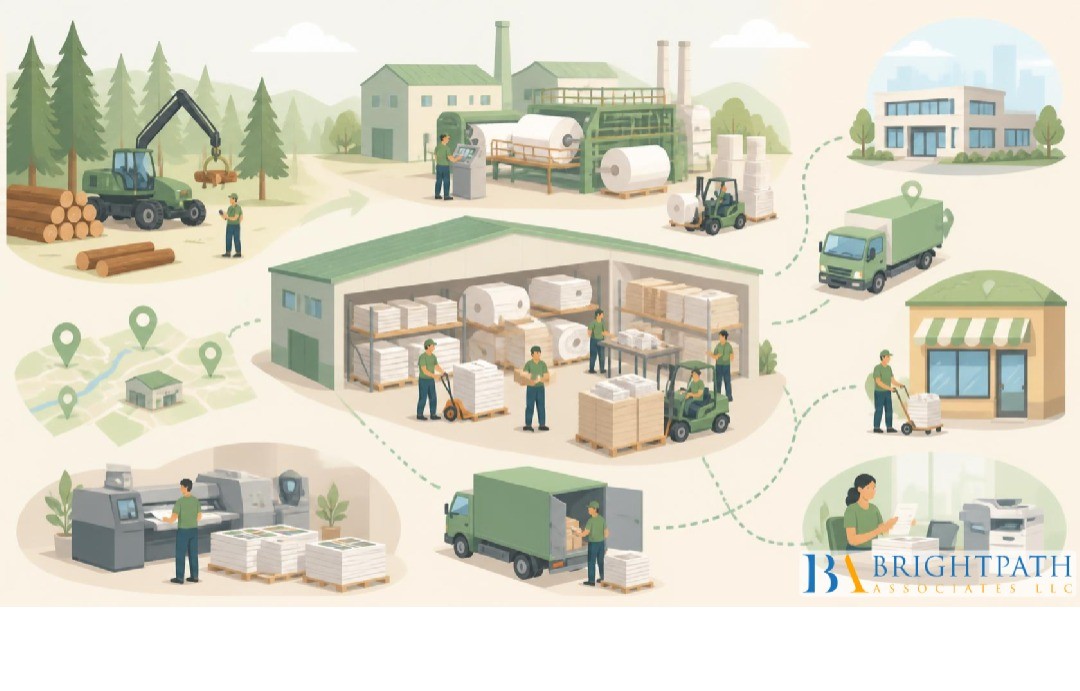
Micro-fulfillment offers a potential solution to these challenges. By positioning smaller, strategically located fulfillment operations closer to customers, paper distributors can shorten delivery distances, improve responsiveness, and create more flexible inventory networks. Instead of depending entirely on one large distribution center, businesses can develop regional fulfillment capabilities that support faster and more efficient order processing.
This model is becoming increasingly relevant as the paper industry responds to changing customer expectations, sustainability requirements, digital commerce, and technological innovation. Effective micro-fulfillment can connect distribution strategy with broader developments across Forest product innovation, Paper and pulp technology, recycling, automation, and supply-chain management.
Understanding Micro-Fulfillment in the Paper Distribution Sector
Micro-fulfillment refers to the use of smaller distribution facilities located close to major customer markets. These facilities can operate independently or as extensions of larger regional warehouses. Their purpose is to improve the speed and efficiency of order processing by reducing the distance between inventory and customers.
For paper distributors, micro-fulfillment can be particularly useful because customer requirements often vary by geography and industry. Commercial printers, packaging companies, publishers, educational institutions, offices, retailers, and manufacturers may require different combinations of paper products and related materials.
A centralized warehouse can provide economies of scale, but it may also create longer delivery routes and higher transportation expenses. A distributed fulfillment model can bring selected high-demand products closer to customers while maintaining centralized storage for slower-moving or specialized inventory.
The objective is not simply to build more warehouses. The objective is to create an intelligent network in which inventory is positioned according to demand patterns, product characteristics, customer requirements, and transportation economics.
Using Demand Data to Design Regional Fulfillment Networks
Successful micro-fulfillment begins with accurate demand analysis. #PaperDistributors need to understand which products customers purchase most frequently, where those customers are located, how often orders are placed, and how quickly deliveries are expected.
Historical sales data can help identify geographic demand clusters. Businesses can also evaluate seasonal patterns, customer industries, order sizes, and delivery frequency.
This information can determine where micro-fulfillment facilities should be located and which products should be stored at each location. High-volume products with predictable demand are often strong candidates for regional inventory. Specialized products with low demand may remain centralized.
Data-driven inventory allocation can also reduce unnecessary duplication. If every fulfillment center carries the entire product portfolio, inventory investment can increase significantly. A more strategic approach is to establish differentiated inventory roles across the network.
Forest product innovation is influencing the types of products paper distributors must manage. Advances in paper manufacturing, packaging materials, fiber technology, coatings, and engineered wood products are creating new categories and applications.
Customers increasingly seek products that provide specific performance characteristics while meeting environmental expectations. Distributors must therefore maintain sufficient flexibility to introduce new products without allowing slow-moving inventory to accumulate.
Micro-fulfillment can support product innovation by allowing distributors to test demand regionally. New products can be introduced in selected markets before being distributed across the entire network. Sales data from these locations can provide insight into customer acceptance and purchasing behavior.
This approach can reduce the risk associated with introducing unfamiliar products while allowing distributors to respond more quickly to emerging market opportunities.
Paper Recycling Solutions and Circular Supply Chains
Sustainability is becoming an increasingly important consideration throughout the paper supply chain. Paper recycling solutions can help distributors participate in circular material systems while reducing waste and supporting customer sustainability objectives.
Regional fulfillment facilities can contribute to these efforts by establishing more efficient collection, sorting, storage, and return processes. Used paper products, packaging materials, and other recyclable fiber streams can potentially be consolidated locally before being transported to appropriate recycling facilities.
Reverse logistics can also be integrated into micro-fulfillment operations. Delivery vehicles returning from customer locations may be used to transport recyclable materials or reusable packaging where operationally practical.
This approach can create additional value from existing transportation capacity while strengthening the distributor’s sustainability proposition.
Advances in Paper and #PulpTechnology are changing production processes and product characteristics across the industry. Modern manufacturing systems can improve quality, efficiency, resource utilization, and product consistency.
Distributors need to understand these developments because changes in manufacturing can affect product specifications, packaging, availability, and purchasing patterns.
Digital technologies can also connect manufacturers and distributors more effectively. Improved information sharing can provide better visibility into production schedules, inventory availability, and potential supply disruptions.
For regional distributors, this visibility is essential. Micro-fulfillment networks require accurate information about inventory levels and replenishment requirements. Without reliable data, decentralized facilities can experience either stockouts or excessive inventory.
Timber Harvesting and Upstream Supply Considerations
Although paper distribution operates downstream from primary forestry activities, developments in Timber harvesting can influence product availability and pricing. Changes in forest management, weather conditions, transportation infrastructure, and environmental requirements can affect fiber supply.
Distributors should monitor upstream market conditions because supply disruptions can move through the value chain and eventually affect product availability.
Understanding the relationship between forestry, pulp production, paper manufacturing, and distribution allows companies to develop more realistic inventory strategies. Regional fulfillment should therefore be integrated with broader supply-chain risk management.
Lumber industry trends can also influence the broader forest-products ecosystem. Changes in construction activity, housing demand, production capacity, transportation costs, and international trade can affect demand for wood fiber and manufacturing resources.
While paper and lumber are distinct product categories, they share aspects of the broader forest-products economy. Changes in one segment can sometimes influence raw-material availability and pricing conditions in another.
Regional paper distributors can benefit from monitoring these market signals when developing procurement and inventory strategies. Broader industry intelligence can help organizations anticipate potential changes rather than responding only after prices or supply conditions have shifted.
Forestry Regulations and Distribution Planning
#ForestryRegulations increasingly influence how forest-based products are sourced, manufactured, transported, and marketed. Customers and regulators may require greater transparency regarding the origin and sustainability of materials.
For distributors, this means that product traceability and documentation are becoming more important. Inventory systems should be capable of maintaining appropriate information about product sources, certifications, specifications, and movement.
Micro-fulfillment facilities must also comply with relevant warehouse, environmental, safety, transportation, and operational requirements. Regional expansion should therefore include regulatory assessment as part of facility planning.
Strong compliance processes can reduce risk while supporting customer confidence in sustainably sourced products.
Paper Industry Economics and the Case for Micro-Fulfillment
Paper industry economics are shaped by raw-material costs, energy prices, transportation expenses, production capacity, customer demand, and inventory levels. Distribution costs can represent a significant portion of the final cost of serving customers, particularly when products are bulky or require specialized handling.
Micro-fulfillment can potentially improve economics by reducing delivery distances and increasing delivery density. When a regional facility serves a concentrated customer base, transportation routes can become more efficient.
However, the model also introduces additional facility, labor, technology, and inventory expenses. The economic case must therefore be evaluated carefully.
Distributors should compare the total cost of centralized and decentralized models, considering transportation, labor, warehouse operations, inventory carrying costs, service levels, and customer retention.
Wood product manufacturing is another important part of the broader forest-products market. Companies involved in wood-based products may share logistics infrastructure, supplier relationships, and customer networks with paper distributors.
Diversification can create opportunities for distributors that have the capabilities to manage multiple forest-based product categories. However, expanding product portfolios can also increase inventory complexity.
Micro-fulfillment can help manage this complexity by assigning different product categories to specific facilities according to local demand. High-volume paper products can be positioned close to major customers, while specialized wood-based products may remain at centralized locations.
This network-based approach allows businesses to expand product offerings without automatically replicating the entire inventory portfolio at every location.
Automation in the Paper Industry and Distribution Operations
Automation in Paper industry operations is becoming increasingly important as companies seek greater productivity and consistency. Although automation is often associated with manufacturing, its principles can also be applied to distribution.
Automated storage and retrieval systems, warehouse management software, barcode scanning, robotic handling systems, conveyor technologies, and automated order processing can improve fulfillment accuracy and speed.
For paper distributors, automation can be particularly valuable because paper products can be heavy, bulky, and difficult to handle manually at high volumes. Appropriate material-handling systems can reduce physical strain while improving warehouse productivity.
The level of automation should match the facility’s volume and #OperationalRequirements. Not every micro-fulfillment center needs advanced robotics. In many cases, a combination of warehouse software, scanning systems, optimized layouts, and selective automation can deliver substantial improvements.
Sustainable Materials and Customer Expectations
Demand for Sustainable materials continues to influence purchasing decisions across many industries. Customers increasingly want paper products with responsible sourcing credentials, recycled content, lower environmental impact, and transparent supply chains.
Distributors can use micro-fulfillment to support regional sustainability initiatives by stocking products based on local demand for sustainable alternatives.
Local availability can also reduce delivery distances and improve service efficiency. However, sustainability claims must be supported by appropriate documentation and credible sourcing information.
The most effective strategy combines sustainable products with efficient operations. A distributor should aim to reduce waste and unnecessary transportation while giving customers access to products that align with their environmental objectives.
Technology and infrastructure alone cannot create a successful micro-fulfillment network. Skilled professionals are needed to manage inventory, transportation, procurement, customer relationships, technology, warehouse operations, and strategic planning.
As distribution becomes more technology-driven, companies require leaders who understand both traditional paper markets and modern supply-chain systems. They must be capable of analyzing data, managing change, optimizing operations, and coordinating teams across multiple locations.
#ExecutiveSearchRecruitment can support regional distributors seeking experienced leaders with expertise in supply-chain transformation, logistics, forest products, procurement, warehouse operations, and digital technologies.
Leadership is particularly important when transitioning from a centralized distribution model to a network-based structure. Executives must establish clear operating standards while allowing regional facilities enough flexibility to respond to local market conditions.
A successful micro-fulfillment strategy should combine customer proximity with centralized control. Regional facilities should have clear roles within the broader distribution network and should be supported by accurate inventory data, standardized processes, effective transportation planning, and reliable supplier relationships.
Technology should provide visibility across all locations. Managers should be able to understand inventory levels, demand patterns, order status, and replenishment requirements in real time or near real time.
The network should also remain flexible. Customer demand can change, new products can emerge, and market conditions can shift. Facilities that can adapt their inventory profiles and operating models will be better positioned to respond.
Conclusion: Turning Distribution Proximity Into Competitive Advantage
Micro-fulfillment represents a significant opportunity for regional paper distributors seeking to improve service levels, reduce transportation inefficiencies, and respond more effectively to changing customer expectations. The strategy becomes especially powerful when combined with modern technology, data-driven inventory management, sustainability initiatives, and strong supply-chain planning.
Developments in #ForestProductInnovation, Paper and pulp technology, Paper recycling solutions, Timber harvesting, and Lumber industry trends are reshaping the wider forest-products ecosystem. At the same time, Forestry regulations, Paper industry economics, Wood product manufacturing, and demand for Sustainable materials are influencing how distributors manage products and relationships.
Automation in Paper industry operations and digital warehouse technologies can further improve fulfillment efficiency, while strategic leadership remains essential to managing increasingly complex distribution networks. Executive Search Recruitment can help organizations develop the leadership capabilities required to guide this transformation.
Ultimately, micro-fulfillment is not simply about placing warehouses closer to customers. It is about creating a smarter distribution ecosystem in which inventory, technology, transportation, sustainability, and talent work together. Regional paper distributors that successfully integrate these capabilities can improve responsiveness, strengthen customer relationships, control costs, and create a more resilient foundation for long-term growth.