
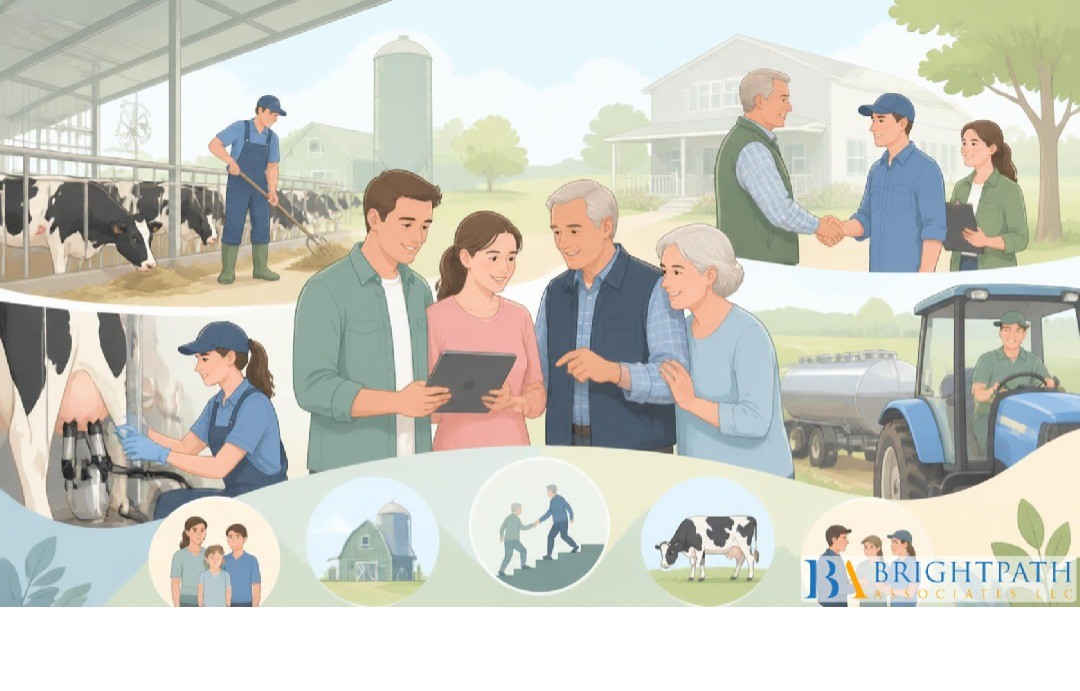
Family-owned dairy businesses have long played an important role in the agricultural and food economy. Many began as small farms built around a few generations, a local customer base, and a strong commitment to producing quality milk. Over time, some have expanded into processing, distribution, branded #DairyProducts, retail, and direct-to-consumer channels.
Yet growth can create a difficult question: how does a family business successfully move from one generation to the next without losing the values and relationships that made it successful?
Succession is more than transferring ownership. It involves leadership, governance, financial planning, operational continuity, technology adoption, workforce development, and a clear understanding of where the business needs to go next. Successful transitions demonstrate that family ownership can remain a competitive advantage when succession is treated as a strategic business process rather than an event that happens when the current leader retires.
Why Dairy Family Businesses Face a Unique Succession Challenge
Dairy businesses operate in an environment where agricultural production and commercial management are closely connected. A family may own the farm, manage livestock, operate processing facilities, oversee sales, and make long-term investment decisions.
This creates strong commitment, but it can also create overlapping roles.
A family member may simultaneously be an owner, employee, manager, and relative of other employees. During periods of growth or disagreement, these relationships can make business decisions more complicated.
The next generation may also have different ideas about technology, financing, sustainability, marketing, and expansion.
A successful transition therefore requires the family to separate personal relationships from business responsibilities while preserving the trust that makes family ownership valuable.
Starting Succession Planning Before It Becomes Urgent
One of the most important lessons from successful family-business transitions is that succession planning should begin well before leadership actually changes.
Waiting until an owner is ready to retire can create unnecessary pressure. A sudden transition may leave the next generation without sufficient management experience or leave employees uncertain about the company’s future.
Early planning gives potential successors time to learn different aspects of the operation.
They can become familiar with milk production, financial management, supply relationships, regulatory requirements, customer relationships, and #WorkforcManagement. This creates a more gradual transition from operational responsibility to strategic leadership.
A structured timeline can also make expectations clearer for family members.
Family ownership does not automatically mean that every family member is prepared to lead.
Successful dairy businesses often distinguish between family membership and leadership capability. The next generation needs opportunities to develop relevant skills and demonstrate that they can make sound business decisions.
Modern dairy operations increasingly require knowledge that extends beyond traditional farming.
Understanding Milk production technologies, financial management, data analysis, marketing, supply-chain management, and food processing can become critical for future leaders.
A successor who understands both agricultural operations and commercial strategy may be better positioned to guide the business through changing market conditions.
Technology Is Changing Dairy Leadership
Technology is transforming dairy production.
Modern #DairyAutomationTechnologies can assist with feeding, milking, herd monitoring, environmental control, data collection, and facility management. These technologies can improve consistency and provide management with more detailed information about operations.
For the next generation, understanding technology is becoming increasingly important.
A successor does not necessarily need to become an engineer, but they need to understand what technology can accomplish and how investments should be evaluated.
The key question should not simply be whether a new system is technologically advanced. Leaders need to determine whether it improves productivity, animal welfare, labor efficiency, product quality, cost management, or long-term competitiveness.
One of the most important changes during a successful family-business transition is often the development of professional management practices.
As a dairy business grows, informal decision-making may become less effective. Clear responsibilities, financial reporting, performance metrics, operating procedures, and accountability become increasingly important.
Professionalization does not mean removing the family from the business.
Instead, it creates a structure where family members can focus on ownership and strategic leadership while qualified employees manage specialized functions.
This distinction can help reduce conflict and ensure that important decisions are based on business performance rather than family dynamics alone.
Food Technology and the Evolution of Dairy Businesses
Dairy businesses that expand beyond primary milk production face another layer of complexity.
Food technology has opened opportunities for companies to develop new products, improve shelf life, enhance processing efficiency, and respond to changing consumer preferences.
The next generation may therefore inherit a business that looks very different from the one established by previous generations.
A family dairy that once focused exclusively on milk may eventually produce yogurt, cheese, butter, nutritional products, or other value-added offerings.
This diversification can create growth opportunities, but it requires new expertise in processing, quality assurance, packaging, marketing, regulatory compliance, and distribution.
Succession planning should account for these future capabilities.
Sustainability has become increasingly important to consumers, retailers, investors, and agricultural stakeholders.
Sustainable dairy farming practices can include improvements in feed efficiency, water management, manure management, energy use, animal welfare, land stewardship, and emissions reduction.
For many family-owned businesses, sustainability also has a deeper significance.
A family may view the farm or dairy operation as an asset that should remain productive for future generations. Investments that protect soil, water, animals, and resources can therefore align with long-term family objectives.
The next generation can play an important role by evaluating sustainability not merely as a compliance requirement but as part of business resilience.
Creating a Long-Term Dairy Industry Growth Strategy
Succession should be connected to the broader direction of the business.
A family may decide that the next stage of growth should involve expanding production. Another may focus on premium products, geographic expansion, technology, or direct-to-consumer sales.
Developing Dairy industry growth strategies requires an honest assessment of the company’s strengths and limitations.
Management needs to understand production economics, customer demand, competitive pressures, available capital, workforce capacity, and supply-chain risks.
The next generation should have a voice in this process, but strategic decisions should be supported by data and professional analysis.
Modern dairy businesses depend on complex networks involving farmers, feed suppliers, processors, packaging companies, distributors, retailers, and customers.
Effective dairy #SupplyChainManagement is therefore becoming increasingly important.
Family businesses transitioning to the next generation may need to reassess supplier relationships, inventory management, transportation, processing capacity, and distribution strategies.
Digital systems can provide greater visibility across these activities.
A new generation of leaders may also be more comfortable using analytics to understand supply-chain performance, helping the business respond faster to disruptions or changing customer demand.
Digital Commerce Is Opening New Opportunities
The growth of online purchasing is changing how food businesses interact with consumers.
Dairy e-commerce can create opportunities for direct-to-consumer sales, subscription models, specialty products, regional brands, and customer engagement.
For family-owned dairy businesses, digital channels can potentially reduce dependence on traditional distribution models and provide valuable information about customer preferences.
However, e-commerce requires capabilities that may not have existed in earlier generations, including digital marketing, fulfillment, packaging, customer service, data management, and online payment systems.
The next generation may therefore bring valuable digital skills into the family enterprise.
Digital Transformation Requires More Than New Software
Dairy industry #DigitalTransformation is not simply about purchasing new technology.
It involves changing how the organization collects information, makes decisions, communicates, and manages operations.
A dairy business may introduce sensors, automated equipment, cloud software, analytics, and digital customer platforms. But these technologies only create value when employees understand how to use them.
Successful family-business transitions often involve younger leaders introducing new technology while experienced family members contribute operational knowledge accumulated over decades.
This combination can be powerful.
The older generation understands the business’s history, customers, suppliers, and risks. The next generation may bring new perspectives on technology, consumer behavior, and market development.
One of the greatest challenges in succession is finding the right balance between preserving tradition and embracing change.
Family businesses often have deeply established ways of working. These traditions can be valuable because they reflect experience and institutional knowledge.
But not every historical practice remains appropriate as the market evolves.
Successful successors learn to distinguish between the company’s core values and its operating methods.
Quality, integrity, customer relationships, and commitment to employees may remain constant. Production methods, technology, marketing channels, organizational structures, and growth strategies can change.
This distinction allows the company to evolve without losing its identity.
The Importance of External Expertise
Family businesses can benefit from outside perspectives during succession.
Accountants, attorneys, financial advisers, agricultural consultants, technology specialists, and industry professionals can provide expertise that family members may not possess.
Independent advisers can also help facilitate difficult conversations about ownership, responsibilities, compensation, and strategic direction.
In some cases, the business may need executives from outside the family.
A professional operations leader, finance executive, technology leader, or commercial executive can bring specialized expertise while allowing family owners to retain strategic control.
This is where Dairy industry executive search becomes increasingly relevant.
Finding leaders who understand both the technical realities of dairy and the commercial demands of a modern food business can be difficult. Specialized #ExecutiveSearchRecruitment can help family-owned companies identify experienced leadership talent when the required capabilities are not available within the family.
Preparing Employees for the Transition
Succession does not affect only family members.
Employees want to know whether the company’s leadership, culture, compensation, and strategic priorities will remain stable.
Communication is therefore essential.
Employees should understand how responsibilities will change and who will make important decisions. Managers should be given opportunities to develop alongside the incoming leadership team.
A well-managed transition can strengthen employee confidence rather than create uncertainty.
The next generation should also recognize that experienced employees possess valuable institutional knowledge. Retaining these individuals can help preserve operational continuity during the transition.
A successful transition should ultimately be measured by business performance rather than simply by whether ownership changed hands.
Indicators may include financial stability, employee retention, customer relationships, production efficiency, technology adoption, product innovation, and sustainable growth.
The strongest family businesses treat succession as an ongoing leadership-development process.
The transition does not truly end when the next generation assumes formal control. The new leaders must continue developing their capabilities and adapting the organization to changing market conditions.
Conclusion: Turning Succession Into a Growth Opportunity
Successful dairy family-business transitions demonstrate that succession can be much more than a transfer of ownership. It can become an opportunity to modernize operations, introduce new technology, strengthen management systems, diversify products, improve sustainability, and develop a stronger long-term growth strategy.
The most resilient family-owned dairy businesses recognize that preserving the past and preparing for the future are not competing objectives.
Experience provides the foundation. Innovation provides the pathway forward.
As #DairyProducts markets evolve and technology reshapes production, processing, distribution, and customer relationships, the next generation will need to combine agricultural knowledge with modern business leadership.
Find your next leadership role in Dairy industry today!