
Introduction
#TextileWaste has become a board-level issue for manufacturers, brands, and distributors because it now sits at the intersection of margin pressure, customer requirements, and tightening expectations across the textile supply chain. The good news is that you do not need a large capex program to begin; you need repeatable operational routines that make waste visible, measurable, and economically actionable.
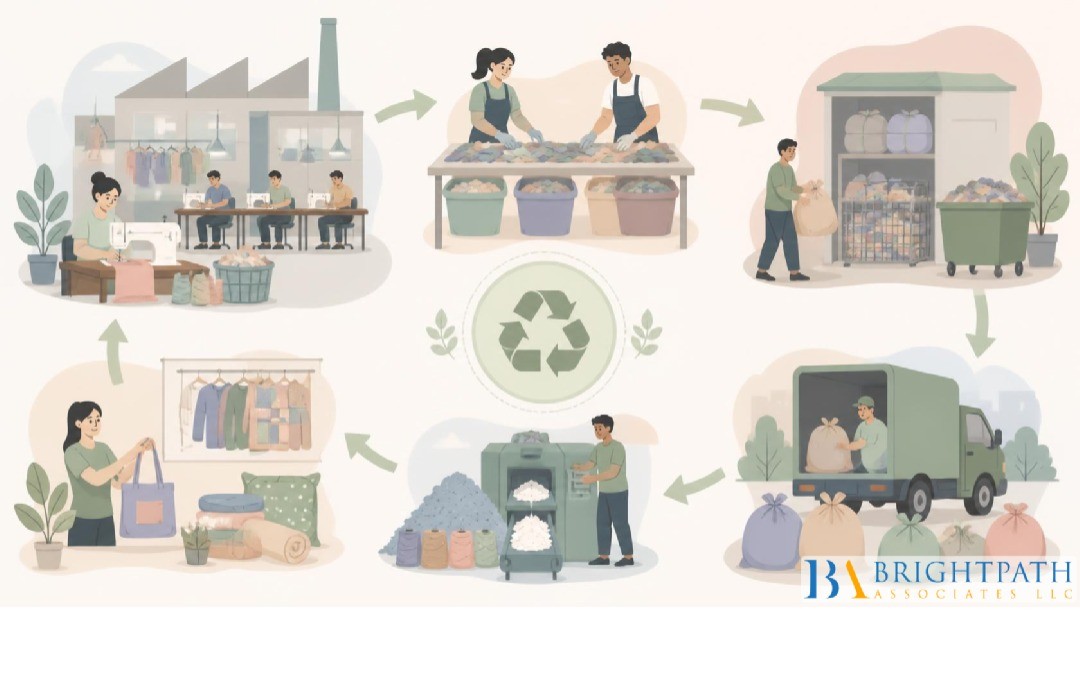
This article lays out low-cost, industrial steps to start textile waste management with discipline: how to run a practical waste audit, how to sort and stabilize materials, where reuse and repair deliver fast payback, how to approach recycling without greenwashing, and how to build the data foundation for textile industry closed-loop systems. Along the way, we connect the work to textile industry investment trends, advanced textile manufacturing technologies, and the emerging role of textile industry data analytics, textile industry blockchain applications, and cognitive automation in textile logistics.
Why textile waste management is now a business system, not a side project
In many organizations, waste has historically been treated as a housekeeping KPI or a sustainability narrative. That framing breaks down when you model the true cost stack: lost fiber value, disposal and hauling fees, rework labor, quality holds, excess inventory, and the commercial impact of failing customer audits. Textile waste management is best run like a production system with clear inputs, controls, and outputs, because the drivers live inside manufacturing and logistics rather than inside a slide deck.
The operational reality is that waste is generated across the full textile supply chain, from fiber preparation to spinning, weaving or knitting, dyeing and finishing, cutting rooms, and distribution centers. A low-cost program starts by selecting a narrow boundary you can control, proving results quickly, and then expanding. This staged approach aligns with textile business strategic planning because it produces decision-grade data without waiting for perfect infrastructure.
Start with a waste audit that produces actionable categories
A textile waste audit should answer one question: what are the top material streams by mass and by cost, and where are they created. Many audits fail because they are too general, mixing dust, sweepings, offcuts, rolls, and rejected goods into a single “scrap” bucket. That hides the difference between high-value clean waste that can be reprocessed and low-value mixed waste that requires stabilization before it can move anywhere.
Keep the first audit operationally simple but methodologically strict. Use a short time window that captures normal variability, then measure waste at points of generation rather than at the dumpster. If you only measure what leaves the site, you lose the context needed to prevent the waste. The goal is to connect each waste stream to a process step, a product family, a shift pattern, and a reason code that production teams recognize, such as changeovers, shade variation, end-of-roll, loom stops, cutting optimization losses, or damage in handling.
A good audit creates a baseline you can use for continuous improvement and #CommercialNegotiation. It captures the material type, contamination risk, typical size or format, and the “next best use” potential, which ranges from immediate internal reuse to external recycling. It also captures who controls the lever, because some waste is created by specification, some by process discipline, and some by upstream variability from suppliers. When you can point to the true drivers, executive leadership in textiles can support interventions that actually change the system, rather than funding symbolic initiatives.
Sorting and handling: the lowest-cost lever with the fastest payoff
Sorting is not glamorous, but it is where economics are won or lost. Clean, consistent textile waste streams keep options open; mixed, wet, or contaminated streams collapse into disposal. The lowest-cost move is to redesign handling so material stays identifiable from the moment it is created. That means separating by fiber type when known, isolating elastane blends, keeping colored and undyed streams apart when shade matters, and protecting high-value offcuts from moisture and floor contamination. These changes are often more about layout and standard work than new equipment.
Treat sorting as a quality function. The same discipline used to protect first-quality product can be applied to protect scrap value. When operators understand that a clean cotton stream can be monetized differently than a mixed cotton-poly stream, behavior changes. If you need a mental model, think of sorting as creating “specification-grade scrap” that can move through downstream partners with fewer disputes and chargebacks.
Reuse and internal recirculation before you chase recycling claims
The fastest returns in textile waste management typically come from reuse and recirculation because they reduce purchase volume and waste volume at the same time. In mills, this can mean reintroducing controlled waste back into blending when quality allows, tightening yarn and fabric defect feedback loops, and reducing changeover losses through better planning. In cut-and-sew operations, it can mean standardizing marker strategies and capturing offcut formats that can be used for small components, reinforcements, or sampling rather than being treated as trash.
Reuse also includes commercial reuse. Seconds and overruns can be sold through controlled channels, donated under documented agreements, or repurposed into non-critical applications. The key is to operationalize the decision rules so the business does not rely on ad hoc heroics. When reuse becomes predictable, planners can treat it as part of supply, which is a meaningful shift in how the textile supply chain is managed.
Repair is often discussed as a brand initiative, but it is equally relevant in industrial settings where defects are recoverable at a lower cost than replacement. The low-cost step is to establish triage criteria and route recoverable goods quickly, before they age into obsolete inventory. Time is a cost multiplier because it increases handling touches and decreases the likelihood of recovery. When repair is tracked as a throughput process, you can identify which defects are most profitable to fix and which should be prevented upstream.
Repair also creates intelligence. If rework is dominated by seam failures, staining, shade variation, or dimensional issues, that is a process control signal, not just a labor expense. This is where advanced #TextileManufacturingTechnologies become strategically relevant: even if you cannot invest immediately, your repair data clarifies which technologies would deliver the highest ROI when investment timing is right.
Recycling: start with contracts and specifications, not marketing language
Recycling in textiles is complex because fiber blends, dyes, finishes, and contamination can render material incompatible with a given process. A low-cost start is to treat recyclers like industrial customers and align on specifications. Define acceptable fiber mixes, moisture limits, bale densities, documentation requirements, and rejection rules. When you manage recycling as a supply contract rather than a waste service, yields improve and disputes decline.
This is also where supplier coordination becomes foundational. Many of the properties that define recyclability are set upstream in materials and chemistry. If you can influence inputs through procurement—favoring simpler blends where performance allows, selecting trims and labels with end-of-life in mind, and requiring documentation that matches reality—you reduce downstream friction. Over time, this shifts recycling from opportunistic to repeatable, which is a prerequisite for textile industry closed-loop systems.
Closed-loop systems are often presented as a moonshot that requires new plants, new chemistry, and new partnerships. In practice, you can begin with “micro-loops” that keep material in higher-value use locally. Examples include returning consistent cutting waste to a nearby spinner, using standardized offcuts in insulation or padding applications, or recirculating controlled fiber back into non-critical yarn lines. The low-cost discipline is to design loops around material streams you can keep stable, then expand as data and trust grow.
The barrier is usually not intent; it is variance. A loop breaks when fiber composition drifts, contamination spikes, or documentation is missing. If you focus your early program on stabilizing one or two streams, you create proof that the organization can control waste like a feedstock. That operational credibility attracts better partners and supports a stronger story when discussing textile industry investment trends with finance teams or external stakeholders.
Textile industry data analytics: turning waste into a controllable metric
Most textile sites already have some production reporting, but waste data is often disconnected, late, or too aggregated. The low-cost path is to build a minimal dataset that is consistent and decision-ready: material stream, weight, location, reason, disposition, and value outcome. Once you have that, textile industry data analytics becomes practical rather than aspirational, because you can trend loss drivers, detect abnormal spikes, and tie waste to product mix and process conditions.
Analytics also changes how you prioritize. A small percentage improvement on a dominant waste stream can outperform a large percentage improvement on a niche stream. When leadership sees waste expressed as a cost per kilogram of output or as a margin impact by product family, it becomes easier to align on process improvements, training, and—when justified—selective investment in advanced textile manufacturing technologies such as automated inspection, improved cutting optimization, or process control upgrades.
Traceability tools are frequently oversold, but they can play a meaningful role when you are moving textile waste or recycled feedstock across multiple parties and need trust without excessive manual reconciliation. Textile industry blockchain applications can be useful when they serve a clear operational purpose, such as preserving chain-of-custody for recycled content claims, reducing disputes about lot identity, or supporting customer audit requirements with tamper-resistant records.
The low-cost approach is to avoid “blockchain for everything” thinking and instead start with one high-risk stream or one customer requirement where documentation is a recurring pain point. If the tool does not reduce transaction cost or improve acceptance rates, it is not an #OperationalInvestment; it is a narrative expense. Keep the evaluation grounded in cycle time, rejection rates, and audit outcomes.
Cognitive automation in textile logistics: reducing waste created after production
A significant share of textile waste is created in logistics through damage, mis-picks, excess handling, and inventory aging. Cognitive automation in textile logistics focuses on decision automation rather than robotics alone. Low-cost use cases include using predictive signals to reduce overproduction of volatile SKUs, flagging shipments at risk of damage based on route and packaging variables, and dynamically redirecting slow-moving inventory to channels that prevent obsolescence.
When paired with basic scanning discipline and consistent master data, cognitive automation can reduce the “hidden waste” that never shows up in mill scrap reports but hits the P&L through returns, write-downs, and disposal. It also creates a bridge between operational execution and textile business strategic planning by connecting demand signals to production and distribution behaviors that drive waste.
Waste management programs often fail under disruption because the organization reverts to short-term survival mode. The global textile industry geopolitical risks of recent years have made that dynamic more common, with shocks in freight capacity, sanctions exposure, energy pricing, and regional compliance expectations. A resilient textile waste management program therefore needs contingency logic, such as diversified recycling outlets, prequalified reuse channels, and clear rules for when to hold, rework, or liquidate inventory.
This is not pessimism; it is industrial realism. When volatility hits, the companies that already have disciplined sorting, contracts, and data can adapt without losing material value. In that sense, waste management becomes a risk-control function for the textile supply chain, not just a sustainability initiative.
Leadership alignment: making textile waste management executable
Even low-cost programs need clear ownership. The most common failure mode is a mismatch between responsibility and authority, where plant teams are asked to improve outcomes without control over specifications, procurement terms, or customer requirements. Executive leadership in textiles can remove that friction by defining a simple operating model: who owns the baseline, who approves disposition pathways, who negotiates supplier and recycler requirements, and who arbitrates trade-offs between cost, quality, and service.
Alignment also requires a shared economic language. If waste is measured only in kilograms, finance will disengage; if it is measured only in dollars, operations will argue the numbers are abstract. The bridge is to report both, and to connect them to controllable drivers like yields, changeovers, damage rates, and rework cycles. Once waste is visible as operational performance, incentives become easier to design and sustain.
#TextileWasteManagement improves fastest when it follows a phased plan that matches capability maturity. The first phase is stabilization: establish sorting, define streams, and lock in disposition contracts that reduce disposal. The second phase is control: connect waste drivers to process changes, supplier terms, and product specifications. The third phase is optimization: expand closed-loop partnerships, integrate with planning, and decide where automation or new technology truly pays back.
This is where textile industry investment trends matter, because leadership teams are constantly balancing modernization projects against working capital and market uncertainty. A waste program that produces reliable data and consistent outcomes becomes investment-ready. It can justify targeted spend on advanced textile manufacturing technologies when the business case is grounded in measured loss drivers rather than assumptions.
Talent and accountability: when executive search recruitment becomes part of the solution
Many organizations discover that the limiting factor is not intent but capability. Waste management touches quality, operations, sourcing, analytics, and external partner management. If those skills are fragmented, #ExecutiveSearchRecruitment can be a practical lever to bring in leaders who can build industrial routines, manage cross-functional trade-offs, and scale systems across sites. The role is less about messaging and more about building a durable operating cadence that survives personnel changes and market swings.
The best hires also understand how to translate technical realities into commercial outcomes. They can negotiate specifications with suppliers and recyclers, build trust in data, and ensure that customer commitments are supported by execution. In a sector facing volatility and global textile industry geopolitical risks, that blend of operational and strategic thinking is increasingly differentiating.
Conclusion: start small, control the streams, and build toward closed loop
Textile waste management does not require a major transformation to begin, but it does require industrial discipline. If you run a waste audit that produces actionable categories, stabilize sorting and handling, prioritize reuse and repair where value recovery is fastest, and treat recycling as a specification-driven supply relationship, you can reduce cost and risk quickly while building the foundation for textile industry closed-loop systems.
From there, the pathway scales naturally. Textile industry data analytics turns waste into a controllable metric, textile industry blockchain applications can reduce documentation friction where trust matters, and cognitive automation in textile logistics can prevent downstream waste that is often ignored. With leadership alignment and textile business strategic planning, the program becomes commercially relevant, resilient under disruption, and ready to support selective investment in advanced textile manufacturing technologies as the economics justify it.
Find your next leadership role in Textile Industry today!