
Introduction
Agriculture is entering a period where competitive advantage is less about how many acres you oversee and more about how well you interpret what those acres are telling you. Weather volatility, input price swings, labor constraints, and tightening expectations around #AgriculturalSustainability are forcing organizations to make faster, higher-stakes decisions in Food production. At the same time, Agricultural technology has matured from “nice-to-have” tools into operational infrastructure, producing continuous streams of data from machines, soil, crops, supply chains, and markets.
In this environment, the most valuable hire is often not another experienced field manager, but a data scientist who can convert Digital Farming signals into decisions. Precision agriculture, modern Farm management software, and a growing focus on Sustainable farming are reshaping how farm businesses plan, execute, and measure outcomes. The question is no longer whether data matters, but whether your organization has the talent to make it actionable—and to direct Sustainable agriculture investment toward what truly improves margins and resilience.
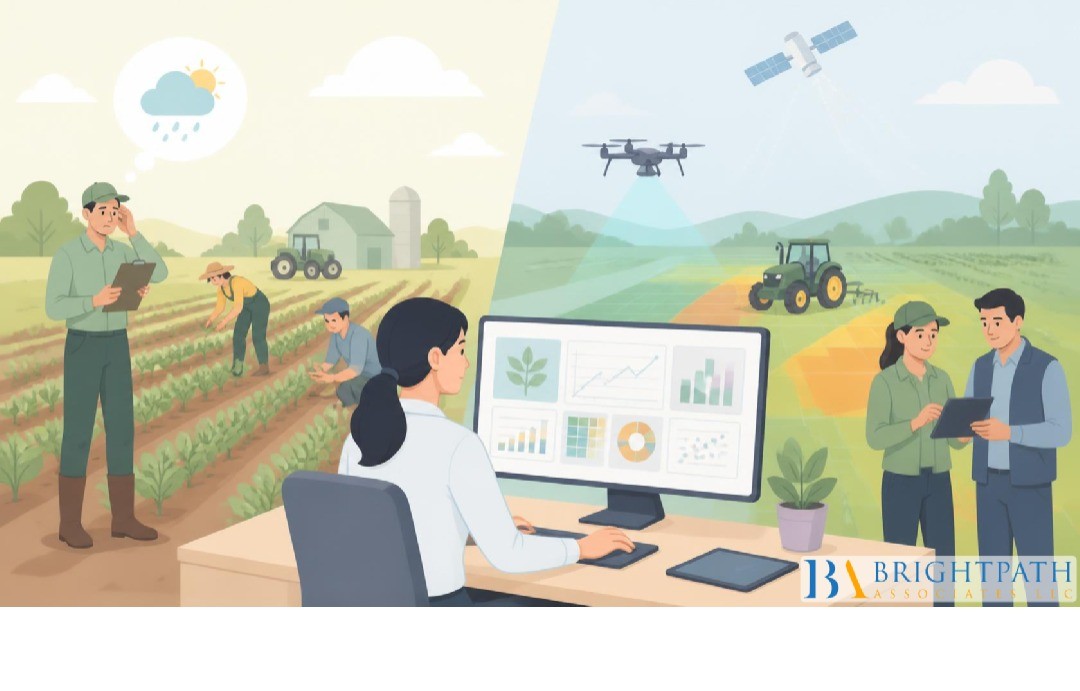
For decades, the center of gravity in farm decision-making lived in local expertise: a field manager’s ability to scout, diagnose, and coordinate actions across people and equipment. That expertise remains important, but it is being augmented—and in some cases outpaced—by Agricultural technology that captures reality at a scale and cadence no human can match. Yield monitors, telematics, satellite imagery, drone surveys, weather stations, variable-rate equipment, soil probes, and lab diagnostics have expanded the definition of “field insight” from observations to measurable, time-stamped evidence.
What changes is not just the volume of information, but the economics of being wrong. When decisions are made across thousands of acres and multiple production systems, a small error in timing, rates, or placement can compound into large losses. Digital Farming platforms now connect equipment performance, agronomy recommendations, inventory, and financial outcomes into one operating picture. That integration turns farm operations into a decision system—one that can be improved when its data is structured, cleaned, and analyzed with discipline.
From intuition-led operations to evidence-led systems
As Agricultural innovation accelerates, organizations that treat data as a strategic asset can test assumptions rather than defend them. The most sophisticated operators do not abandon agronomic judgment; they operationalize it. They can model what happens when planting dates shift, when nitrogen is split into additional passes, when hybrid selection changes, or when irrigation scheduling is optimized under new water constraints. They can quantify the likely impact before the season ends and measure the realized impact after harvest. That feedback loop is the heart of modern Food production management, and it is increasingly dependent on analytical capability rather than field supervision alone.
In practical terms, Agricultural technology is pushing leadership teams toward a portfolio mindset. Instead of “What worked last year?” the question becomes “What is working now, where, and why?” Precision agriculture makes it possible to manage variability, but it also exposes variability that was previously hidden. Translating that variability into an advantage requires a professional who is trained to model uncertainty, separate signal from noise, and build decision tools that scale across farms, regions, and seasons.
Precision agriculture is often described as the targeted application of inputs, but its broader meaning is operational: it is the ability to plan and act with granularity, then verify results with data. #DigitalFarming extends that concept beyond the field, connecting agronomic actions to logistics, quality outcomes, carbon accounting, and customer requirements. Together, they are transforming Farm management software from a recordkeeping tool into a decision engine that influences daily execution and long-term strategy.
Historically, Farm management software focused on compliance, traceability, and basic cost tracking. Today’s platforms ingest spatial layers, machine data, agronomic prescriptions, remote sensing, and even market signals. This is a meaningful shift because it changes where bottlenecks occur. The limiting factor is no longer access to data, but the ability to harmonize it across vendors, formats, and seasons, and to derive insights that improve profitability and Agricultural sustainability at the same time.
Why the “software layer” matters more than the “equipment layer”
Many organizations invest heavily in equipment upgrades and sensors under the banner of Agricultural innovation, only to find that performance gains plateau. The reason is simple: value is unlocked when data moves reliably from collection to interpretation to action. A data scientist can identify which data streams are trustworthy, create pipelines that reduce manual handling, and define metrics that tie operational changes to measurable outcomes in #FoodProduction. They can also build analytical models that complement Precision agriculture workflows, such as detecting yield-limiting patterns, forecasting disease risk, optimizing route and fleet utilization, or quantifying the payoff of variable-rate strategies by soil zone.
The modern reality is that Farm management software is increasingly a layer where competitive differentiation happens. As Digital Farming tools converge, leadership teams need insight into which integrations matter, how to evaluate vendor claims, and how to design data governance that protects the organization while enabling speed. A field manager can help execute programs, but a data scientist can improve the system that generates the program—and can do so in a way that scales across locations, crops, and business units.
Precision agriculture also forces clarity on what success means. It is not enough to say an input program “worked.” Organizations need definitions: yield stability, margin per zone, nitrogen-use efficiency, water productivity, quality premiums, or reductions in risk. These are analytical problems as much as agronomic ones. A data scientist can translate operational goals into measurable KPIs, design experiments that fit real-world constraints, and build dashboards or models that leadership trusts. This is how Agricultural technology becomes a management discipline rather than a collection of tools.
The next decade of Food production will be shaped by the ability to produce more with fewer resources while maintaining profitability. Sustainable farming is no longer a marketing slogan; it is increasingly tied to regulation, consumer expectations, and downstream buyer requirements. Agricultural sustainability pressures show up in fertilizer scrutiny, water allocation, biodiversity considerations, residue limits, and climate-related risk. Agricultural innovation, when deployed thoughtfully, offers ways to address these constraints without sacrificing competitiveness.
#DigitalFarming data can document practices and outcomes in ways that manual reporting cannot. Precision agriculture can reduce over-application, limit runoff risk, and improve efficiency by matching decisions to variability. Farm management software can support traceability and verification, which matters when customers demand transparency and when organizations pursue Sustainable agriculture investment aimed at measurable impact. Yet the promise of Agricultural technology for sustainability only holds if the organization can measure, attribute, and continuously improve outcomes based on evidence.
Organic farming and data are not opposites
Organic farming is sometimes positioned as the counterpoint to technology, but the reality is more nuanced. Organic systems face intense complexity: weed pressure management, soil health maintenance, rotations, biological inputs, and strict compliance. These systems benefit from analytics because success depends on timing, field histories, local microclimates, and consistent documentation. Precision agriculture can support organic production through targeted cultivation plans, scouting prioritization, variable-rate compost or amendments where allowed, and early detection of stress patterns from imagery. Farm management software can also reduce administrative burden, improve audit readiness, and connect operational choices to market premiums.
In both conventional and Organic farming, the sustainability conversation is moving toward quantification. Organizations are asked to demonstrate reductions in emissions intensity, improvements in soil organic matter, or changes in water-use efficiency. These are measurement and modeling challenges. A data scientist can develop baselines, define sampling approaches, integrate third-party datasets, and build credible reporting that stands up to scrutiny. This is crucial for Agricultural sustainability because credibility and repeatability determine whether sustainability initiatives create value or create overhead.
Turning sustainable intent into operational advantage
Sustainable farming becomes strategic when it is linked to decision quality. If an organization can prove that certain practices improve resilience and stabilize yield under stress, it can justify #SustainableAgriculture investment with confidence. If it can identify which practices work best by soil type or region, it can allocate resources where they matter most. If it can forecast risk and optimize interventions, it can reduce waste while protecting outcomes. These are exactly the domains where Agricultural technology produces raw inputs, but analytical talent creates the competitive edge.
The case for a field manager is easy to understand: they coordinate crews, manage schedules, troubleshoot equipment issues, scout fields, and keep operations moving. In many organizations, strong field leadership is essential. But when the strategic objective is to improve decision-making under complexity, a data scientist often provides leverage that compounds over time. The difference is not about replacing agronomy with algorithms; it is about creating an operating system for decisions where agronomic expertise, Precision agriculture tools, and Farm management software reinforce one another.
A field manager’s impact is real but largely bounded by geography, time, and the number of people they can directly supervise. A data scientist can build models, workflows, and measurement frameworks that scale across all operations. They can reduce the time it takes to identify underperforming zones, detect emerging issues, reconcile as-applied data with plans, and translate operational variability into actionable recommendations. They can establish data standards so Digital Farming information is consistent across farms and seasons, which improves the value of every future data point the organization collects.
This matters for Sustainable agriculture investment because leadership needs to know what works before committing capital. Whether the investment is a new sensor network, variable-rate capability, upgraded Farm management software, or new sustainability programs, the payoff depends on adoption, measurement, and iteration. A data scientist can evaluate return on investment across both margin and Agricultural sustainability outcomes, helping avoid expensive initiatives that look innovative but do not deliver.
Risk management is becoming an analytical discipline
Modern Food production is increasingly exposed to climate variability, pest and disease pressure shifts, labor scarcity, and supply chain disruptions. The organizations that navigate these risks well often have an analytical capability that can forecast scenarios, optimize decisions under uncertainty, and communicate trade-offs clearly to executives. Precision agriculture provides more control, but it also increases the number of decisions that must be made correctly. Agricultural technology can overwhelm teams without a role dedicated to extracting signal, designing experiments, and building repeatable decision processes.
Field management remains critical for execution, especially during tight windows. But execution improves when it is guided by stronger priorities. A data scientist can help determine where scouting should be concentrated, which fields carry the highest risk-adjusted return, and which interventions are most likely to protect margin. In this way, analytics strengthens field leadership rather than competing with it, and the organization becomes more consistent in both yield outcomes and Sustainable farming performance.
#ExecutiveSearchRecruitment in agriculture has historically favored operational leaders, often because analytics roles were seen as peripheral. That assumption is changing as Digital Farming matures. The most effective data scientist hires in Agricultural technology contexts tend to combine strong technical skill with domain curiosity and a practical understanding of operations. They can communicate with agronomists and field teams, translate business questions into analytical work, and deliver outputs that integrate into Farm management software and decision routines.
For leadership teams, Executive Search Recruitment should focus less on generic credentials and more on evidence that the candidate can drive adoption and trust. Can they build a measurement strategy that makes Precision agriculture economically defensible? Can they reconcile messy, real-world datasets? Can they quantify Agricultural sustainability outcomes without overpromising? Can they connect analytics to procurement, logistics, and market signals that influence Food production profitability? These are the competencies that turn Agricultural innovation into performance, rather than a collection of pilots.
Conclusion
Agricultural technology is accelerating, and the organizations that benefit most will be those that can consistently translate Digital Farming data into decisions. Precision agriculture, Farm management software, and Agricultural innovation are creating new possibilities for efficiency, resilience, and transparency, but those possibilities do not automatically become results. They require analytical capability that can connect operational actions to outcomes across profitability, Sustainable farming, and Agricultural sustainability.
Hiring a data scientist is a strategic move because it strengthens the decision system that governs the entire organization, including how Sustainable agriculture investment is prioritized and measured. Whether you operate conventional systems, expand Organic farming programs, or pursue sustainability-linked markets, data-driven talent will increasingly determine who adapts quickly and who falls behind. In a world where Food production must be both more productive and more accountable, the next standout agricultural organization will not just manage fields well—it will manage information better.
Find your next leadership role in Farming Industry today!