
Introduction
If you operate in mining and metals today, you already know that “where did this material come from?” is no longer a niche question asked only by auditors. It is a #CommercialRequirement shaped by customers, regulators, financiers, and communities who expect evidence, not assurances, about how ore was produced, processed, and transformed into usable metal.
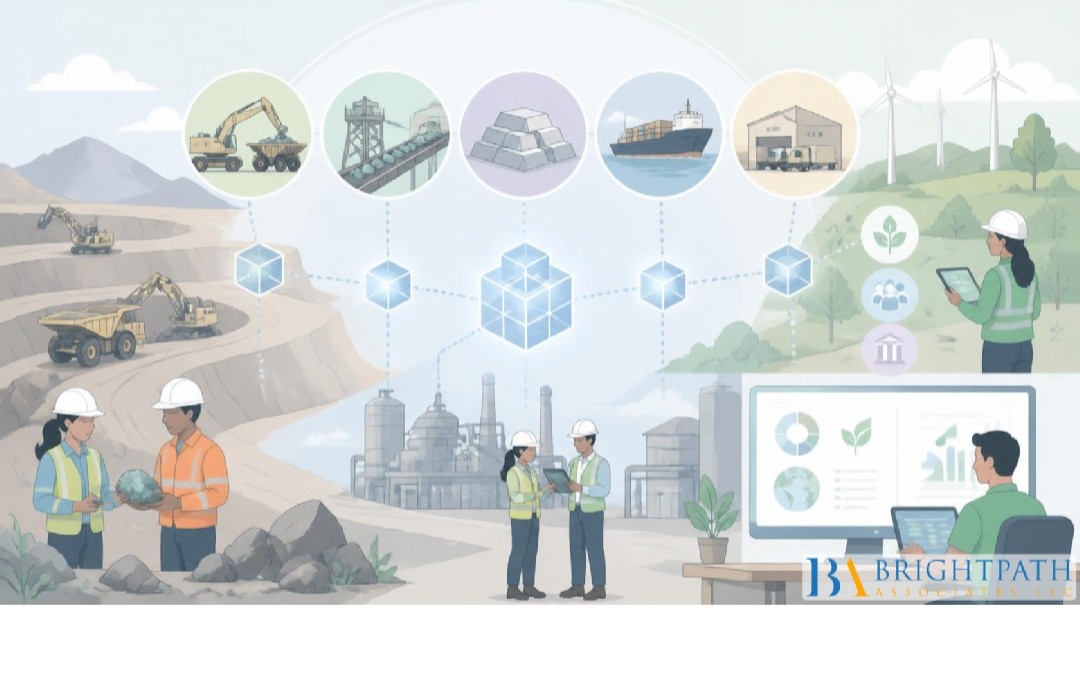
Blockchain is increasingly discussed as a way to meet that expectation at industrial scale. When implemented as part of a broader Mining technology and data-governance program, it can strengthen provenance, reduce disputes, and support Sustainable mining claims with traceable records that survive handoffs across sites, vendors, and jurisdictions. This article explains how blockchain fits across Ore extraction, Metal processing, and Metallurgy workflows, and how it can improve ESG reporting, compliance, and trust amid fast-moving Metals industry trends.
Why Provenance Has Become a Strategic Requirement in Metals Supply Chains
Mineral provenance used to be managed through fragmented documentation: shipping papers, laboratory certificates, spreadsheets, and contractual attestations. That approach struggles under today’s operating reality, where mineral supply chains are long, multi-party, and frequently reconfigured. A single batch may be blended, split, upgraded, or reclassified multiple times before it becomes a saleable product, and every transformation creates a new opportunity for data loss, inconsistency, or manipulation.
This pressure is amplified by decarbonization and electrification. As demand grows for battery metals and critical minerals, buyers want assurance that materials are responsibly sourced and that claims about labor, environmental impact, and community engagement can be demonstrated. Mining policy is also evolving toward stronger due diligence and disclosure requirements, shifting the cost of weak traceability from a back-office inconvenience to a strategic risk that can delay permits, disrupt financing, or exclude material from premium markets.
The business case is therefore broader than compliance. Strong provenance supports faster dispute resolution, improved working capital confidence, and better customer retention. It can also enable product differentiation when producers can credibly document low-carbon operations, responsible waste handling, or verified chain-of-custody controls. In that sense, traceability becomes an operating capability that connects mining innovation to market access.
Blockchain as a Trust Layer, Not a Replacement for Operational Systems
Blockchain is best understood as a shared, tamper-evident record of events rather than a standalone application. In industrial deployments, it does not replace historians, ERPs, laboratory information management systems, or fleet systems. Instead, it provides a consistent ledger where multiple parties can record and verify key provenance events without relying on a single organization’s database as the “source of truth.” This matters in mining because many critical steps are executed by different entities: operators, contractors, transport providers, laboratories, processors, refiners, and traders.
When properly designed, blockchain records can improve data integrity by making it difficult to change history without detection, while still allowing participants to keep sensitive operational details in their own systems. The ledger stores proofs of what happened, when, and under which controls, establishing a defensible chain of custody. For ESG reporting, that can shift discussions from “we believe” to “we can demonstrate,” particularly when records are anchored to verifiable measurements and controlled processes rather than subjective declarations.
The industrial value depends on governance. #PermissionedNetworks, role-based access, and clear rules for who can write which events are often more practical than open, anonymous designs. In this model, blockchain becomes a coordination mechanism across the value chain, aligning incentives for accurate reporting while reducing the friction of reconciliation between organizations with different data standards and risk tolerances.
To create traceable provenance, the ledger must follow material through the transformations that define mining and metals. The goal is not to record every sensor reading, but to capture the events that establish identity, custody, condition, and transformation in ways that stand up to audit and commercial scrutiny.
Ore extraction: tying physical reality to a digital identity
In Ore extraction, the first challenge is establishing a defensible starting point. A provenance record is only as credible as the process that creates the initial identity of the material. That identity typically depends on controlled sampling, location and time stamping, and a clear link to the extraction method, pit or stope, and operational controls. When those source events are written to a shared ledger, downstream participants can verify that a shipment’s origin and declared attributes were created under defined procedures rather than reconstructed later from memory or incomplete files.
Practical deployments often start with a limited set of high-value events: creation of a lot or parcel, sample collection and chain-of-custody, laboratory assay issuance, and transfer of custody to haulage or stockpile management. The point is to create an immutable narrative of the batch’s origin while allowing operational systems to continue handling scheduling, dispatch, and production reporting. When mining innovation adds autonomy, remote operations, and higher-frequency data, blockchain can still remain a lightweight record of the “facts that matter” for provenance and reporting.
Metal processing: tracking transformation, blending, and yield
In #MetalProcessing, provenance becomes more complex because materials are commonly blended, upgraded, or chemically transformed. If a ledger cannot describe how inputs became outputs, traceability breaks at the moment the supply chain adds the most value. A practical blockchain design records conversion events that specify input lots, process step identifiers, key quality attributes, and output lots. This provides a consistent way to demonstrate lineage, even when one input becomes multiple outputs or multiple inputs become one product stream.
The operational benefit is not only compliance. Recording these transformation events can reduce reconciliation effort between operations, laboratories, commercial teams, and customers. It can also support yield analysis, shrinkage investigations, and dispute resolution when grade, moisture, or impurity levels are contested. For sites under tight cost pressure, the value often appears first as reduced cycle time in settlement, fewer exceptions, and clearer accountability across handoffs.
Metallurgy: linking metallurgical decisions to final product claims
Metallurgy sits at the junction of process performance and product credibility. Decisions about reagent schemes, temperature profiles, furnace practice, and impurity control can materially influence what a downstream customer receives and how that material performs. When key metallurgical certificates, assay results, and specification conformance events are anchored to a shared ledger, buyers can validate that a batch met declared criteria and that certificates are not detached artifacts that could be swapped or altered without detection.
This is especially relevant as Metals industry trends push toward lower-carbon production pathways, novel feedstocks, and increased circularity. Where scrap, recycled inputs, or secondary materials are introduced, provenance must describe not only where material came from, but how it was processed and verified to meet quality and ethical sourcing expectations. Blockchain can help by preserving the lineage of certifications and quality events across multiple transformations, enabling credible claims while still accommodating operational variation and continuous improvement.
Outside the plant, provenance depends on logistics and custody controls that often involve third parties. Transport events, storage events, and custody transfers are where many supply chains lose clarity. A shared ledger can reduce ambiguity by providing a single, time-ordered record of custody changes, including when a shipment left a facility, who accepted it, and under what conditions and documentation. When paired with consistent sampling and seal controls, this can materially reduce fraud risk and improve confidence in chain-of-custody for both sustainability claims and commercial settlement.
The strongest programs treat blockchain as one component in a broader Mining technology stack that includes master data discipline, digital work execution, laboratory integration, and controlled identity management. In this architecture, blockchain improves trust between organizations, while operational systems continue to optimize throughput, recovery, and cost. The result is not a theoretical “perfect traceability” vision, but an industrially workable provenance backbone that can scale across sites and partners.
How Blockchain Strengthens ESG Reporting, Compliance, and Supply-Chain Transparency
#ESGReporting in mining and metals has shifted from narrative disclosures to evidence-backed metrics and verifiable claims. Blockchain can support that shift by anchoring ESG-relevant events to an auditable chain of custody. For example, when a batch is associated with controlled sampling, verified origin, and process certifications, it becomes easier to demonstrate that the material aligns with stated sourcing standards and due diligence requirements.
Compliance benefits emerge when reporting requirements depend on data shared across organizational boundaries. Regulations and customer programs may require proof of origin, evidence of responsible sourcing, or documentation of specific risk controls. If those records live in isolated systems, producing a coherent audit package can become a manual, time-consuming effort that is vulnerable to version conflicts and missing data. A shared ledger reduces that friction by providing a consistent sequence of recorded events that auditors and partners can validate without re-litigating basic facts.
Mining policy also shapes what “good traceability” looks like. Jurisdictions may differ on disclosure thresholds, data residency expectations, and acceptable assurance mechanisms. A permissioned blockchain approach can accommodate these differences by controlling access while preserving integrity. This is particularly valuable for cross-border supply chains where material passes through multiple regulatory regimes, each with its own expectations for transparency and control.
For Sustainable mining, the reputational value is tied to proof. Stakeholders increasingly challenge generalized claims, especially when incidents occur elsewhere in the sector. Blockchain does not make operations sustainable by itself, but it can provide a credible structure for showing that specific lots were produced under defined standards, within controlled processes, and with measurable evidence attached. That credibility can help producers earn trust, maintain customer relationships, and participate in premium programs that reward verified performance rather than promises.
Data Integrity and Auditability: Designing Records That Hold Up Under Scrutiny
Traceability programs fail when they record the wrong things, record them inconsistently, or cannot prove that the recorded events reflect reality. Blockchain improves auditability because it preserves an immutable history, but the ledger is not inherently “true.” Industrial deployments must therefore focus on the integrity of the inputs: standardized event definitions, controlled identity for lots and participants, and clear rules for how data from sensors, laboratories, and human workflows is validated before it is written.
In practice, organizations often define a provenance “minimum viable record” that captures the essential chain-of-custody and transformation events while avoiding unnecessary complexity. That record can be expanded over time as governance matures and operational teams gain confidence. The discipline lies in treating provenance as an engineered system: clear specifications, version control, and change management when processes, equipment, or standards evolve. This approach aligns well with Mining innovation initiatives, where new technologies can change how data is produced and interpreted.
Operational Adoption: Making Blockchain Work in Real Plants and Mine Sites
The most common barrier to blockchain success is not cryptography, but operations. Mine sites and processing facilities are optimized for throughput, safety, and reliability, and new digital work adds friction if it is not integrated with existing roles and systems. Adoption improves when blockchain events are generated automatically from existing systems and when the remaining human inputs are embedded into standard work rather than layered on as extra reporting tasks.
An effective operating model clarifies responsibilities across IT, operations, metallurgy, commercial teams, and compliance. It also establishes who owns master data, who resolves exceptions, and how disputes are handled when the ledger surfaces conflicting claims. These governance decisions determine whether blockchain becomes a trusted backbone or another underused platform. Training, user experience, and incident response processes are just as important as technical architecture, particularly when the system spans multiple companies with different cultures and risk appetites.
Talent and leadership are a strategic constraint. Many organizations now treat traceability and ESG data leadership as executive priorities, which is why Mining executive search has become closely linked to digital transformation programs. The same is true for mining and metals recruiters supporting roles that blend operations understanding with data governance, cybersecurity, and compliance. In complex, multi-site deployments, #ExecutiveSearchRecruitment can accelerate progress by securing leaders who can align stakeholders, standardize data, and drive adoption without compromising production realities.
Challenges and Tradeoffs: What Blockchain Does Not Solve on Its Own
Blockchain can strengthen trust, but it does not eliminate the need for physical controls, credible assurance, and robust governance. If sampling is inconsistent, if custody controls are weak, or if certification processes are not reliable, a shared ledger can simply preserve bad data more permanently. Successful programs therefore pair blockchain with tighter chain-of-custody procedures, laboratory quality management, and clear escalation paths for anomalies.
Integration complexity is another practical challenge. Mining technology environments often include legacy systems, vendor platforms, and site-specific configurations. Establishing consistent identifiers, event taxonomies, and interfaces across operations can take longer than expected, especially when partners have different digital maturity levels. There are also questions of confidentiality and commercial sensitivity: participants may want proof without exposing proprietary process details or contract terms. Permissioned designs can help, but they require careful architecture and clear legal agreements about data rights and responsibilities.
Cost and value realization must be managed realistically. Blockchain initiatives can fail when they are pitched as a sweeping transformation rather than a targeted solution to traceability and reporting pain points. The strongest implementations start with a contained scope, focus on high-friction handoffs, and expand as benefits are demonstrated. They also align with Mining policy trajectories and buyer requirements, ensuring that the provenance record created is the one that customers and auditors will actually accept.
Finally, industry collaboration is both essential and difficult. Provenance is inherently cross-organizational, but incentives do not always align. Some participants benefit from opacity, while others fear added liability. Leadership matters here: organizations that treat traceability as a competitive advantage and a trust-building mechanism are more likely to invest, participate, and shape standards as Metals industry trends continue to elevate transparency expectations.
Conclusion: Turning Provenance Into a Durable Capability for ESG and Market Trust
Integrating blockchain for traceable mineral provenance is ultimately about industrial credibility. When blockchain is used as a trust layer across Ore extraction, Metal processing, and Metallurgy workflows, it can create a defensible chain of custody that supports ESG reporting, compliance readiness, and supply-chain transparency without forcing every participant into a single centralized database.
The path to value is practical and operational: define the events that matter, ensure data integrity at the source, integrate with existing #MiningTechnologySystems, and build governance that survives organizational boundaries. As Sustainable mining expectations harden into policy and procurement requirements, companies that invest in traceability as a system, supported by the right leadership and execution discipline, will be better positioned to earn trust, reduce disputes, and compete in a market where proof increasingly matters as much as production.
Find your next leadership role in Mining & Metals Industry today!
Stay informed with the latest insights on Mining & Metals Industry!