
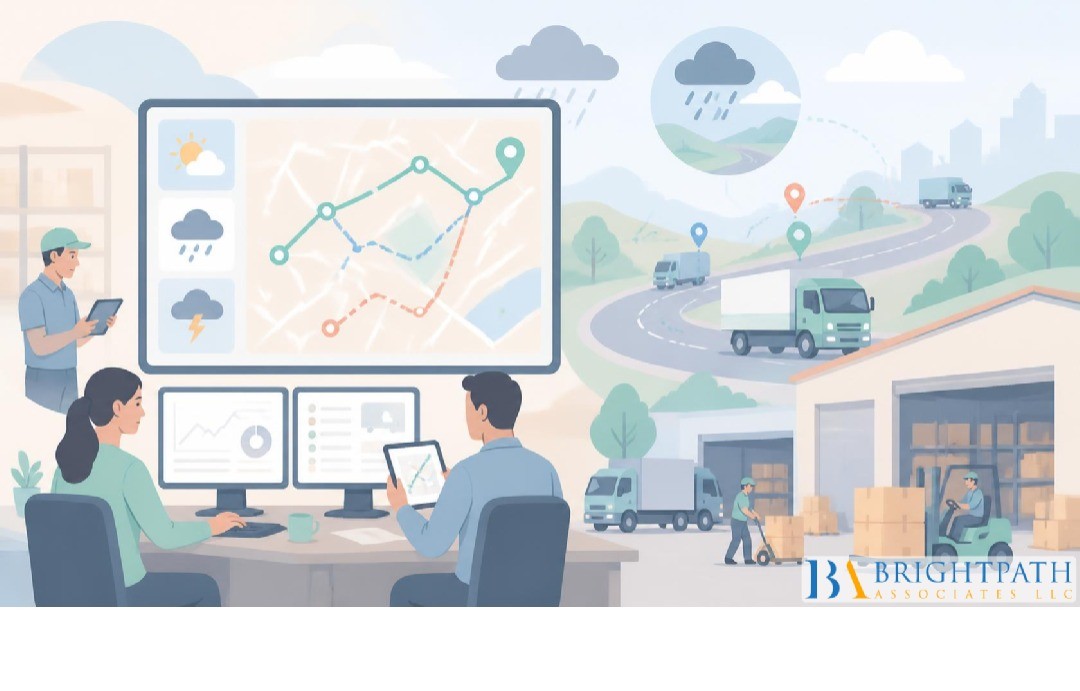
Introduction
Weather has always been a variable in #FleetOperations, but for small and mid-sized businesses it often becomes a disproportionate cost driver. When a storm line shifts, a freeze arrives early, or visibility drops on a critical corridor, SMB fleets can feel the impact immediately: missed delivery windows, cascading dispatcher workload, and the uncomfortable choice between pushing drivers harder or disappointing customers.
Predictive weather logic changes the nature of that tradeoff. Instead of treating weather as a last-minute disruption, it turns forecast signals into routing decisions that are continuously refreshed as conditions evolve. Done well, it helps you reduce delays, improve fuel efficiency, protect drivers, and stabilize customer service—without turning your operation into a science project. This article breaks down the business case, how the technology works, what data matters, how to adopt it pragmatically, and why people and process determine whether the promise becomes measurable performance.
The business case: turning weather uncertainty into controllable cost
For SMB fleets serving retail, construction, field service, or regional distribution, a single weather-driven delay can trigger overtime, missed appointments, and re-delivery costs. Predictive weather logic supports dynamic route adjustments earlier in the day—sometimes before the first vehicle leaves the yard—so the network absorbs disruption in smaller, manageable shifts rather than in late, expensive corrections.
Weather doesn’t just slow you down; it changes the cost of each mile. Headwinds, precipitation, stop-and-go congestion around incidents, and detours can push fuel consumption up while lowering stops per hour. Shipping optimization in this context is not abstract math—it is the practical act of selecting corridors and schedules that preserve average speed, avoid closures, and reduce idling exposure. When the route plan is updated using forward-looking conditions, you waste less fuel reacting to the weather after it has already degraded the day’s plan.
SMB fleets often operate with lean safety resources, yet they face the same expectations from shippers, insurers, and regulators as larger carriers. Predictive weather logic gives dispatchers and supervisors a consistent, defensible basis for slowing down, staging, or rerouting. That consistency matters when investigating an incident or responding to a customer who asks why a delivery was rescheduled. In the transportation industry trends shaping shipper expectations, the winners are the fleets that can explain service decisions with data, not guesswork.
In e-commerce logistics and the broader delivery industry, customers are increasingly conditioned to expect updates, narrow delivery windows, and clear exceptions. For parcel delivery and last-mile operations, predictive weather logic can reduce surprise “out for delivery” failures by adjusting promised windows earlier and choosing safer, more reliable sequences for stops. For freight shipping, it can help preserve appointment discipline at terminals and receivers by adjusting ETAs and rebooking before congestion becomes extreme.
How predictive weather logic works: forecasting meets routing intelligence
#PredictiveWeather logic typically sits alongside existing dispatch, delivery technology, and planning tools. It translates weather forecasts into operational constraints and costs that a routing engine can use. Rather than simply warning that “storms are coming,” it quantifies how different weather cells, wind fields, or temperature thresholds are likely to affect travel time, stop productivity, and safety risk across specific road segments and time windows.
Traditional routing often assumes that conditions are stable across the day. Predictive weather logic introduces a timeline: the same road may be acceptable at 10 a.m. and a poor choice at 2 p.m. as precipitation intensifies, traffic incidents rise, or plowing resources shift. The router recalculates not only the path but also the sequence of stops and the departure or staging times needed to keep service reliable. This is particularly valuable in the delivery sector, where narrow delivery windows and dense routes leave little slack for late corrections.
Many systems transform forecast elements into an exposure score—such as a probability of hazardous conditions on a corridor at a given hour. The score can be tuned to your operation: refrigerated freight shipping may be sensitive to temperature and icing; parcel delivery may be more sensitive to neighborhood road conditions and visibility; regional freight shipping may prioritize highway closures and wind risk for high-profile equipment. A practical implementation is less about perfect forecasts and more about consistent thresholds that trigger well-defined actions.
Weather forecasts update, and so should your plan. The best implementations avoid constant churn by setting “replan rules” that determine when a change is warranted: an updated storm track that intersects a critical corridor, a rise in predicted wind gusts for a trailer type, or a temperature drop that increases ice risk. Done correctly, dynamic route adjustments become a managed cadence—stable enough for drivers and customers, responsive enough to avoid preventable disruption.
What data inputs matter most: from forecast grids to fleet reality
Not all forecasts are equally useful for routing. SMB fleets typically benefit from high-resolution precipitation type and intensity, wind speed and gusts, temperature and freeze risk, visibility, and storm warnings. The key is alignment with road-level impact rather than city-level summaries. If the system cannot translate an input into a time penalty, a corridor restriction, or a safety trigger, it will remain informational rather than actionable.
Many delays during storms are not caused by the weather itself but by how other drivers respond to it. Accident clusters, reduced speeds, and localized congestion can dominate travel time variance. Blending predictive weather logic with traffic feeds improves ETA stability and helps dispatch decide whether to reroute, resequence stops, or hold a vehicle at a safe staging location until a bottleneck clears. This is particularly important for parcel delivery where route density amplifies small speed changes into large schedule risk.
Your vehicles and freight respond differently to the same conditions. Trailer height and weight, tire type, engine characteristics, and even driver experience change how you should interpret a forecast. Load value and temperature sensitivity also matter in freight shipping. If the model knows the difference between a box truck doing urban deliveries and a tractor-trailer running linehaul, it can recommend different decisions without making the dispatcher manually apply rules at every turn.
Routing choices only make sense relative to what you promised and what your network can accept. Appointment windows, dock hours, consignee restrictions, and drop priorities determine whether a detour is worth it or whether an early delivery is even possible. In e-commerce logistics, proactive customer communication depends on having accurate predicted ETAs that incorporate weather impacts. The result is not merely a better route; it is a better service plan.
SMB shippers and carriers often rely on freight brokerage services to cover overflow or to route loads through spot capacity. Predictive weather logic can improve broker interactions by forecasting lane-level risk earlier, enabling better timing for tendering, more realistic pickup and delivery commitments, and fewer last-minute surprises. It can also support smarter decisions on when to use a brokered option versus holding freight for a safer, more reliable schedule.
Adopting predictive weather-driven routing without overcomplicating operations
SMB fleets succeed when the first deployment solves a clear problem: winter storm avoidance on a core lane, heavy rain impacts on last-mile productivity, or wind risk for certain equipment. The goal is to prove value in a limited scope, then expand. This approach fits the realities of the delivery industry, where dispatchers cannot absorb constant change and drivers need stable plans they can trust.
You may already have a TMS, a routing tool for parcel delivery, ELD telematics, and customer notification. Predictive weather logic is most effective when it feeds those tools rather than living in a separate dashboard. For SMB fleets, the practical standard is simple: a planner can accept a recommended route change, a dispatcher can see the reason and the trigger, and a customer service team can communicate updated ETAs with confidence. If those three actions are smooth, the operation will actually use the capability.
Many SMBs know the value is there but struggle with the design choices: which thresholds should trigger a replan, how to handle driver breaks and HOS constraints during weather events, and how to preserve service tiers during disruption. A practical consulting engagement focuses on routing policy, exception management, and measurement—not just software selection. In other words, the consulting value is in building an operating model that turns prediction into repeatable decisions.
If you tender freight through brokers or accept brokered loads, set weather-aware service rules: when to pre-emptively adjust appointments, when to require updated ETAs, and what constitutes a force majeure delay versus preventable disruption. Predictive weather logic makes these conversations easier because it provides a documented basis for decisions. It also supports stronger carrier performance management by separating unavoidable weather impact from avoidable planning gaps.
SMB fleets do not need a #MeteorologyTeam, but they do need someone who can own configuration, outcomes, and adoption. In many organizations, that is an operations analyst, a dispatch manager, or a technically inclined transportation supervisor. As delivery sector tech talent becomes more competitive, some SMBs turn to #ExecutiveSearchRecruitment to find leaders who can bridge operations and systems. The best hires tend to be pragmatic: they understand routing and driver realities and can still work comfortably with data, vendors, and change management.
Weather-aware routing should be judged on on-time performance, variability reduction, fuel and idle impacts, safety indicators, and customer contacts per delivery. For freight shipping, include appointment adherence and dwell impacts. For parcel delivery, include route completion rates and redelivery reduction. These metrics keep the project grounded in operations rather than turning it into a technology showcase.
The people and process factor: making dynamic adjustments stick
Predictive weather logic should not create confusion about who can change a route, when drivers can be held, or how customer commitments are updated. The strongest implementations define roles clearly: the system recommends, dispatch approves, drivers acknowledge, and customer service communicates using standardized messages. This structure reduces friction during high-stress weather events and prevents the common SMB failure mode where only one person understands the tool.
The value of predictive weather logic appears when conditions are changing quickly. That is exactly when ad hoc decisions proliferate. Training should focus on what to do when the model recommends a detour that increases miles, how to handle missed windows, and how to coordinate across teams when a route is resequenced. In the transportation industry, reliability is often defined by what happens on bad days, not good ones.
Weather models are predictions; your operation produces outcomes. Capture what actually happened—speeds, stoppages, customer failures, and driver feedback—and use it to tune thresholds and penalties. Over time, your fleet’s “weather response profile” becomes a competitive advantage because it reflects your geography, your customers, and your operating constraints. This is shipping optimization as an operational discipline: continually narrowing the gap between planned and actual performance.
Customers care less about the reason for a delay than about being informed early and accurately. #PredictiveWeatherLogic supports proactive communication by improving ETA confidence and by highlighting which deliveries are most at risk. In e-commerce logistics and parcel delivery especially, proactive updates reduce inbound calls and improve satisfaction even when delivery must shift. When service teams trust the prediction, they communicate sooner, and the customer experience feels controlled rather than chaotic.
Conclusion: predictive weather-driven route adjustment as an SMB advantage
Predictive weather logic gives small and mid-sized fleet operators a way to compete on reliability without matching the scale of larger networks. By converting forecast signals into practical, time-aware routing decisions, you can reduce delays, improve fuel use, protect drivers, and stabilize customer service across freight shipping, parcel delivery, and hybrid delivery models. The most durable benefits appear when the technology is paired with clear operating rules, disciplined exception handling, and a measurement mindset that keeps the system tuned to real outcomes.
As transportation industry trends push customers toward tighter windows and higher visibility, dynamic route adjustments become less of a premium feature and more of a baseline capability. With a pragmatic adoption plan—supported by the right delivery technology, selective logistics consulting services, well-aligned freight brokerage services, and the right mix of operational leadership and delivery sector tech talent—SMB fleets can implement predictive weather logic without overcomplicating operations. The result is not only smarter routing, but a more resilient service promise that holds up when conditions are at their worst.
Find your next leadership role in Packaging and Freight Industry today!
Stay informed with the latest insights on Packaging and Freight Industry!