
Introduction
#IndustrialEnergySystems in 2026 are being redesigned under pressure from two directions. First, energy security has moved from a procurement optimization exercise to an enterprise-wide resilience mandate. The drivers are familiar—price volatility, constrained transmission capacity, extreme weather, and supply-chain disruption—but their compounding effects are new. For many operators, the most consequential risk is no longer the cost of energy alone; it is the probability of interruption and the cascading impacts on safety, quality, and contractual delivery.
Second, Environmental compliance is expanding from facility-level permit adherence into a multidimensional requirement that spans emissions intensity, local air quality, wastewater and effluent integrity, and transparent reporting across assets and suppliers. Enforcement is increasingly data-driven, with greater attention to episodic events such as flaring, fugitive emissions, and discharge excursions. In practical terms, environmental performance is becoming inseparable from operational reliability because the very actions taken to protect energy supply—fuel switching, backup generation, load shifting, onsite storage—can trigger new permitting thresholds or community scrutiny if not designed with environmental outcomes in mind.
This whitepaper focuses on the convergence of these priorities in 2026 for energy-intensive sectors such as manufacturing, chemicals, metals, data infrastructure, and logistics. It analyzes how technology adoption, regulatory expectations, capital allocation, and organizational capability are evolving together. It also clarifies what this paper does not attempt to do: it is not a jurisdiction-by-jurisdiction legal guide, and it does not advocate a single “best” decarbonization pathway. Instead, it provides an industry analysis of patterns that are emerging across markets and offers a framework for building resilient, compliant systems that remain investable amid policy and market uncertainty.
Energy Security as an Environmental Issue
The traditional separation between energy procurement and environmental management is breaking down because energy choices are increasingly constrained by environmental limits, and environmental outcomes are increasingly sensitive to energy system design. When industrial operators add firming capacity through backup generators, dual-fuel boilers, or onsite power plants, they often introduce new point sources that must meet stricter emissions limits. Even temporary or emergency operations can draw attention when local communities experience odor, particulate matter, or visible plumes. In 2026, energy security projects succeed faster when environmental requirements are built into the design basis from day one, rather than treated as downstream permitting work.
At the same time, environmental regulators are paying closer attention to resilience measures that can change a facility’s emissions profile during grid events. Peak-period operation and rapid cycling can elevate nitrogen oxides, particulate emissions, and unburned hydrocarbons, creating compliance risk that is not obvious from annual averages. This is driving renewed emphasis on air pollution control systems that perform under transient conditions, not only at steady-state loads. It also raises the bar for monitoring and verification, because real-time operational data is increasingly used to demonstrate compliance and to defend decisions under public scrutiny.
Energy diversification—adding renewables, storage, alternative fuels, and demand response—can improve both resilience and #EnvironmentalSustainability, but the interaction effects matter. For example, electrification can reduce onsite combustion emissions while increasing exposure to grid emissions factors and grid reliability constraints. Conversely, fuel switching can reduce carbon intensity but create new wastewater streams or catalyst management requirements that shift burdens to Water treatment and waste handling. The convergence of goals means decision-makers must evaluate energy pathways using a broader lens that includes emissions, water, waste, permitting timelines, and community acceptance, not only levelized cost or headline carbon metrics.
The most capable operators are therefore treating environmental performance as a component of energy security. They recognize that an asset with repeated environmental excursions—unplanned releases, discharge nonconformance, chronic opacity issues—faces operational interruptions that are just as real as a fuel shortage. In 2026, compliance maturity is emerging as a resilience differentiator: fewer shutdowns, faster approvals, more flexible operating envelopes, and stronger stakeholder trust when disruptions occur. This is one reason Environmental services providers are increasingly contracted not only for remediation or reporting, but also for reliability-related design reviews and operational readiness programs that tie environmental controls to uptime.
Clean Technology, Green Technology, and Compliance-by-Design
Technology adoption in 2026 is increasingly framed as “compliance-by-design,” where environmental performance is engineered into core processes rather than bolted on as end-of-pipe mitigation. This shift is visible across #CleanTechnology and Green technology categories that reduce emissions at the source, stabilize operations under variable energy supply, and create auditable performance data. Importantly, the value proposition is not limited to carbon. Many projects are justified because they reduce criteria pollutants, lower water intensity, and simplify permit conditions by reducing the number and variability of emission points.
For combustion and thermal processes, the modern approach to air pollution control integrates sensors, advanced controls, and more responsive abatement equipment to address the variability created by fuel switching and dynamic load profiles. Operators are increasingly investing in continuous optimization that aligns energy efficiency with emissions control, because each incremental efficiency gain lowers fuel throughput, reduces combustion byproducts, and improves the margin of compliance during upset conditions. In parallel, process electrification is advancing where it improves controllability and reduces local emissions, but it is now evaluated alongside grid constraints and the emissions characteristics of marginal power during peak events.
Water is becoming a defining constraint in the convergence narrative. Industrial growth, drought exposure, and rising discharge expectations are elevating Water treatment from a support function to a strategic capability. Facilities are redesigning cooling and process water loops to reduce intake, improve reuse, and minimize the risk of noncompliant discharge during operational swings. This is where #EnvironmentalInnovation is most visible: modular treatment trains, improved membrane performance, smarter chemical dosing, and analytics that predict excursions before they occur. In 2026, water programs are increasingly evaluated in the same meetings as energy resilience initiatives because both determine the facility’s ability to operate under stress conditions.
Another defining trend is the normalization of digital compliance infrastructure. Environmental measurement is becoming more continuous, more granular, and more integrated with operations and finance. This supports faster root-cause analysis, more credible reporting, and stronger defense against enforcement actions. It also enables better capital planning by revealing the true cost of noncompliance as a function of downtime, maintenance, and lost flexibility. As a result, the boundary between environmental management systems and energy management systems is thinning. When compliance data is treated as operational intelligence, it becomes easier to justify investments that simultaneously reduce emissions risk and improve energy efficiency or reliability.
Yet technology alone is not sufficient. Many organizations discover that the bottleneck is not equipment availability but engineering capacity, permitting expertise, and the internal governance needed to maintain performance over time. This is why the market for specialized Environmental services is expanding: third-party expertise is used to accelerate permitting, validate performance claims, and bridge gaps in monitoring, reporting, and verification. In the Environmental industry, differentiation increasingly comes from the ability to integrate technical solutions into a client’s operating model, not only to supply equipment or write compliance documents.
Regulatory and Market Dynamics in 2026
Regulatory expectations in 2026 reflect a broader shift from static compliance to performance accountability. Permitting and enforcement are increasingly shaped by the credibility of an operator’s monitoring program, its ability to detect and correct excursions quickly, and its transparency with stakeholders. Where regulators and communities perceive that resilience investments could raise local environmental burdens, scrutiny intensifies. This is pushing companies to adopt a proactive posture: demonstrating how energy security investments also deliver measurable local benefits such as reduced particulates, lower nitrogen oxides, safer chemical handling, and stronger wastewater safeguards.
Capital markets and customers are reinforcing the same convergence. Industrial buyers increasingly treat environmental performance as a proxy for supplier reliability and governance quality, while lenders and insurers price risk based on operational stability and legal exposure. In this environment, Environmental sustainability is not a separate narrative aimed at reputation; it is increasingly a contract and financing condition that affects cost of capital and access to long-term demand. The practical implication is that environmental performance improvements must be documented with defensible data, aligned with operational reality, and sustained through management systems that survive leadership changes and market cycles.
This convergence is also changing the internal role of environmental teams. Instead of serving primarily as compliance reviewers, environmental leaders are increasingly expected to shape energy strategy, influence capital allocation, and guide technology selection. That expanded mandate is driving a surge in Environmental executive search as companies compete for leaders who can bridge policy, engineering, and commercial priorities. The most sought-after profiles combine deep regulatory fluency with experience deploying Clean technology, managing complex stakeholder environments, and establishing measurement systems that stand up to audit and enforcement. As these roles become more strategic, #ExecutiveSearchRecruitment firms are also being asked to build cross-functional slates that include operations, procurement, and digital leaders alongside environmental specialists, reflecting how integrated the problem has become.
Talent scarcity is not limited to executives. The broader workforce requirement includes environmental engineers who understand advanced control systems, permitting specialists who can navigate multi-agency reviews, data professionals who can operationalize emissions and water analytics, and plant leaders who can manage tradeoffs without eroding compliance discipline. In 2026, companies that treat talent as infrastructure—investing in retention, training, and structured succession—are more likely to maintain compliance during operational stress and more likely to deliver resilience projects on schedule. In contrast, organizations that rely on heroic effort from understaffed teams are at higher risk of compliance drift, delayed approvals, and public trust erosion when disruptions occur.
Conclusion: The New Operating Model for Resilient Compliance
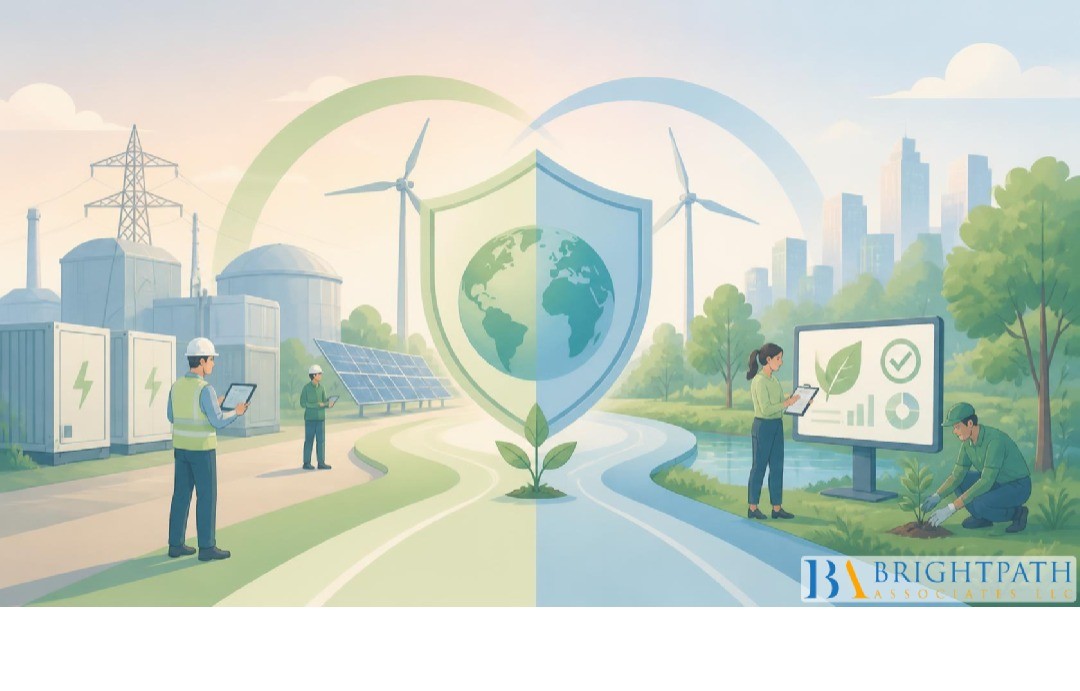
The convergence of energy security and #EnvironmentalCompliance in 2026 is best understood as an operating model shift. Resilience is no longer achieved simply by adding redundancy; it is achieved by designing systems that remain reliable within environmental limits, across normal operations and stressed conditions. Likewise, compliance is no longer demonstrated only through periodic reporting; it is sustained through continuous performance control, credible data, and governance that links environmental outcomes to operational decision-making.
Industrial operators that internalize this convergence are positioned to move faster and with fewer surprises. They are more likely to win permits, secure financing, retain customers, and withstand grid and market volatility—because their energy strategy is built on a foundation of defensible environmental performance. In 2026, the most durable advantage comes from treating energy resilience and environmental integrity as the same strategic system, optimized together rather than negotiated after the fact.
Find your next leadership role in Environmental Services Industry today!
Stay informed with the latest insights on Environmental Services Industry!