
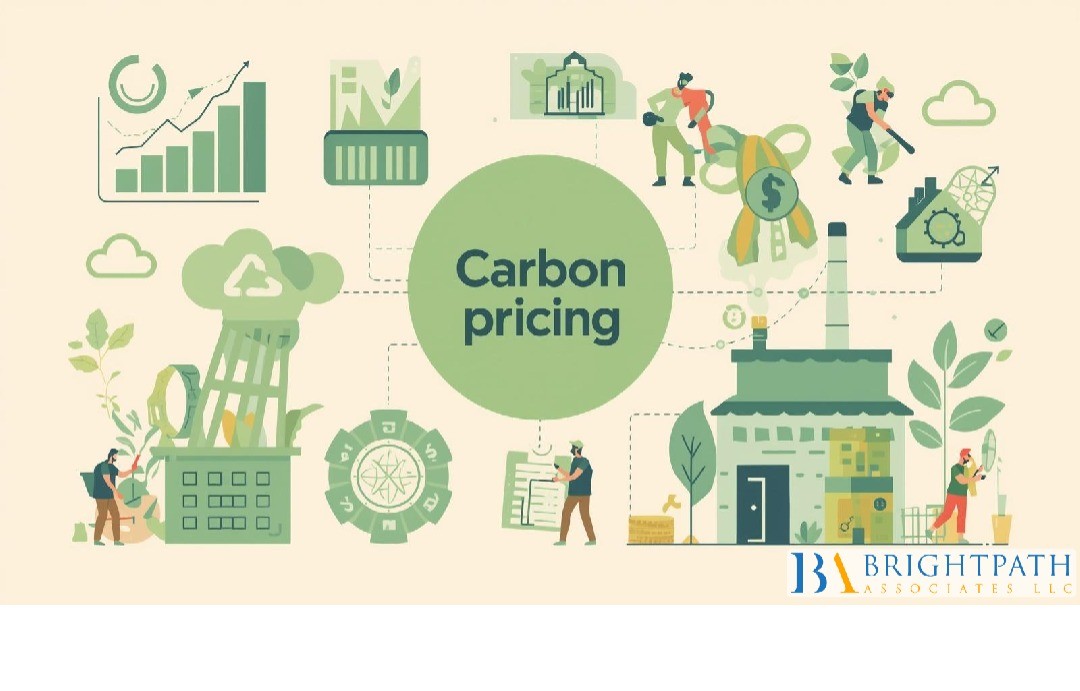
#CarbonPricing is transforming how industrial firms plan, finance, and operate long-lived assets. By turning greenhouse gas emissions into an explicit, escalating cost, carbon taxes, emissions trading systems, and border adjustment mechanisms now shape capital allocation alongside traditional drivers such as fuel prices, demand growth, and regulatory risk. For project sponsors in power, heavy industry, transport, and infrastructure, this evolution calls for a new planning discipline that blends scenario-based economics, engineered flexibility, and robust governance. The strategic prize is clear: firms that internalize credible carbon price trajectories into project decisions can lower risk, protect margins, and convert the transition to Clean energy into a durable competitive edge grounded in Renewable energy innovation, Renewable energy technology, and Green technology.
Understanding the Carbon Price Landscape
Over the past decade, carbon pricing instruments have expanded across key economies, with emissions trading systems and carbon taxes covering a growing share of global emissions and generating record public revenues. Mature markets such as the EU Emissions Trading System have delivered both a stable market architecture and tangible abatement, particularly in the power sector where fuel switching and renewables growth have driven emissions down. At the same time, prices remain below the levels that analysts and policy commissions associate with Paris-aligned decarbonization, which implies further tightening over the asset lifetimes of today’s investments. The introduction of border measures like the EU’s Carbon Border Adjustment Mechanism adds a trade-facing dimension to carbon costs by monetizing the embedded emissions of covered imports, reinforcing the importance of lifecycle carbon intensity and Environmental management systems in supply chains.
For planners, the practical implication is twofold. First, treat carbon pricing as a structural and rising cost across multiple jurisdictions, rather than a transient policy. Second, anchor long-term assumptions in recognized scenario frameworks that map global pathways and regional heterogeneity. Central-bank-oriented scenarios, for instance, present shadow carbon price trajectories that rise significantly under orderly transitions and spike later under delayed action. These trajectories, when coupled with local Environmental regulations, define a range of plausible price paths that should inform investment screening and risk management.
From Policy Signals to Project Cash Flows
Carbon prices affect project economics through several channels. On the cost side, direct compliance costs on Scope 1 emissions and residual Scope 2 emissions flow into operating expenditures for fossil-based processes and heat generation. On the revenue side, decarbonization investments that avoid compliance costs or earn product premiums for low embedded carbon can raise margins. Projects exposed to cross-border trade into regulated markets face additional liabilities on embedded emissions, which can materially alter delivered-cost parity. In sectors like cement, steel, aluminum, fertilizers, and hydrogen, this exposure makes the choice of process route and feedstocks a strategic determinant of competitiveness.
Translating these policy signals into cash flows requires embedding explicit, dynamic carbon price lines in financial models. Rather than a single static price, long-term planning should employ a baseline trajectory aligned to current policies, an upside trajectory consistent with 1.5–2°C pathways, and a downside trajectory that captures temporary price softness or delays. Each trajectory should interact with project-specific abatement curves that reflect the timing and intensity of operational changes such as electrification, fuel switching, and carbon capture. The outcome is a range of net present values, debt service coverage ratios, and payback periods that reveal sensitivity to carbon price pathways. This approach is the foundation of credible #RenewableEnergy economics in capital deployment.
The Case for Internal Carbon Pricing
Internal carbon pricing is now a mainstream management tool for steering capital toward Sustainable energy solutions. A forward-leaning shadow price, applied consistently in project appraisal and portfolio management, ensures that the firm’s investment hurdle rates reflect expected policy externalization over the asset life. Many industrial groups set internal carbon prices above prevailing market prices to “future proof” investments and prioritize low-carbon alternatives that align with tightening Environmental regulations. When paired with an internal carbon fee, the approach can create a dedicated budget line to fund decarbonization projects, accelerating Renewable energy innovation and enabling scaled investments in Clean energy and Green technology deployments. Over time, this discipline shifts the firm’s asset base, emissions profile, and cost of capital in favor of transition-aligned growth.
Real Options: Engineering for Flexibility Under Uncertainty
#CarbonPolicy and technology cost curves are both sources of uncertainty that create option value in timing and design. Real options analysis offers a framework for quantifying the value of deferring, staging, expanding, switching, or abandoning projects based on observable triggers such as allowance prices, carbon tax thresholds, or cost breakthroughs in Renewable energy technology. For example, a steelmaker considering a direct-reduced iron route with green hydrogen might stage investments with tollgates tied to hydrogen price parity and carbon price floors. A chemicals producer evaluating a carbon capture retrofit may embed switchability into process design to move between fuel sources or adjust capture rates as prices and incentives evolve. By specifying modularity, reserving space and utilities for future CCS tie-ins, oversizing electrical infrastructure for later electrification, and writing contracts with carbon-intensity reopeners, planners can lock in downside protection while preserving upside participation. These design choices are essential to resilient long-term project planning and directly support Environmental management systems aimed at continuous improvement.
Sector Perspectives: Where Carbon Prices Bite and Where Value Emerges
In power generation, carbon pricing has accelerated coal-to-gas switching and underpinned the profitability of wind, solar, and storage. The Wind energy industry exemplifies how scale, policy certainty, and carbon costs combine to shift the generation mix. Long-term planning for power portfolios should assume progressively rising carbon costs or tightening caps, and should emphasize contracting strategies such as power purchase agreements and contracts-for-difference that stabilize revenue and hedge against both commodity and carbon price volatility. Grid investment, flexibility services, and digital controls complement generation assets by reducing curtailment and improving system efficiency, strengthening the business case for Sustainable energy solutions across the stack.
In industrial materials and chemicals, product specifications increasingly recognize embodied emissions, and buyers are beginning to pay premiums for low-carbon grades. The cement sector’s path runs through clinker substitution, low-carbon binders, electrified kilns, and carbon capture for process emissions; steel shifts to scrap-optimized electric arc furnaces and hydrogen-based direct reduction where ore quality permits; aluminum pursues inert anodes and low-carbon electricity integration. These strategies lower exposure to border adjustments and unlock market access in regulated zones. Strategic offtake agreements for green products can underwrite early investments before mass-market parity arrives, while innovation funds and targeted incentives enhance bankability. The combination of Renewable energy technology, Green technology, and market-linked incentives helps bridge the green premium in the near term.
In fuels and mobility, aviation, maritime, and heavy trucking face a convergence of sectoral measures, SAF mandates, low-carbon fuel standards, and ETS integration. Fleet and infrastructure decisions with 20–30 year lifetimes should factor in tightening carbon cost exposure and the trajectory of alternative fuels. Drop-in fuel strategies, electrification or hybridization where feasible, and long-term supply contracts that index to carbon intensity can reduce cost variance and position operators ahead of regulatory curves. These decisions also catalyze Renewable energy jobs across supply chains—from electrolyzers and synthetic fuels to port bunkering and charging infrastructure—underscoring the workforce dimension of the transition.
Financing Structures, Risk Allocation, and Disclosure
As carbon pricing becomes pervasive, #FinancingStructures evolve to allocate and mitigate transition risk. On the liability side, borrowers can use forward purchases of allowances or structured hedges to cap compliance costs within risk tolerances, recognizing liquidity, margining, and basis considerations. On the revenue side, offtake agreements that reward verified carbon intensity reductions distribute value along the chain and make decarbonization investable. Public supports, including grants, tax credits, and auctions for low-carbon commodities, interact with market carbon prices to lift bankability by improving debt capacity and smoothing cash flows. For sponsors, careful stacking of incentives with carbon-inclusive cash flows often creates the decisive gap between marginal and investable projects.
Disclosure standards are also converging on scenario-based resilience. With climate-related reporting requirements now asking companies to analyze their strategies under multiple climate and policy futures, boards must oversee robust assumptions on carbon pricing, technology adoption, and macro variables. Aligning strategic planning cycles with scenario analysis not only meets investor expectations but also sharpens internal capital discipline. This alignment encourages consistent application of shadow prices, reinforces the case for option-rich project design, and can ultimately reduce the firm’s cost of capital as markets reward credible transition narratives. Here, high-quality Environmental management systems provide the measurement, verification, and audit trails that underpin both compliance and investor confidence.
Human Capital, Capabilities, and the Talent Market
The transition from high-emissions to low-emissions business models is also a talent transition. Companies need engineers versed in process electrification, digital optimization, and carbon capture; data professionals who can build emissions baselines and automate MRV; project finance experts who can integrate carbon-inclusive economics into bankable structures; and regulatory specialists who can navigate evolving Environmental regulations and trade rules. The scale-up of Clean energy manufacturing, grid modernization, and industrial retrofits is already creating significant Renewable energy jobs across design, construction, operations, and maintenance. As the pace accelerates, competition for specialized talent will intensify.
#ExecutiveSearchRecruitment will increasingly focus on leaders who can bridge commercial, technical, and policy domains. Boards will seek executives who can operationalize Renewable energy innovation, translate scenario analysis into portfolio choices, and build partnerships that de-risk early-stage technologies. For operating teams, capability building in carbon accounting, energy systems integration, and supplier engagement will be critical to hitting both compliance milestones and profitability targets. Organizations that weave talent strategy into capital strategy—aligning incentives and training with carbon-inclusive value creation—will sustain an execution advantage.
Building a Carbon Price Playbook
Successful long-term planning under carbon pricing rests on an integrated playbook that connects strategy, finance, engineering, and operations. At the strategy layer, firms define a carbon price corridor by jurisdiction, aligned to credible scenarios and local policy trajectories, and embed that corridor in decision rights and capital allocation processes. At the finance layer, every relevant investment case includes carbon-inclusive NPVs under multiple trajectories, with explicit recognition of real options value and go or no-go triggers tied to observable signals. At the engineering layer, project specifications prioritize modularity, retrofit readiness, and switchability to lower exposure and preserve upside. At the operations layer, metering and data infrastructure deliver verifiable emissions profiles that support both compliance and commercial differentiation, strengthening the case for Renewable energy economics in procurement and sales.
Critically, this playbook is not static. #CarbonMarkets evolve as policymakers recalibrate caps, broaden sector coverage, and refine market stability mechanisms. Border adjustments expand scope, default values and verification tighten, and supply chains adjust. Technology costs decline unevenly, sometimes suddenly, creating windows where Renewable energy technology rapidly outcompetes incumbents. Firms must revisit their carbon price corridors, stress tests, and execution plans in cadence with strategic planning cycles, using new data to adjust investment pacing, offtake strategies, and hedging postures.
Converting Carbon Pricing into an Advantage
For industrial firms, the choice is not between engaging or ignoring carbon pricing; it is between treating it as a compliance burden or harnessing it as a catalyst for profitable change. The path to advantage is clear. Price carbon explicitly and progressively in every material investment decision. Design projects with embedded optionality to flex as policy and technologies evolve. Leverage public and private instruments to bridge the green premium and accelerate time-to-bankability. Build the data backbone and Environmental management systems to verify progress, reduce uncertainty, and earn stakeholder trust. Invest in people and partnerships that accelerate Renewable energy innovation and deployment at scale.
As Clean energy, Green technology, and the Wind energy industry scale, and as Environmental regulations converge on lifecycle performance and transparency, companies that master carbon-inclusive planning will shape markets rather than chase them. They will protect margins as carbon costs rise, secure market access as border adjustments harden, and unlock new profit pools as customers prioritize low-embodied-carbon products. Most importantly, they will convert the transition to Sustainable energy solutions into a source of enduring growth, shared prosperity through Renewable energy jobs, and resilience in a world where emissions have a price for the long run.
Find your next leadership role in Renewable Energy and Environment Industry today!
Stay informed with the latest insights on Renewable Energy Environment Industry!