
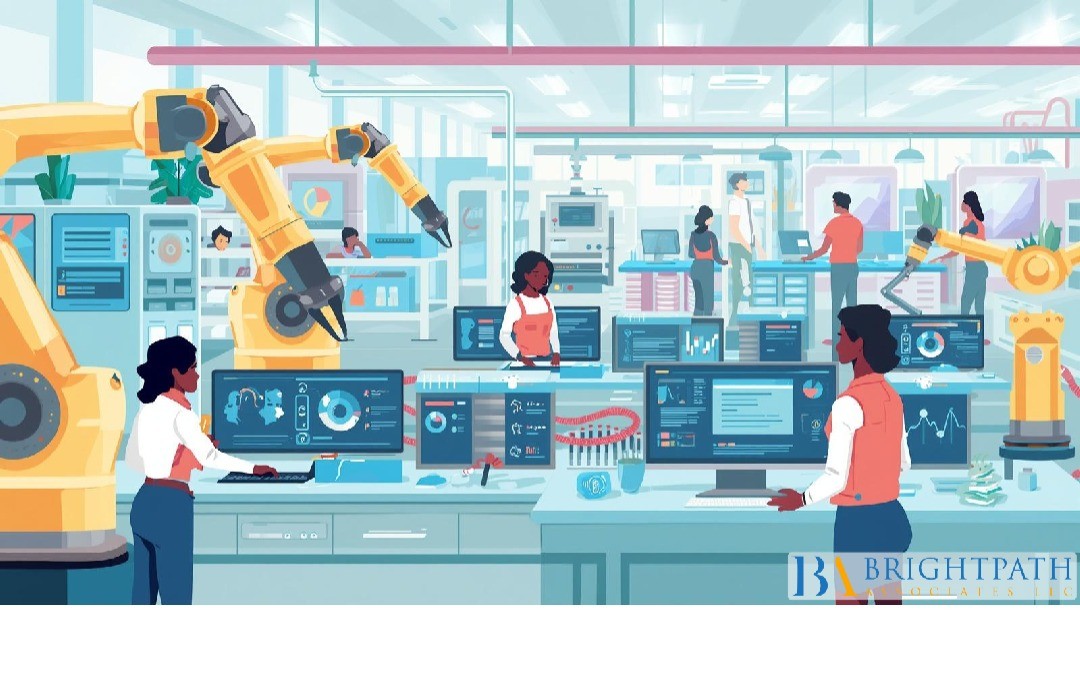
Introduction: From Mechanization to Intelligence-Driven Production
#IndustrialAutomation is moving beyond incremental efficiency into a new era defined by data, connectivity, and intelligence. Factories are no longer a collection of isolated machines and manual set-ups; they are becoming software-defined, insight-driven environments where equipment, people, and processes are orchestrated for reliability, quality, and speed. This evolution rests on a modern stack that spans sensors, networks, analytics, and interoperable Control systems, and it transforms how organizations design products, run operations, and scale capacity. As manufacturers navigate this shift, understanding the principal trends, the challenges to adoption, and the trajectory of technology is essential for making the right strategic bets.
The Digital-Industrial Foundation: Data, Determinism, and Interoperability
At the heart of contemporary Industrial automation lies a simple proposition: better data leads to better decisions, and better decisions require reliable, timely, and contextualized information. Sensors, machine vision, and embedded controllers provide the raw signals. SCADA systems, historians, and edge platforms contextualize and curate those signals into actionable information. Standards-based connectivity and semantic models ensure that data flows freely across vendors and life cycles. Together, these capabilities convert factories from islands of automation into integrated ecosystems.
Within this foundation, determinism and interoperability are critical. Real-time constraints call for networks and protocols that can guarantee bounded latency for time-sensitive actions, while also transporting rich, non-real-time data for analytics and traceability. This combination enables control loops to remain stable, quality systems to act instantly, and engineers to iterate virtually through digital twins before implementing changes on the floor. When paired with disciplined PLC programming service practices and well-architected Manufacturing automation integration, these components ensure that insights reach the point of control without compromising safety or uptime.
AI at the Edge: From Prediction to Prescription
The most visible transformation across automation solutions is the rise of artificial intelligence embedded at the edge. Rather than sending every signal to the cloud, manufacturers are running models directly on gateways, vision systems, and industrial PCs colocated with the line. This proximity supports real-time decisions, such as classifying defects, detecting anomalies, or modulating process parameters to hold tolerances.
Predictive maintenance is often the on-ramp. By analyzing vibration, temperature, acoustic, and current signatures, models can flag incipient failures and schedule interventions during planned stops. The effect is cumulative: fewer surprises, faster root-cause analysis, and a higher percentage of planned work. As confidence grows, organizations move from prediction to prescription, where optimization targets—energy, yield, cycle time—are dynamically balanced based on operating context. Digital twins accelerate this evolution by providing a low-risk environment to validate AI-driven policies before they are deployed to live #ControlSystems.
Robotics Integration: Flexible Automation for High-Mix Manufacturing
Robotics integration has shifted decisively toward flexibility. Cobots and next-generation industrial robots work safely around people, adapt to frequent changeovers, and are calibrated through simulation rather than protracted on-site tuning. In high-mix, low-volume operations, these capabilities reduce time-to-value by letting teams configure workflows virtually, pre-test them against takt time and quality constraints, and then load them to robots with minimal downtime.
The power of this approach compounds when machine vision joins the loop. Vision-enabled picking, assembly, and inspection reduce the need for custom fixturing and allow processes to handle variability in parts and presentation. When combined with closed-loop feedback to PLCs and motion controllers, the result is dynamic path planning, real-time quality gates, and fast corrective actions without halting the line. The best Robotics integration programs tightly couple vision, controls, and safety, ensuring that robots augment the workforce by taking on dull, dirty, or dangerous tasks while people focus on complex judgment and continuous improvement.
Networks Built for Industry: Deterministic Ethernet and Industrial-Grade Wireless
Modern plants combine converged deterministic Ethernet with industrial-grade wireless to align performance and flexibility. Deterministic Ethernet domains serve motion control, synchronized processes, and other time-critical workloads. #SCADASystems, HMIs, and analytics consume the same data in parallel without disturbing the control plane. In parallel, private wireless—especially private 5G—extends coverage to mobile assets like AGVs and AMRs, handhelds, and wearables, providing resilient mobility, predictable bandwidth, and strong security at scale.
The result is architectural freedom. Fixed lines that demand hard real-time control utilize deterministic segments. Zones with changing layouts or mobile equipment rely on robust wireless. Data is prioritized according to its purpose, and Quality of Service classes map cleanly to use cases ranging from ultra-low-latency control to high-throughput video for advanced inspection. This blend of wired determinism and flexible wireless creates a network fabric that can sustain both rapid reconfiguration and steady, predictable operation.
SCADA, PLCs, and the Composable Control Layer
Despite the new digital layers, classic building blocks remain vital. SCADA systems consolidate supervisory control, alarming, and visualization; PLCs and PACs execute real-time logic; and edge gateways connect brownfield machines to the modern data layer. The shift is not about replacement but about composability. A well-run PLC programming service now considers not only ladder logic and safety interlocks, but also semantic data modeling, diagnostics exposure, and integration patterns that allow control programs to be monitored, versioned, tested, and deployed with software engineering rigor.
Composable architectures separate concerns cleanly: device control remains deterministic and safety-certified; orchestration and analytics evolve on faster cycles; and interfaces between these layers are explicit and testable. This separation speeds changeovers, simplifies governance, and keeps plants nimble without compromising reliability.
Manufacturing Automation Integration: From Point Solutions to Platforms
Early digital initiatives often began as point solutions that proved value on a single asset or cell. Scaling requires a platform mindset. #ManufacturingAutomation integration focuses on common data models, reusable connectors, and a stable core of services for identity, role-based access, time-series storage, and event processing. As more use cases come online—predictive maintenance, real-time quality, energy optimization—the platform amortizes integration costs and enables rapid composition of new workflows.
The shift to platforms also changes procurement and vendor management. Instead of bespoke interfaces for each system, manufacturers prioritize open standards, robust APIs, and certification to industry security baselines. This approach reduces lock-in, shortens commissioning times, and enables multi-vendor ecosystems to operate coherently. Ultimately, it allows automation solutions to evolve with business needs rather than locking processes into a single vendor’s roadmap.
Cybersecurity and Governance: Securing Converged OT/IT
With increased connectivity comes the imperative for strong security. Good governance starts with accurate asset inventories, clear segmentation between business IT and OT, and secure remote access policies that reflect the unique safety and availability requirements of industrial environments. From there, patch and vulnerability management, continuous monitoring, and incident response tailored for control systems complete a foundational program.
Security must be built into every layer, from component selection through commissioning and operations. Product suppliers should be held to rigorous development and testing practices, and integrators should commit to defensible architectures, encrypted communications, and least-privilege access. Asset owners, in turn, need procedures for change control, backup and recovery, and periodic validation of protections. When cyber hygiene becomes routine, the organization can adopt new technologies faster and with greater confidence.
People, Skills, and the Rise of Industrial Talent Markets
Technology alone does not transform factories; people do. The skills portfolio required to run modern operations spans Controls engineering, OT networking, data engineering, AI/ML, and cybersecurity, alongside deep process knowledge. This widening competency footprint is reshaping talent strategies and fueling demand for Automation jobs that bridge engineering and data disciplines.
Two market responses are becoming prominent. First, companies invest in large-scale upskilling, pairing formal coursework with on-line simulations and digital twins so teams can practice without risking production. Second, organizations engage specialized #ExecutiveSearchRecruitment firms to identify leaders and architects who can unify operations, engineering, and digital functions. Executive search industrial automation services now target roles like Head of Manufacturing Data Platforms, OT Security Director, and Automation Platform Architect—positions that blend technical depth with change leadership. In parallel, the general market for Automation jobs continues to diversify, as integrators, OEMs, and end-users compete for talent in PLC programming service, Robotics integration, SCADA systems engineering, and machine vision analytics.
Practical Roadmap: From Pilot to Scaled Value
A practical transformation roadmap begins by selecting high-impact, low-risk use cases that rely on available data and do not require extensive downtime. Predictive maintenance on a critical bottleneck asset often meets these criteria, delivering tangible savings and service-level improvements. Once value is demonstrated, teams expand the scope to adjacent assets and integrate the workflows into maintenance planning and spares management.
In parallel, leaders invest in the platform underpinnings: a well-managed data layer with contextual models, resilient and segmented networks, identity and access management harmonized across OT and IT, and reusable connectors to MES, ERP, and quality systems. Digital twins are introduced initially for virtual commissioning and then extended to scenario testing for scheduling, energy optimization, and changeovers. Over time, this foundation supports more sophisticated capabilities such as closed-loop parameter tuning, prescriptive maintenance, and adaptive scheduling based on real-time conditions.
Throughout this journey, governance keeps pace with growth. Security policies are codified into procurement, vendor onboarding, and commissioning checklists. Documentation, version control, and test automation are extended from IT to OT software artifacts. Education programs and communities of practice cultivate internal champions who share patterns, templates, and lessons learned across plants. Rather than a single “big bang,” the transformation becomes a sequence of compounding wins whose momentum drives cultural adoption.
The Sustainability Imperative: Energy as a First-Class KPI
#SmartManufacturing is increasingly judged by its energy and material efficiency as much as by its throughput and quality. Digitalization makes energy use visible in near-real time, revealing where processes drift from optimal setpoints, when idle loads accumulate, and how scheduling choices affect peak demand. With that visibility, teams can prioritize retrofits, parameter tuning, and load shifting to reduce intensity without sacrificing output. As electrification deepens and renewable integration grows, flexible demand becomes a source of resilience and cost savings. The most advanced plants treat energy metering, carbon accounting, and optimization as integrated elements of their Manufacturing automation integration, rather than separate reporting chores.
The Near Future: Software-Defined, Predictive, and Human-Centric
The next phase of Industrial automation will be characterized by composable systems, predictive defaults, and human-centered design. Composable systems allow plants to reconfigure lines and logic via software rather than invasive mechanical work, shrinking the gap between engineering intent and operational reality. Predictive defaults mean that maintenance, scheduling, and quality workflows start with model-informed recommendations that shift teams from firefighting to optimization. Human-centered design ensures that cobots, AR-guided procedures, and intuitive engineering tools amplify expertise, reduce cognitive load, and make continuous improvement routine.
In this future, the best automation solutions will not merely execute instructions; they will understand context. Machine vision will detect features and infer process states, Control systems will negotiate trade-offs under constraints, and SCADA systems will serve as action hubs that synthesize insights into clear, prioritized guidance. Robotics integration will further blend precision with adaptability, enabling manufacturers to change what they make and how they make it with unprecedented speed.
Conclusion: Building Resilience and Competitive Advantage
#IndustrialAutomation has entered a decisive chapter. Data-rich operations, AI at the edge, digital twins, deterministic communication, and industrial-grade wireless are converging into plants that are more adaptive, more reliable, and more sustainable. Yet technology is only one side of the equation. The other is disciplined execution: robust cybersecurity, composable architectures, rigorous PLC programming service, thoughtfully designed SCADA systems, and well-governed Manufacturing automation integration.
Organizations that align these technical foundations with a deliberate talent strategy—leveraging Executive Search Recruitment where needed and cultivating internal skills for next-generation Automation jobs—will translate innovation into durable advantage. By making factories software-defined, predictive by default, and human-centric in practice, leaders can turn Industrial automation into a strategic engine for growth, resilience, and continuous improvement in an increasingly dynamic global market.
Find your next leadership role in Industrial Automation Industry today!
Stay informed with the latest insights on Industrial Automation Industry!