
Introduction
The #WaterSector is entering a decisive phase shaped by accelerating climate volatility, aging infrastructure, tightening regulations, cyber risk, and rising service expectations. In parallel, data-rich systems, advanced analytics, and modular technologies are opening pathways to cost-effective resilience. Understanding Utility industry trends is therefore critical for leaders seeking Suitable utility solutions that can be implemented at pace and scale. The most successful utilities are integrating Utility technology innovation with disciplined asset management, non-revenue water reduction, digital operations, advanced treatment, decarbonization, and enterprise-level risk governance. This essay distills best practices and frontier innovations into an actionable framework, reflecting the industrial realities of cost control, regulatory compliance, and dependable service.
Strategic Alignment through Modern Asset Management
High-performing utilities start with strategic alignment. A formal asset management system anchored in lifecycle thinking, risk-based prioritization, and continuous improvement ensures that capital and O&M resources deliver the greatest value per dollar. By translating organizational objectives into measurable levels of service and risk tolerances, utilities create a line of sight from boardroom strategy to field execution. Clear roles, competencies, and decision rights help embed consistency across planning, maintenance, operations, engineering, finance, and customer teams. When codified in a Strategic Asset Management Plan and supported by robust data governance, this approach elevates decision quality, improves transparency, and strengthens regulatory and public confidence. Within current Utility industry trends, this discipline is the backbone that allows Digital transformation utilities programs and other innovations to deliver sustainable results rather than isolated pilots.
Non-Revenue Water as a Strategic Capacity and Cost Lever
Reducing non-revenue water (NRW) is among the most powerful Suitable utility solutions available because it improves supply reliability, reduces chemical and energy intensity, and frees up system capacity without large new assets. Leading practices pair a validated water balance with district metered areas and pressure-managed zones to separate real losses from apparent losses and to target remedial actions with high confidence. #PressureManagement, valve maintenance, and transient control reduce background leakage and burst frequency, while smart metering and data reconciliation sharpen billing accuracy and identify customer-side leaks. Increasingly, utilities are augmenting acoustic methods with satellite-enabled leak targeting to accelerate field productivity and concentrate surveys where probabilities are highest. The operational point is industrial: repeatable audits, routine data-quality scoring, and standardized playbooks turn episodic campaigns into enduring leakage control programs. As a result, utilities can stabilize demand-supply balance, manage contingency margins more effectively, and demonstrate tangible performance gains aligned to Utility technology innovation.
Digital Transformation and the Rise of Operational Twins
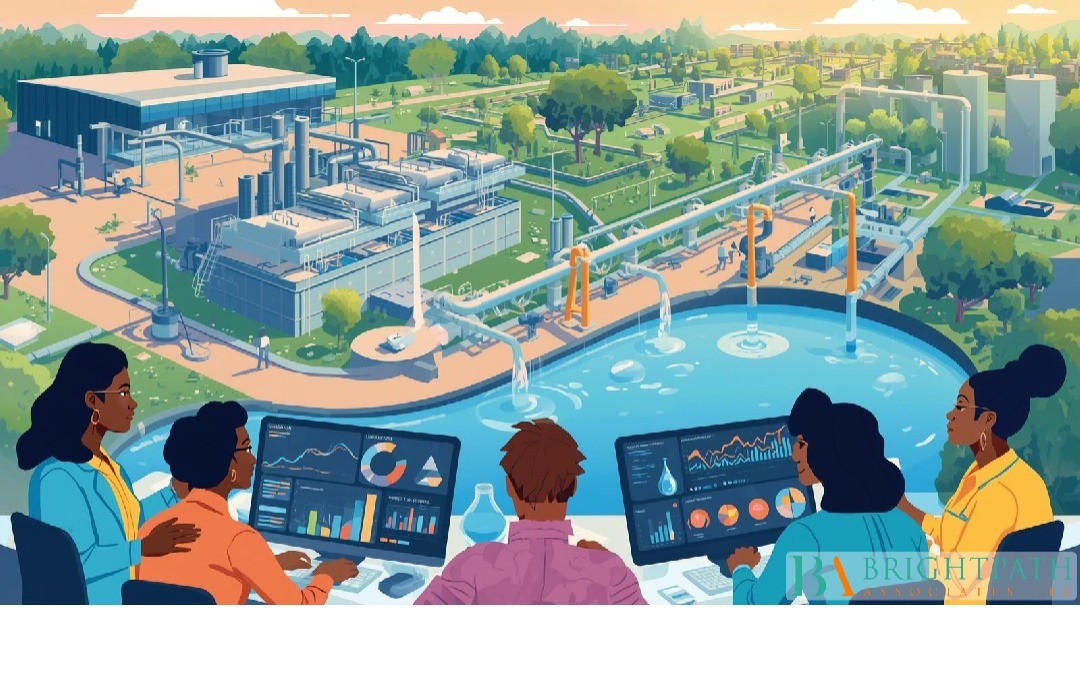
Digital transformation utilities initiatives are moving beyond dashboards to real-time decision support that unifies SCADA, IoT sensing, GIS, hydraulic and process models, laboratory information, and financial data. The operational “digital twin” is the culmination of this integration, enabling planners and controllers to visualize system states, run scenarios, forecast risks, and recommend actions. In treatment plants, advanced analytics tune coagulation and aeration to stabilize quality and reduce energy use. In distribution, AI-driven anomaly detection flags pressure and flow deviations before they become incidents, while optimized pump scheduling cuts demand charges and total cost of electricity. At enterprise scale, shared master data and role-based views offer a single source of truth, increasing trust in KPIs and shortening decision cycles. The result is a shift from reactive troubleshooting to anticipatory operations, where exceptions trigger targeted responses and operators manage by risk and cost rather than by alarms alone. These capabilities represent core Utility technology innovation and support the seamless integration of Utilities and renewable energy choices within day-to-day planning horizons.
Water Quality Leadership and Emerging Contaminants Management
Public confidence rests on a demonstrably conservative stance toward water quality. Utilities are strengthening source protection and deploying multi-barrier treatment for microbial and chemical contaminants while preparing for emerging compounds such as PFAS. Readiness entails prioritized monitoring, pilot-scale evaluations of high-selectivity adsorbents and membranes, and cradle-to-grave management for residuals. Utility consulting services often facilitate bench and pilot testing, lifecycle cost modeling, and risk communication plans to guide board approvals and regulator engagement. Operationally, plants benefit from resilient control philosophies that combine online integrity checks, redundant safeguards, and well-drilled diversion protocols. Linking these efforts to enterprise risk registers, sampling programs, and customer outreach ensures that compliance is not only achieved but is credibly sustained. This comprehensive posture aligns with broader #UtilityIndustry trends emphasizing transparency, evidence-based investment, and rigorous performance verification.
Supply Diversification and Direct Potable Reuse Maturity
Drought resilience strategies are evolving rapidly as advanced purification and robust oversight make potable reuse a practical addition to the supply portfolio. Direct potable reuse (DPR) projects, once considered niche, now reflect a maturing risk framework and operations philosophy. Success depends on source control, multi-barrier designs with online performance verification, and supervisory control schemes that prioritize safety under all foreseeable upsets. Raw-water augmentation and direct system injection each require tailored safeguards, but share a common need for rigorous commissioning, continuous monitoring, and operator training. The industrialization of reuse means utilities can treat DPR like any other mission-critical process: with clear operating envelopes, playbooks for deviations, and performance-based maintenance. For governing boards, a prudent renewable Energy strategy integrates reuse alongside aquifer storage and recovery, stormwater capture, and demand management to optimize reliability per dollar while preserving environmental flows and community trust.
Energy, Emissions, and the Circular Utility
Energy often represents the largest controllable expense in water and #WastewaterService. Utilities are therefore pursuing Energy storage solutions, real-time pump optimization, and process efficiency for tangible OPEX savings while advancing decarbonization. At water recycling centers and wastewater plants, optimizing anaerobic digestion, recovering biogas, and selectively deploying combined heat and power or biomethane export improves both cost and emissions profiles. Treatment process innovations that reduce aeration intensity or improve oxygen transfer deliver compounding benefits at large facilities. On the electric side, on-site solar and battery systems, coupled with flexible pump scheduling, hedge against volatile tariffs and reduce peak demand charges. Fleet electrification, facility retro-commissioning, and procurement of green power further embed a practical Renewable energy utilities pathway. The most robust programs maintain financial discipline, prioritizing short-payback efficiency first, then layering renewables and Energy storage solutions where they add net present value and operational flexibility. By tying these interventions to a utility-wide renewable Energy strategy, leaders connect capital planning, operating procedures, and market procurement into a coherent whole rather than a patchwork of projects.
Cybersecurity as Core Operating Risk
As utilities digitize, cyber risk becomes inseparable from public health and safety. An industrial-strength cybersecurity posture begins with asset inventories, role-based access control, multi-factor authentication on remote access, and network segmentation between IT and OT. Routine patching windows for OT assets, secure configurations for programmable logic controllers and HMIs, and continuous monitoring of network anomalies reduce exposure. Just as importantly, tabletop exercises, backup and restoration tests, and an incident response playbook align operators, engineers, and executives on their roles during an event. Incorporating vendor security requirements into procurement and commissioning closes a frequent gap in risk transfer. These practices align with the same operational rigor seen in process safety and emergency management, confirming cybersecurity’s place alongside water quality and reliability as a top-tier utility risk domain.
Workforce, Culture, and Leadership Capacity
No transformation endures without people who can run it day after day. Utilities are reshaping roles, incentives, and training to build fluency in analytics, automation, and risk-based decision-making. Cross-functional operations reviews and coaching reinforce a common language of performance, while competency frameworks clarify advancement pathways. In a tight labor market, #ExecutiveSearchRecruitment plays a pivotal role in attracting senior leaders who can blend domain expertise with digital acumen and change management. The leadership team’s capacity to sponsor programs, remove roadblocks, and communicate purpose sets the tone for adoption velocity and cultural buy-in. As technology stacks evolve, partnerships with universities, apprenticeships, and vendor training pipelines ensure a steady inflow of operators and technicians equipped for modern plants, networks, and cyber-physical systems.
Industrialization Patterns that Scale
Utilities that consistently deliver results approach their modernization programs like an industrial production system. They define a lean, shared data spine that harmonizes identifiers, metadata, and quality rules across SCADA, GIS, CMMS, AMI, and laboratory systems. They codify standard work in playbooks for leak detection, PRV tuning, pump scheduling, and energy dispatch, and they manage exceptions with service-level triggers. They run structured pilots with explicit hypotheses, capture learning, then scale with modular, cyber-secure platforms. And they embed benefit tracking into budgeting, linking performance to accountability. This industrial rhythm transforms Utility technology innovation from a series of proofs-of-concept into system-level capability. Utility consulting services can accelerate this journey by facilitating maturity assessments, playbook design, and change management, but sustained internal ownership is the hallmark of durable performance improvement.
Implementation Roadmap for Executives
An actionable path begins with governance. Establish a concise strategy-to-asset line of sight and approve a #StrategicAssetManagement Plan that clarifies risk tolerances and levels of service. In parallel, baseline NRW with a validated water balance and launch a pressure and DMA program with data-quality scoring. Build a secure data backbone integrating key systems, and initiate a focused digital twin pilot for a priority plant or distribution zone. Execute cyber quick wins—asset inventory, MFA, segmentation, and backups—while drafting an incident response plan that is exercised, not just written. Evaluate energy saving opportunities and short-payback upgrades first, then position high-load facilities for solar and battery pairing, and prioritize pumping optimization against tariff structures. Begin prudent planning for advanced treatment and reuse where source water and regulatory trajectories point toward future requirements, and pilot unit processes to validate performance and lifecycle costs. Throughout, invest in people: define competencies, align roles to the new operating model, and sustain recruitment for digital-savvy leadership through targeted Executive Search Recruitment. By year two, scale what works, retire pilots that do not, and institutionalize performance reviews tied to risk, cost, and service.
Utilities and Renewable Energy: Integrating Markets and Operations
Integrating Utilities and renewable energy is no longer purely a policy choice; it is an operational one. Variable renewables change grid dynamics, time-of-use tariffs, and opportunities for load shifting. Water utilities, with their inherent storage and flexible pumping, can act as demand-side resources that hedge costs while supporting grid stability. Energy storage solutions at treatment and boosting sites add resilience against outages and enhance arbitrage potential. Coordinated planning among Power market specialists, plant operators, and asset managers ensures that renewable Energy strategy decisions—procurement, on-site generation, or participation in flexibility markets—support the water mission rather than distract from it. The utilities that master this integration will stabilize OPEX, reduce emissions, and improve continuity of service during grid stress events.
Conclusion
Advanced #WaterUtilityManagement is an operating system, not a single project or technology. It fuses strategic asset management, NRW discipline, digital twins and AI, rigorous quality and reuse programs, decarbonization, strong cybersecurity, and a capable workforce into one coherent whole. The competitive advantage now lies in industrialized execution—common data, standard work, continuous learning—and in pragmatic governance that focuses innovation on measurable outcomes. As Utility industry trends converge around risk, resilience, affordability, and climate, leaders who select Suitable utility solutions, cultivate Utility technology innovation, engage Utility consulting services wisely, and align operations with Utilities and renewable energy will deliver durable value. With a clear renewable Energy strategy, thoughtful integration with Power markets, and sustained investment in people through targeted Executive Search Recruitment, water utilities can deliver reliable, safe, and sustainable service—at scale, at speed, and at a cost their communities can afford.
Find your next leadership role in Utilities Industry today!
Stay informed with the latest insights on Utilities Industry!