
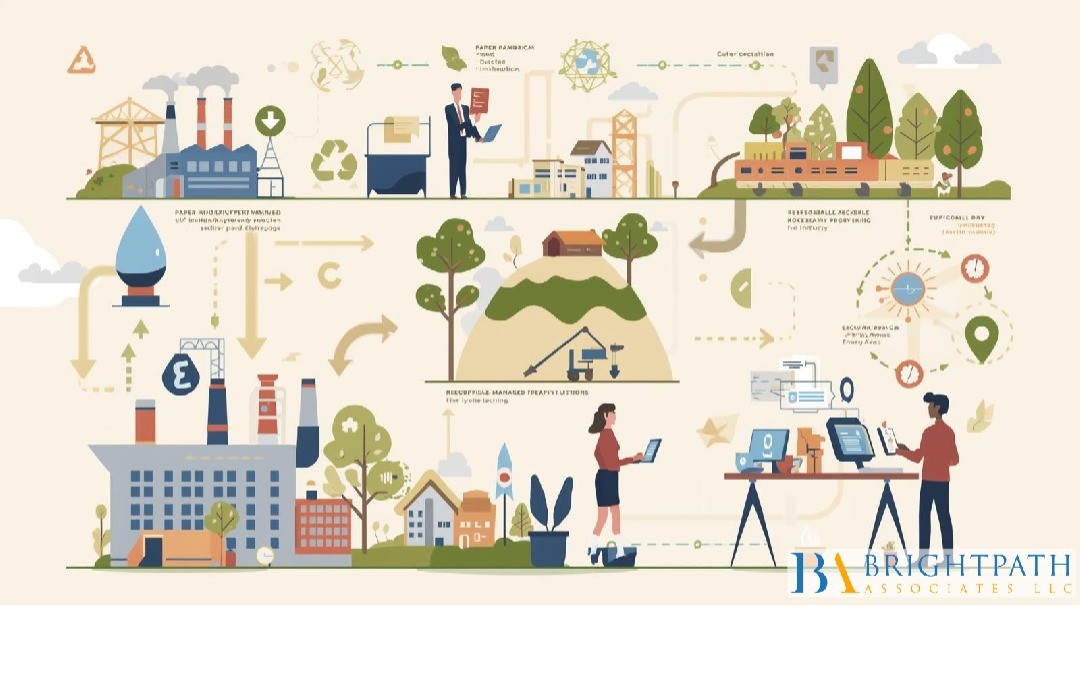
The Paper Industry at a Strategic Inflection Point
The paper and #ForestProductsIndustry is undergoing a fundamental transformation driven by mounting environmental expectations, evolving regulations, and changing customer preferences. Traditional linear models built around extraction, production, use, and disposal are increasingly misaligned with modern economic and sustainability realities. As pressure intensifies to reduce waste, conserve resources, and demonstrate responsible forestry practices, circular economy principles are emerging as a defining strategic priority. For leadership teams, the challenge is no longer whether circularity matters, but how quickly and effectively it can be embedded into core operations without compromising profitability or resilience.
The Economic and Environmental Case for Circular Models
Circular economy adoption in the paper industry is rooted as much in financial logic as in environmental responsibility. Volatility in raw material availability, rising energy costs, and increased compliance requirements have exposed vulnerabilities in traditional supply chains. By emphasizing paper recycling solutions, fiber recovery, and resource efficiency, organizations can stabilize input costs while reducing dependency on virgin materials. At the same time, circular practices strengthen brand credibility with customers who increasingly favor sustainable materials, creating a direct link between environmental stewardship and long-term revenue growth.
Forest Product Innovation as a Competitive Advantage
Innovation plays a central role in closing the loop across paper and forest operations. Advances in paper and pulp technology have significantly improved fiber yield, recycling efficiency, and product durability, enabling companies to extend material lifecycles while maintaining quality. Forest product innovation is also reshaping how #TimberHarvesting and forestry management are approached, with greater emphasis on regenerative practices and traceability. Companies that invest in innovation are better positioned to differentiate their offerings, respond to regulatory scrutiny, and capture value from emerging sustainability-driven markets.
Rethinking the Paper Supply Chain
Circularity demands a fundamental redesign of the paper industry supply chain. This includes closer integration between forestry operations, manufacturing facilities, and downstream distribution partners. Sustainable timber harvesting, optimized logistics, and increased use of recycled inputs are becoming essential components of modern supply chain management. For small to mid-sized companies, collaboration across the value chain is particularly critical, as partnerships can offset scale limitations while enabling access to advanced recycling infrastructure and specialized capabilities.
Digital Enablement and Operational Intelligence
#DigitalTransformation is accelerating the shift toward circular operations in the paper industry. Advanced monitoring systems, data analytics, and automation tools provide leaders with greater visibility into resource consumption, waste generation, and process efficiency. These insights enable continuous optimization, helping organizations reduce environmental impact while improving operational performance. However, technology alone is insufficient without leadership capable of translating data into strategic action and organizational alignment.
Leadership Challenges in a Circular Economy Transition
As the paper industry evolves, leadership requirements are expanding beyond traditional operational expertise. Executives are now expected to balance sustainability objectives with cost control, oversee compliance across complex regulatory environments, and guide innovation initiatives that span multiple functions. This shift has exposed a growing leadership talent gap, particularly among organizations seeking leaders with experience in circular business models, sustainable materials, and cross-functional transformation. Many companies find that internal pipelines are not fully prepared to meet these demands.
Changing Expectations for Executive Roles
Executive roles within paper and #ForestCompanies are becoming broader, more strategic, and more externally focused. Leaders must engage with regulators, customers, and supply chain partners while also driving internal cultural change. Sustainability and circular economy performance are increasingly viewed as leadership accountabilities rather than departmental initiatives. This evolution requires executives who combine technical knowledge of paper industry economics with strong change management and strategic planning capabilities.
Talent Constraints Facing Small to Mid-Sized Companies
Smaller and mid-sized paper companies often face disproportionate challenges in attracting experienced leadership talent. Larger organizations may offer greater visibility, resources, and perceived stability, intensifying competition for a limited pool of qualified executives. As a result, leadership gaps can slow circular transformation efforts, delay innovation initiatives, and increase operational risk. Without proactive talent strategies, these constraints may limit growth potential and erode competitive positioning.
The Evolution of Recruitment in the Paper Industry
Traditional recruitment approaches are proving insufficient for today’s leadership challenges. Hiring based solely on past #OperationalExperience no longer guarantees success in an environment defined by sustainability mandates, digitalization, and supply chain complexity. Recruitment strategies are evolving toward deeper industry specialization, long-term leadership alignment, and a stronger emphasis on strategic capability rather than functional familiarity. This shift reflects the growing recognition that leadership quality directly influences transformation outcomes.
Executive Search Recruitment as a Strategic Solution
#ExecutiveSearchRecruitment has emerged as a critical enabler for paper and forest companies navigating circular economy transitions. By leveraging deep industry insight, targeted market mapping, and rigorous candidate assessment, executive search recruitment connects organizations with leaders who possess the right blend of technical expertise, strategic vision, and cultural fit. Rather than filling roles reactively, this approach supports long-term leadership planning aligned with sustainability goals and business strategy.
Building Circular-Ready Leadership Teams
Successful circular transformation depends on assembling leadership teams capable of driving integration across operations, innovation, and governance. Circular-ready leaders demonstrate adaptability, systems thinking, and the ability to align diverse stakeholders around shared objectives. Strategic executive search recruitment enables organizations to identify and secure such talent, strengthening succession planning and ensuring continuity through periods of change.
Leadership as the Key to Closing the Loop
Ultimately, the transition to a circular economy in the #PaperIndustry is a leadership challenge as much as a technical one. While innovation, digital tools, and sustainable materials are essential, their impact depends on leaders who can orchestrate change, inspire confidence, and make disciplined strategic decisions. For C-suite executives and founders, investing in leadership capability through executive search recruitment is a decisive step toward closing the loop, building resilient organizations, and securing sustainable growth in an increasingly complex industry landscape.
Call to Action:
How prepared is your leadership team to drive circular transformation across your organization? If leadership capability is the missing link between ambition and execution, now is the time to reassess your executive strategy and engage in a conversation about building the talent required for long-term success.
Find your next leadership role in Paper & Forest Products Industry today!
Stay informed with the latest insights on Paper & Forest Products Industry!