
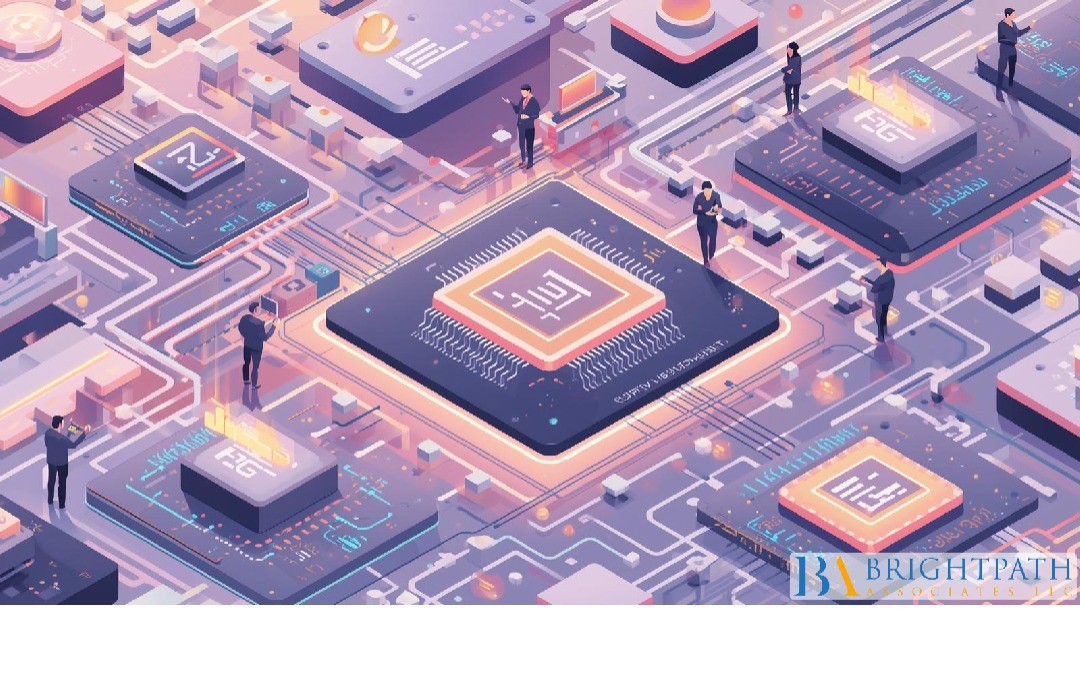
The Strategic Shift in Semiconductor Innovation
The global #SemiconductorIndustry is undergoing one of the most complex transformations in its history. From advanced semiconductor processors powering AI workloads to breakthroughs in semiconductor nanotechnology and quantum computing, innovation is accelerating at a pace that is redefining competitive advantage. Between 2023 and 2025, semiconductor companies—particularly small to mid-sized firms—are navigating not only rapid technological disruption but also an escalating leadership talent shortage that threatens execution, scalability, and long-term growth.
Semiconductor innovation is no longer confined to Moore’s Law–driven performance gains. The focus has expanded toward semiconductor AI chips optimized for machine learning, semiconductor memory architectures designed for energy efficiency, and processors built for semiconductor data centers and edge computing environments. As these shifts intensify, the demand for leaders who can translate deep technical progress into commercially viable strategies has never been higher.
Emerging Processor Technologies Driving Market Realignment
Next-generation semiconductor processors are increasingly defined by specialization. Semiconductor AI chips now dominate investment priorities as AI workloads grow exponentially across healthcare, automotive, finance, and defense. Industry estimates suggest that AI-focused semiconductor segments are growing at more than twice the rate of traditional processor markets, forcing companies to rethink product roadmaps, R&D allocation, and leadership structures simultaneously.
In parallel, semiconductor quantum computing continues to move from experimental labs toward early-stage commercialization. While still nascent, quantum processors are influencing hiring strategies today, as companies seek executives capable of managing long-term R&D horizons while balancing short-term revenue pressures. Semiconductor nanotechnology is further enabling smaller node sizes, higher transistor density, and lower power consumption—developments that demand leadership with cross-functional expertise spanning engineering, manufacturing, and supply chain optimization.
These technological evolutions are reshaping not only what semiconductor companies build, but how they must be led.
Leadership Talent Shortages Across the Semiconductor Ecosystem
From 2023 onward, leadership hiring has emerged as one of the most pressing constraints in the semiconductor sector. While technical talent shortages have been widely discussed, executive-level gaps are proving more difficult to resolve. Semiconductor leadership hiring is increasingly constrained by a limited pool of executives who possess both deep domain expertise and the strategic agility required for next-generation markets.
Data from industry workforce analyses indicate that more than 60 percent of semiconductor companies report difficulty filling senior leadership roles, particularly in R&D leadership, #ProductStrategy, and operations. The challenge is especially acute for small to mid-sized semiconductor firms competing against global giants for the same leadership talent. These organizations often lack the internal recruitment infrastructure needed to identify and attract executives capable of scaling innovation-driven growth.
The result is prolonged vacancies, leadership burnout, and delayed decision-making—factors that directly impact speed to market in a highly competitive environment.
Evolving Role Expectations for Semiconductor Executives
The definition of semiconductor leadership itself is changing. Traditional executives who specialized narrowly in engineering, fabrication, or sales are no longer sufficient for today’s demands. Modern semiconductor leaders must integrate technical depth with business acumen, regulatory awareness, and global supply chain resilience.
For example, executives overseeing semiconductor processors today must understand semiconductor edge computing requirements alongside semiconductor data center architectures, balancing performance with power efficiency and sustainability goals. Similarly, leaders in semiconductor memory and sensors must navigate increasingly complex customer ecosystems, where processors, software, and system integration converge.
This evolution has shifted hiring priorities toward hybrid leaders—individuals who can bridge innovation, commercialization, and organizational leadership. Identifying such profiles requires far more than conventional recruitment methods.
Strategic Recruitment Transformation from 2023 to 2025
#RecruitmentPractices within the semiconductor industry have evolved significantly since 2023. Companies are moving away from reactive hiring toward proactive leadership mapping, succession planning, and confidential executive searches. The urgency stems from the realization that leadership gaps directly translate into missed innovation cycles and lost market share.
Executive search recruitment has become a strategic necessity rather than an optional service. Unlike transactional hiring approaches, executive search enables semiconductor companies to access passive, high-impact leaders who are not actively seeking roles but possess the specialized experience required for next-generation processor development and commercialization.
For founders and C-suite executives, this shift represents a recognition that leadership acquisition is as critical as capital investment or R&D spending.
The Role of Executive Search Recruitment in Closing Leadership Gaps
#ExecutiveSearchRecruitment plays a pivotal role in addressing the structural leadership shortages facing the semiconductor industry. By leveraging deep industry networks, market intelligence, and rigorous assessment methodologies, executive search partners help organizations identify leaders aligned with both technological direction and corporate culture.
For semiconductor companies advancing in areas such as semiconductor AI chips, quantum computing, and nanotechnology, executive search recruitment ensures access to leaders who understand the full innovation lifecycle—from concept and fabrication to market adoption. It also mitigates hiring risk by ensuring leadership candidates possess the adaptability required in an environment defined by rapid technological change.
Importantly, executive search recruitment supports confidentiality, a critical factor when leadership changes could signal strategic shifts to competitors or investors.
Competitive Advantage Through Leadership Alignment
As semiconductor processors become more specialized and markets more fragmented, leadership alignment emerges as a defining competitive advantage. Companies that successfully integrate executive talent acquisition into their growth strategy are better positioned to respond to evolving customer demands, regulatory pressures, and technological breakthroughs.
Small to mid-sized semiconductor firms, in particular, benefit from leadership that can accelerate decision-making, foster innovation culture, and build partnerships across the semiconductor ecosystem. In contrast, organizations that delay addressing leadership gaps risk falling behind in critical areas such as semiconductor edge computing, data center scalability, and advanced memory development.
Between 2023 and 2025, the semiconductor companies that thrive will be those that view leadership not as a static asset, but as a dynamic capability requiring continuous investment.
Looking Ahead: Leadership as the Catalyst for Semiconductor Growth
The next generation of semiconductor processors will define the future of #DigitalInfrastructure, artificial intelligence, and advanced computing. However, technology alone will not determine success. Leadership—capable, forward-thinking, and strategically aligned—will be the true catalyst enabling semiconductor innovation to translate into sustainable growth.
As leadership expectations rise and talent shortages persist, executive search recruitment stands out as a vital solution for semiconductor companies navigating this complex landscape. By securing leaders equipped to manage innovation, scale operations, and drive strategic clarity, organizations can position themselves to compete effectively in an industry where execution speed and vision matter more than ever.
Find your next leadership role in Semiconductor Industry today!
Stay informed with the latest insights on Semiconductor Industry!